

Print Story
X




A number of forms that quietly balance the poetic output and bring out a more diverse reading experience
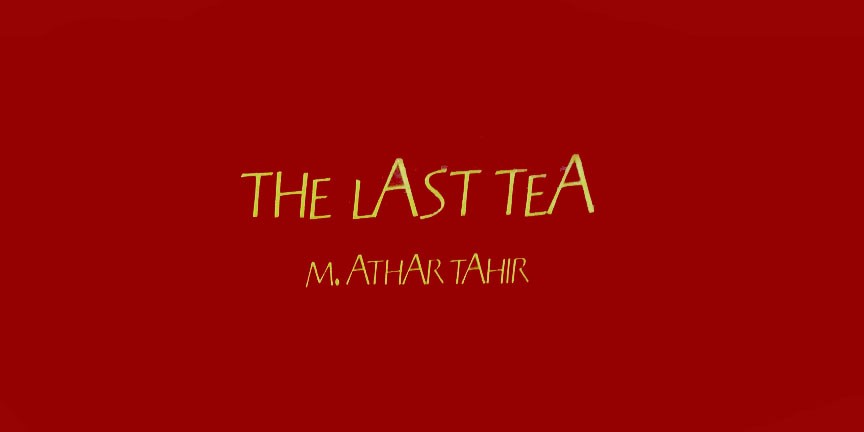
It appears that Athar Tahir has taken upon himself the difficult task of expressing himself in a few words. Though it can be said that one manner of defining poetry could be, the most said in as few words as possible, this may not always be the case. In many forms the prolixity of language and its greater sweep is considered a worthy literary pursuit. It could be that he is more impressed by the economy of expression in poetry and there he is following the major form of poetry in Persian and Urdu, that is the ghazal, where the true virtue of expressing a sensibility ideally should not override the two lines or a couplet.
Ghazal is supposed to be self-contained, and no matter what many later practitioners may have done in attempting the expansion of the formal limitations of this form, the truth remains that the cardinal virtue is this self containment and the ability of the poet to say as much in as few words as possible.
As if this was not enough Athar Tahir has taken a step further and occupied himself with the Japanese form haiku which is even more aggressive and rigorous in preserving the economy of words. Actually it revels in that scarcity. If the basic poetic unit of the ghazal is a couplet, it nevertheless forms as one of the many in a ghazal. It is rare, though it has happened that the ghazal comprises very few couplets -- in case of Ghalib even one, two or three would suffice. This could have been the fallout of his vigorous pursuit at self-editing and self-selection.
It would be an overstretch to call a single couplet as if representing an entire ghazal. But there are other forms more familiar to Punjabi literature like the mahiaya or dohra which also call attention to the brevity of lines and hence high compression of emotions.
It is well-known that Athar Tahir has probed into the various Punjabi literary forms, and in his own poetry seemed to have drawn the right quantum of inspiration. But his poems are closer haiku than to ghazal because three lines can be considered aesthetically sufficient to hold and then communicate an embedded sentiment or an emotion.
The West was always fascinated with the East, its most convoluted expression, its more arcane forms, and its sensibility that does not fully embrace the rational. In the later part of the 19th century Japanese visual artists made a lasting impression on the European visual landscape and many new experiments as a result changed the way the Europeans looked at the inner and outer world.
It was much later that the literary forms too started to influence poetry and fiction and it was the translations into English that made the Japanese literary forms and expressions accessible to the English speaking world. Since we also fall in the same block, the Japanese have come to us twice removed, through the medium of the English language.
One wonders how many of us are proficient enough in the Japanese language to really appreciate poetry in its original expression. But forms including haiku did inspire many to attempt a journey of experimentation in Urdu as well. As one explores the form it strikes us of the similarities with our literary forms. It is the discovery of the East through the medium of the English language, and opens many a door that has been shut or that the door only opened just a little to reveal a dark inside.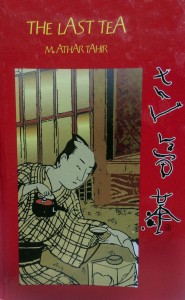
Post colonial literature has added to the significance of English as a language that can have an existence outside the territorial limits of England. The large number of writings in India fully illustrates this point. The corpus of writings has made the existence of English as legit. There has been immense pressure to expose the writings of Pakistanis to the English speaking and reading world.
Since the corpus of writing in English is limited at home the translations were much sought after and a few translations have also been made and appreciated. But the original writings in English, though on the increase have relatively been few and far between. The original writings in English from India in comparison have been very large and may have been the impetus for looking anew at the prospect of writing in English in Pakistan.
Haiku forms only a portion of The Last Tea and the reading of the lines, top to bottom or sideways can be called experimentation inclusive of the visual impact of the written word formation. Though incongruous, it can be seen as the willingness to imbibe another culture’s full impact without reservation but the capturing of the Japanese ethos in some of the longer poems like the Tanka, another Japanese poetic form, at least released the pressure to conform to pure formalism. In these poems the poet seemed to be breathing more freely and hence using his abilities in a more relaxed manner.
From a language
Where letters shorten for words
To yours where sounds seek
Approximate images
We overlapped, just.
In his earlier works though the form he avowedly employed in most of the poems was the sonnet in all its three variations -- Petrarchan Spenserian, Shakespearean, it was coupled with the incursion into the Japanese poetical form, the haiku. The poets of Urdu and Punjabi were struck by the similarities of the imagistic pattern of haiku with some of the contemporary forms in art and its resonating familiarity with some of our traditional forms like the ghazal.
In English, Athar Tahir has exploited the form, discarding the narrative in the process to be in tenor with the poems. But in The Last Tea there are a number of forms that quietly balance the poetic output and bring out a more diverse reading experience.