Print Story
X




The strong link between politics and police has been castigated by all but nothing changes on the ground
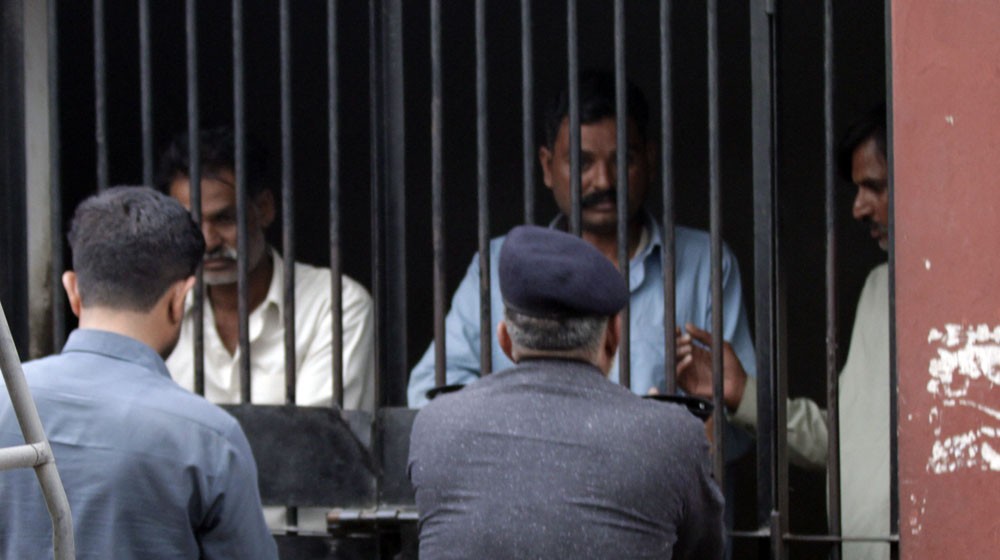
The recent dismissal of senior police officer, Muhammad Ali Nekokara and forced retirement of Islamabad police chief, Aftab Cheema, who reportedly refused to obey the orders of the ruling political leadership, are the latest examples of how police have been politicised in Pakistan.
In 2005, the European Union expressed concern over what it called "politicisation of police" in Pakistan, and urged the government to implement the Police Order 2002 "in its letter and spirit".
Lack of political will is considered the biggest obstacle to reform police. As a matter of principle, police must stand away from politics. On the contrary, what has been observed in our country is a strong link between politics and police.
The police force in the developed countries, for instance -- US, Canada, Japan, Britain, and other European nations -are fully independent in conducting investigations without any interference from politicians or bureaucrats, contrary to what happens in Pakistan and India.
While being used to further political objectives of various groups, the police gradually became politicised. In a report published in 2001, former inspector general of police, Muhammad Shoaib Suddle, complained about the "arbitrary and whimsical mismanagement of police by the executive authority of the state at every level -- police were increasingly recruited, trained, promoted, and posted without regard to merit and mainly for their subservience to people with influence and power. This trend was particularly pronounced in the 1990s.
The last decade of the 20th century particularly witnessed an almost complete collapse of the existing law and order apparatus, thanks mainly to growing and reckless interference in vital aspects of police administration by the ‘persons of influence.’
Recruitments were made on the basis of political affiliations (initially with the PMLN and the PPP, then later with the MQM in Sindh and the ANP in KP). As a result, standards kept declining while public mistrust for the police kept increasing.
Afzal A Shigri, former Islamabad police chief who also served on important positions in Sindh, Punjab, and Khyber Pakhtunkhwa, says, "There is, no doubt, that our police are gradually politicised. The institution has been used as a political tool since the beginning for suppressing opponents but it increased significantly during the 1990s. Police reforms in 2002 were gradually demolished and there have been no transparency in running the force."
Shigri, who also runs a blog on police reforms in Pakistan, says the impact of this politicisation is deep and has made the force dysfunctional. "The politicisation of police is creating a huge vacuum, adding mistrust which has ended up in reliance on paramilitary and military, resulting in developing impressions of army’s supremacy, "he says. Shigri believes "the government must positively revise and implement Police Order 2002."
He disputes the claim of depoliticisation of police in KP. He believes there is a slight improvement at high level positions but there are hardly any positive changes at the local level.
"We have to face political pressures and influences in many investigations. This has a negative impact on investigations but we keep quiet to save our positions," says a senior investigation officer, serving in the Punjab.
Police are demoralised after trying to adopt an independent strategy to control political and religious mobs, he says, while referring to the Model Town incident last year in which police had raided a religio-political party’s secretariat to remove encroachments that resulted in the killing of more than seven people.
"Sometimes we take action against the mob but we face political pressure. That is why nowadays the police fail in controlling mob violence," the official says.
"In Sindh, for example," a senior police officer tells TNS, "it has been observed that honest police officers appointed on senior posts are sent in far off districts and officers who work on the directions of ministers are given prominent and central postings," he adds.
"Police, Politics, and the People of Pakistan," a PILDAT report authored by Tariq Khosa, a well-known former police officer, talks about the fundamental problems that prevent the institution from performing.
It says, "Depoliticisation and autonomy of police was, unfortunately, not on the priority of the political parties." The report further says that police force in Pakistan is criticised for their inefficiency, corruption, and politicisation. There is a major disconnect between the police and citizens of the country. As a result, the service delivery, governance and performance of the police forces have been dissatisfactory.
The Police Order 2002 focused on addressing the arbitrary use of power, misuse of authority, political interference in police operations and administration, corruption, lack of specialisation, and the ineffective command and control of the police forces. Furthermore, it intended to make the Public Safety Commissions control the police, and diminish the connections between police and politics.
Unfortunately, the very government of Musharraf took steps that made the Police Order 2002 ineffective by making it partisan. "By 2008, the National Police Safety Commission stopped holding its meetings and became a ceremonial entity," the report reads.
The report also suggests the federal government to establish an independent Federal Police Complaints Authority as per Articles 97-102 of the Police Order 2002. The Punjab government brought a few amendments in the Police Order 2002 in September 2013 based on public interest for streamlining investigative process and recruiting sub-inspectors instead of Assistant Sub-Inspectors through the public service commission.
The Khyber Pakhtunkhwa government has not abandoned the Police Order 2002 and is debating about making some useful amendments that are relevant in the local context. It is the only provincial government that has a Provincial Public Safety Commission notified and now they are considering making it more effective as a police oversight institution.
"The Sindh Province must revert back to the Police Order 2002 that it repealed in July 2011. The Balochistan province should also repeal the Police Act of 2011, which is a carbon copy of the 1861 Act and also seriously consider adopting the Police Order 2002," the report further recommends.