

Print Story
X




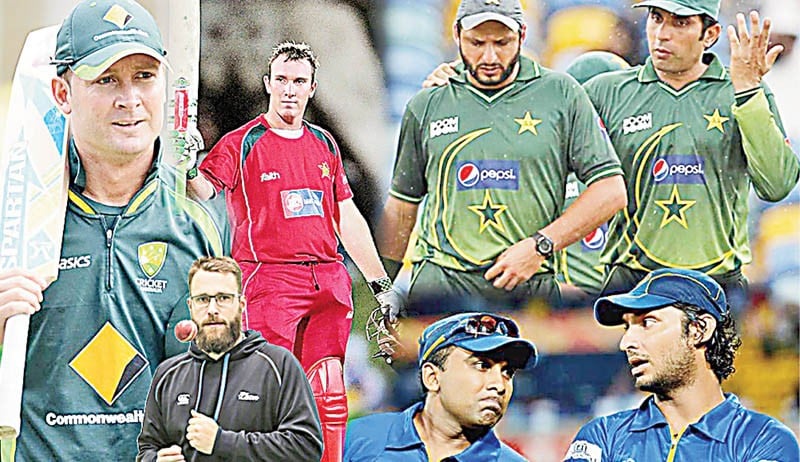
As the World Cup 2015 ended, following leading cricketers said goodbye to international cricket to make room for youngsters
Every player wants to play for his country and try to prolong his career as much as possible. But a time does come when he hangs his boots before the management ignores him or says your services are no more required.
Therefore, the best time to say goodbye to the game is when a player feels that his form is not up to the standard and his performance is going down and he is becoming a burden on the team.
As the World Cup 2015 ended, following leading cricketers said goodbye to international cricket to make room for youngsters.
Those who already have announced their retirement are: Misbah-ul-Haq and Shahid Afridi from Pakistan, Michael Clarke and Brad Haddin from Australia, Kumar Sangakkara and Mahela Jayawardene from Sri Lanka, Daniel Vettori of New Zealand and Zimbabwe’s Brendan Taylor.
Pakistan World Cup skipper Misbah-ul-Haq, before the departure to Australia, announced that the World Cup would be his last ODI tournament. Under his leadership Pakistan qualified for the quarter-final but lost to Australia.
In the mega event Misbah remained the most successful batsman from Pakistan with 350 runs in seven matches, averaging 50 with four half-centuries.
Misbah played 162 One-day Internationals for Pakistan. He made his debut on 27th April, 2002, against New Zealand at Gaddafi Stadium, Lahore, where he made 28 off 37 balls.
Misbah, 40, is the first batsman in international cricket who completed 5000 runs without a century. His highest one-day score was 96 which came against the West Indies at The Oval in the 2013 Champions Trophy.
"It was my wish to score a one-day hundred but it didn’t come about," said Misbah in an interview after the World Cup.
Misbah is Pakistan’s most successful Test captain, having won 15 Tests in 32 matches, surpassing Imran Khan and Javed Miandad who won 14 Tests each in 48 and 34 Tests, respectively. Misbah recently silenced his critics who accused him of being a defensive player by equaling Viv Richards’ 56-ball hundred records.
Misbah’s performance as skipper is more praiseworthy because he never played as captain on home soil.
Shahid Khan Afridi also hung his ODI boots after the World Cup.
In his 19-year career, Afridi played 398 ODIs, scored 8064 runs at an average of 23.57, hitting six hundreds and 39 fifties. Afridi also took 395 ODI wickets, missing the opportunity to become the first all-rounder with 8000 runs and 400 wickets. He also holds the record for most sixes in ODIs having hit 351.
Afridi also has a good captaincy record in ODI format, as he led the national team to 18 wins in 34 matches, losing 15.
The 35-year-old all rounder led Pakistan to the semi-finals of the World Twenty20 in 2010 and the semi-finals of the ODI World Cup in 2011 in India, but both times Pakistan fell in the semis.
Australian skipper Michael Clarke is the luckiest player among those who announced their retirement after World Cup as he retired when his team became the World Champions the fifth time.
Clarke, 34, made his ODI debut against England on January 19, 2003, at Adelaide, scored 39 runs not out while batting at number 6 and took one wicket for 24 runs in 7 overs. During his 12-year career he played 245 ODIs, scored 7981 runs with the help of eight centuries and 58 fifties, averaging 44.58. He also took 57 wickets at an average of 37.64.
Sri Lankan former captains Mahela Jayawardene and Kumar Kangakkara also announced retirement after the nine-wicket loss against South Africa in the mega-event’s quarter-final at Sydney.
Jayawardena and Sangakkara were the backbone of Sri Lankan batting for more than a decade. They guided their team to many famous victories, including the World Twenty20 in 2014. Both players were part of the team that reached the World Cup finals in 2007 and 2011.
Jayawardena (548) and Sangakkara (541) are among only five players who scored 500 or more runs in a single World Cup.
Jayawardene scored 12,650 runs in 448 ODIs, while Sangakkara ended his ODI career with 404 caps and 14,234 runs.
Sangakkara’s 482 dismissals are more than any other wicket-keeper.
New Zealand’s Daniel Vettori also confirmed his retirement from international cricket after his team lost the World Cup final against Australia. He took 15 wickets in the World Cup at 20.46 and an economy rate of 4.04.
Vettori, 36, took 397 ODI wickets in 291 appearances, averaging 31.96. He was also a handy batsman in the lower order. He scored 2253 runs with four fifties at an average of 17.33. But his batting record is much better in Test matches where he scored 4531 in 113 Tests with a healthy average of 30. He also scored six centuries and 23 fifties.
New Zealand fast bowler Kyle Mills also announced quitting from all cricket. Mills was included in the World Cup squad but he did not get a chance to play.
Kyle Mills, 36, made his ODI debut against Pakistan in April 2001 at Sharjah where he took one wicket for 33 runs. In 170 One-day Internationals career he took 270 wickets at an average of 27.02. He is the second leading ODI wicket-taker for New Zealand after Vettori. He also played 19 Tests and took 44 wickets averaging 33.02.
Brendan Taylor announced his retirement from international cricket after his team failed to qualify for the quarter-finals.
In his 169 One-day Internationals, Taylor scored 5258 runs at an average of 34.82, hitting eight hundreds and 32 fifties.
Taylor, 29, was the fourth highest scorer of the World Cup 2015 with 433 runs at a high average of 72.15 with two hundreds and one fifty.
Taylor was appointed captain after the 2011 World Cup; he led them to a successful Test comeback later that year, in which he also scored his maiden century and to a win over Pakistan a month later.