Print Story
X




Pakistan needs a legal framework within the democratic and constitutional norms and spirit
The state has spoken. It has given a 20-point national action plan and announced committees and sub committees to implement this plan. This is not the first time the state has spoken with such emphasis, nor is such military-civilian consensus displayed for the first time.
The resolve against terrorism has seen organisations like Nacta being set up and National Internal Security Policy announced with a lot of fanfare. And yet Peshawar happened.
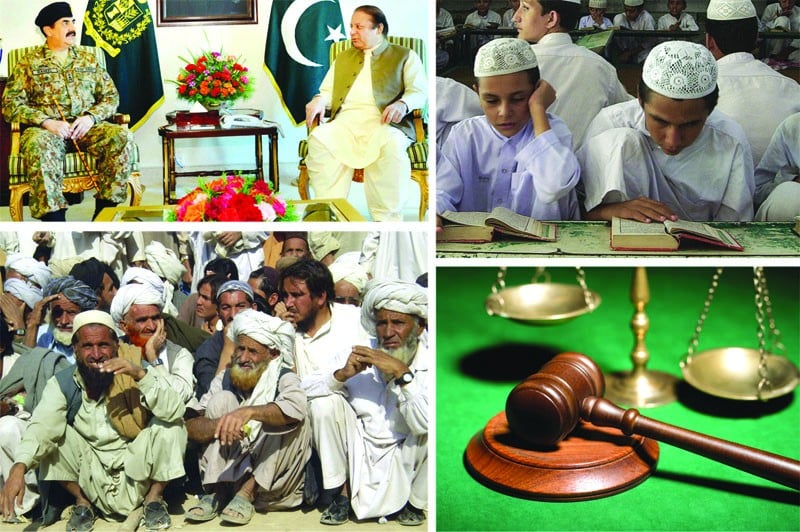
Before jumping on to its 20 points, the state of Pakistan must take four broad steps. To start with, the legal framework to deal with terrorism which has culminated in the form of military courts is the worst strategy we could adopt as a state. As I.A. Rehman writes in his article, this brutalising of justice will lead to an even more brutalised society.
Ironically, what has been termed as a knee-jerk reaction is not so knee-jerk after all. The announcement of military courts is directly linked with legislations like The Protection of Pakistan Act. Even before this Act, the blanket approval for military operation in the tribal areas and all the opaqueness and human rights violations attached with them only paved way for such a decision. A little before this decision, the entire society it seemed had favoured the decision to lift the moratorium on death penalty.
So the state of Pakistan needs a legal framework within the democratic and constitutional norms and spirit.
Two, the state of Pakistan must decide in favour of the elected government formulating its foreign policy.
Three, the state of Pakistan must settle the fate of Fata. Once again, the elected gover,nment, and not the security establishment, must effect the reforms that have already been spelt out in great detail in various commissions and committees constituted for the purpose.
And last but not the least; the state must put its foot down and do something about the madrassas. All children must get uniform education for the first sixteen years of their life. The madrassa education must only constitute specialised degrees after the first sixteen years. The state has to figure out if that involves declaring all madrassas as schools henceforth.
There are, of course, a hundred other things the state will have to do if it indeed thinks its defining moment has come. But these four steps, we think, are a good starting point.