


Print Story
X




Some observations from inside the court room at the Lahore High Court
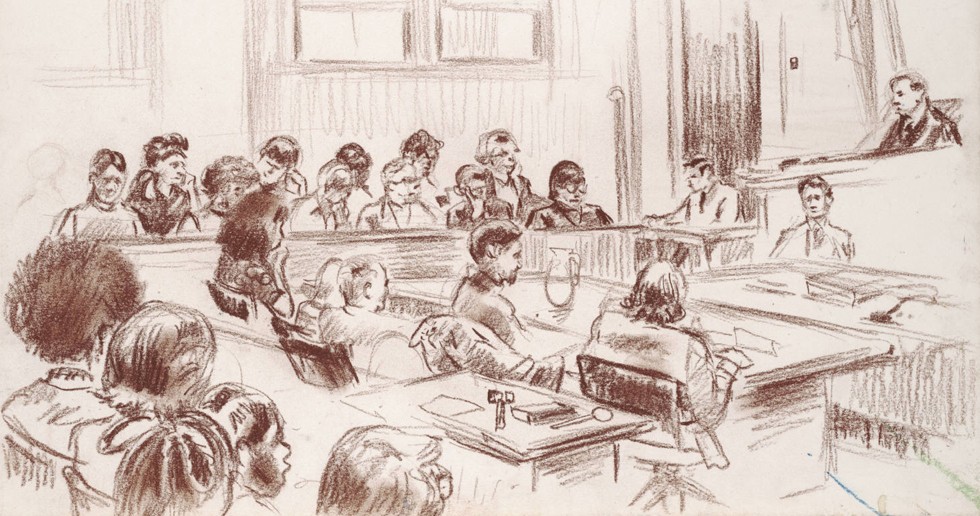
October 16. 10.30am. A court associate in a two-judge Lahore High Court appellate bench calls aloud, "Asia Bibi versus State!" and almost everybody in the small courtroom -- more than a dozen lawyers, a few rights activists, and a few clerics -- rise from their seats.
The court guard quickly moves outside the courtroom and repeats loudly "Asia Bibi versus State".
The two sides of the counsels, no less than five on each side, along with associates, take their positions in a group form on the two sides of the rostrum where the two judges -- Justice Anwarul Haq and Justice Shahbaz Ali Rizvi -- are seated.
Justice Haq, observing the situation, asks: how many are representing this case?
He gets the answer in murmurs.
Those defending Asia Bibi include senior attorney Chaudhry Naeem Shakir, S.K. Chaudhry, and Tahir Khalil Sindhu, who is also a minister in the Punjab cabinet, among others.
Ghulam Mustafa Chaudhry leads the complainant’s side, among others.
In the first 30 minutes, the two judges ask the counsels to recall facts of the case against Asia Bibi. That is, how the incident occurred, whether the procedure of investigation was correct, and some key statements. They then announced tea-break, calling the court again at 11.30am to listen to arguments from both sides.
The LHC appellate bench resumes after 30 minutes. By that time, a few clerics had also entered the court, quietly sitting along the wall, close to the complainant’s counsel. One of them, by looks in his 60s, with white beard and white shalwar kameez, sitting beside the complainant, started reciting darood sharif in a very low voice to "get the blessings of God," he says.
In the two-hour argument, the judges give ample time to the defence lawyers. They also set aside extra-judicial evidences in the case, carefully listening to the flaws pointed out in the investigations and contradictions in the statements of witnesses.
Senior counsel, Shakir, starts his arguments, saying a Federal Shariat Court judgment -- the court which maintained only death sentence under Section 295-C and abolished the previous option of life imprisonment -- had equated the blasphemy death sentence with to Hadd which meant that a pious witness was required in such cases. He also raises the point that there is no independent corroboration of the two main witnesses -- two sisters -- by the prosecution, terming the allegation of blasphemy against Asia based on enmity and prejudice.
The defence lawyer points to the delay in lodging of police case after consultation with local cleric and contradictory statements of witnesses.
The judges repeatedly ask him as to why didn’t the defence counsel cross-examine the two main witnesses at all in the trial court. "There is not even a single question by the defence in trial court to these two sisters who are the key evidence and witnesses to this charge," Justice Haq says. "There is even no request from the defence side to call for psycho-analysis or psychological examination of the charged person."
SK Chaudhry, the lawyer in the trial court representing Asia, has little to say in reply to the judge’s questions.
Ashiq Masih, husband of Asia, standing behind his lawyers and quietly listening to the arguments is trying to get a sense of what was going on in the proceedings, mainly in English language. Justice Haq says the bench had adjourned all other cases that day due to the sensitive nature of Asia’s case and urges on the defence counsel to argue more. "We are ready to listen to the arguments till evening and we want to decide it today," he says.
The complainant’s counsel, Ghulam Mustafa Chaudhry, in the few minutes’ argument tells the court that the case is based on facts and investigations were done properly and that derogatory words were uttered by Asia.
He urges the court to uphold the decision of the trial court.
After a two-hour hearing, the senior judge on the bench, Justice Anwarul Haq, announced "The appeal is dismissed," and stands up from his chair.
The announcement is followed by celebrations from the complainant’s side.
"At one time, we were surprised, thinking the judges were taking a different line but the weak defence helped us," Ghulam Mustafa Chaudhry, counsel of the complainant tells TNS.
He says he needed two hours to present his arguments but he could get only 10 minutes, while the judges appeared quite patient and calm during the defence counsels’ argument.
Asia Bibi, 47, worked as a low-paid labourer in village Ittanwali, district Nankana. On June 14, 2009, some Muslim co-workers refused to drink water which she had fetched for them. The co-workers refused to drink water believing that the utensil had become ‘unclean’ after it was touched by a Christian woman. The exchange of harsh words between the two sides developed into a religious brawl during which Asia allegedly uttered derogatory remarks about Prophet Muhammad (PBUH).
The situation led to a meeting in the village headed by some elders and a local cleric, Qari Salim, who later became complainant of the case which was lodged five days after the incident occurred. Asia was arrested the same day the case was lodged -- June 19, 2009. She was accused of blasphemy under Section 295-C of Pakistan Penal Code, and was sentenced to death by a local court on November 8, 2010.
This section contains mandatory death sentence for this particular crime under blasphemy laws. Under the blasphemy laws, a high court must confirm a death sentence from a lower court. Due to this, many of those who are convicted remain on death row for years with their appeals pending before the overburdened high courts.
Asia is the first Christian woman in Pakistan who is sentenced to death under this particular law.
Lack of coordination among her defence lawyers and show of unity on the complainants’ side is quite visible in the court during the proceedings.
The case of Asia Bibi gained more attention when Salmaan Taseer, the then Punjab governor, went to jail to meet her and assure her of all possible legal help. Taseer had maintained that the case against Asia was fabricated and based on false grounds. He had moved a request to the former president of Pakistan to pardon Asia’s sentence. Taseer never knew his support to Asia would cost him his life, that his official guard, Mumtaz Qadri, would shoot him dead in broad daylight in a busy market in the country’s capital, Islamabad, on January 4, 2011.
An Anti-Terrorism Court (ATC) awarded Qadri death penalty in October 2011, against which he has filed an appeal. The judge who gave the death sentence quietly left the country, feeling his life under threat due to extremism and deep polarisation in the society on sensitive issues.
About two months after the assassination of Taseer, the then federal minister for minorities, Shahbaz Bhatti, was also killed in the country’s capital for talking about the need to revise the blasphemy laws, which are considered controversial by many rights groups. Pope Benedict XVI also issued a condemnation statement on the ordeal of Asia, urging Pakistan to do justice.
As under-trial inmate, Asia Bibi kept waiting for her appeal to be heard before LHC for almost four years and her ordeal is likely to continue for another few years till her appeal is heard before the Supreme Court of Pakistan -- the last appellate forum -- according to the schedule in view of a pile of pending work due to slow pace and limited number of judges.
The laws made in the name of religion -- objected to by many groups and endorsed by the majority groups -- and flawed criminal justice system, allow quick arrest of people under blasphemy charges due to pressures of certain extremists religious groups. The system puts the accused in jail where they suffer for years.
The principle of "justice delayed is justice denied" needs independent and cautious application in such cases which are highly sensitive in nature.