


Print Story
X




The functioning of election tribunals should be improved for timely decisions
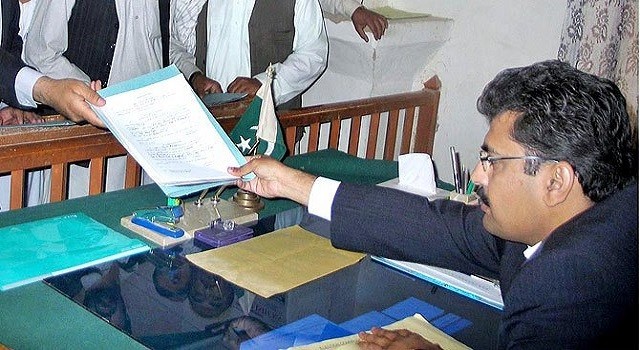
It is in this backdrop that the Pakistan Tehreek-e-Insaf (PTI) has recently voiced its reservations on the poor performance of the election tribunals.
According to the Pakistan’s Peoples’ Representative Act and election laws, the election tribunals are supposed to decide electoral petitions within a period of four months, and hear the case on day to day basis -- a rule which is hardly followed.
A senior official in the Election Commission of Pakistan (ECP), who does not want to be named, tells TNS that there were around 425 electoral appeals filed with the commission after the results of May 2013 general election. Out of them, around 300 have been decided in a span of one year while the rest are still pending, mainly in Punjab.
He says the ECP formed 14 election tribunals across Pakistan to decide the petitions.
The ECP, in the past few years, made an important amendment in the election tribunals appointment laws to speed up the process --appointing retired judges as election tribunals, instead of serving Lahore High Court judges, so that they can pay attention to the appeals and decide them exclusively.
Later, the ECP also added penalties and fines to the candidates/appellants/parties involved in the appeal if they continuously seek adjournments and cause delay in the appeal’s proceedings.
"Despite all these things, the election tribunals are unable to decide the cases in four months," says the ECP official, adding, "However, the performance of the tribunals has been improved through these changes as compared to the previous elections."
The official says the issue is that there is no accountability mechanism of these tribunals. "They work independently and the appellant, after the decision has been given, can directly move the Supreme Court of Pakistan."
But, he says there is no clause in the law which can urge the ECP to hold the tribunals for delay or poor performance -- "We cannot do anything except wait."
There is need to revise the law, as candidates/appellants seek adjournments and cause delay in the decision. "The sitting ECP authorities are aware of the situation and have taken some steps to address these problems."
A 2011 report of the International Crisis Group on "Reforming Pakistan’s Electoral System" urges immediate need of reforms in the electoral process, including the functioning of tribunals. "Dysfunctional election tribunals, (allegedly) characterised by corruption and prolonged delays, prove incapable of resolving post-election disputes. Such internal weaknesses constrain the ECP from overseeing credible elections and an orderly political transition," the report observes.
Kanwar Dilshad, former ECP secretary, who has served the commission for a long time, tells TNS that there is need to revise the rules and laws. "The parliament has a role in speeding up things," he says. "In Pakistan, the power of the ECP mostly lies in the hands of the judiciary, while in India the composition of ECP and its functioning in dealing with the electoral appeals is entirely different where only two members of the commission can decide the appeals of the whole India quickly. This is high time all political parties sit together and work on the reforms."
Pakistan Institute of Legislative Development and Transparency (PILDAT), a non-government organisation, states in its policy brief. ‘Agenda for Electoral Reforms in Pakistan -- After 2013 General Elections’ has urged the ECP to develop a mechanism and appoint sufficient number of tribunals by assigning sufficient number of judges so that the requirement of law is fulfilled.
"This can be ensured only if sufficient numbers of judges are assigned the work of Election Tribunals so that they can exclusively hear election petitions and not take up any other burden during the period of hearing and disposing election petitions. The Tribunals should exclusively hear and dispose election petitions during the four-month period. A period should also be fixed within which the appeals to the decisions of the tribunals should also be decided," the report suggests.
Justice Tariq Mahmood, former judge of the Balochistan High Court, however, sees improvement in the functioning of the tribunals. "Still, there is room to make things better," he says, adding, "ECP and tribunals should discourage adjournments. If there is need for reforms, they should be brought up in consultations with parliamentary parties before the next elections. Otherwise, we cannot hold the elections under new system."
He says the winning candidates always try to seek adjournment to delay the case which makes the tribunal’s performance slow. He also indicates that there is no accountability mechanism of the tribunals in the law.
Free and Fair Election Network (FAFEN), a prominent non-governmental organisation, in its recent statement says, "PTI enjoys zero success rate in deciding election complaints. A total of 21 complaints of Pakistan Tehreek-e-Insaf (PTI) and 28 of Pakistan Muslim League-Nawaz (PML-N) are pending with the ECP," the statement reads.
According to the report, over 100 complaints are pending and election tribunals are not delaying the PTI complaints only. It further notes, out of 58 PTI complaints, 21 are pending whereas out of 66 PML-N complaints, 28 are still pending.