

Print Story
X

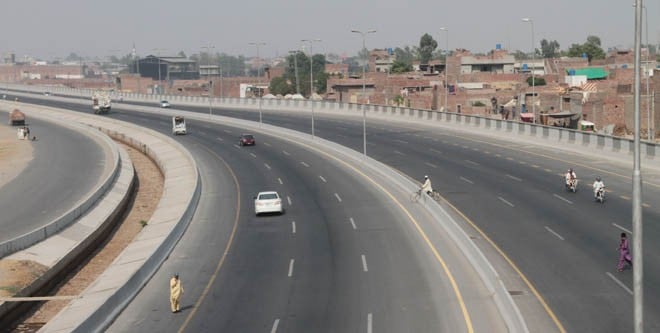
The city is expanding from all sides and more and more roads are being constructed to make distant housing settlements accessible to those in and around the city centre. While this large-scale road construction has facilitated the flow of traffic to a fair extent and triggered real estate development, the growth has come at a price: there are many who believe the pedestrians have been totally ignored while planning and engineering most of these roads.
As a large number of these roads pass through congested urban areas, the fast moving traffic poses threats to the pedestrians crossing these roads frequently and often meeting with an accident.
Sure, a lot of the areas that would have taken ages to develop transformed within no time primarily because of their proximity to signal-free roads such as the Lahore Ring Road which has reduced travel time drastically. The developers and planners have come under fire for looking at the concept of measuring distances in terms of time only. A typical ad placed by a housing society on the outskirts of Lahore says it takes such-and-such amount of time to reach there from a prominent landmark of the city. One can try to travel this distance within the stated time period and only succeed if the road is clear of any obstruction and/or living creature and if one is able to drive one’s vehicle at the maximum speed attainable.
Jamshed Ali, 23, is a salesperson at a sanitary appliances store on Ferozepur Road. He has to cross the road many times as the godown where his products are kept in bulk is on the other side. Earlier, it was easier for him and other employees of the store to cross over when the nearby signal turned red. But today, as the road has become signal-free, they have to stand for long and guess the speed of the approaching vehicle before daring to set foot on the road.
According to Ali, the commuters are no saints and they drive equally recklessly at any given chance. "Instead of slowing down, they increase the speed of their vehicles at the sight of an approaching pedestrian."
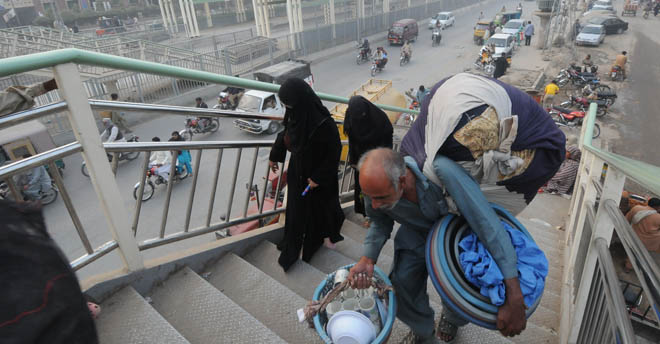
Ali does not agree with the assertion that overhead pedestrian bridges are a solution. "How can you travel half a kilometre and climb a hundred steps before going down the same number of stairs just to get to the other side of the road?" he asks.
"The whole exercise becomes even more treacherous if you have to walk the distance a number of times in a day."
Nadeem Aslam, a resident of Iqbal Town, thinks the widening of Multan Road has helped to make the traffic movement faster but it has also "made life tougher for pedestrians, bicycle riders, motorcyclists and those using donkey carts to transport goods.
"At different points along the road, from Scheme Morr to Thokar Niaz Bagh, you have no footpaths or service lanes. The situation becomes worse when it gets dark because the road lights are not working most of the time."
The worst happens when those wanting to cross at a point meet an open sewer. "They have erected makeshift bridges by placing wooden planks over the sewer," says Aslam.
He also complains of accidents being the order of the day. These sometimes prove fatal, especially when a pedestrian is hit by a fast-moving vehicle that failed to control speed.
No doubt some responsibility lies with the pedestrians as well but "they are helpless," Aslam says. "Those in power are impressed by the road infrastructures they find in developed countries but they do not realise that those countries have different arrangements in densely populated residential areas.
"They charge high parking fees to discourage motorised vehicles in these areas and strictly enforce speed limits whereas in Pakistan the situation is quite the other way round. They look over the people in the residential areas and just want to facilitate the commuters."
Ahmad Rafay Alam, an environmental lawyer with an interest in urban planning, says pedestrians are involved in most of the accidents that occur on the city roads -- a fact which is confirmed by Rescue 1122.
However, Alam says, there is no doubt the pedestrians have been totally ignored while planning the roads.
He also says such infrastructure suits areas where the laws are strictly enforced and the commuters have concern and respect for pedestrians. "Overhead bridges for pedestrians have been erected at some locations but there is no provision for old or ailing people who cannot climb them."
Alam speaks of a suggestion that was made to place escalators at these bridges but it did not appear to be workable, considering the crisis of energy which the country is faced with.
Fast moving vehicles weaving on obstacle-free roads are a common sight now. Weaving, Ahmad Rafay Alam says, is "the frequent shifting of a vehicle from one lane to the other which increases the risk of accidents, especially for those pedestrians who cannot figure it out from the side."
Weaving is quite common on the canal road where people have to shift lanes abruptly when approaching the underpasses some of which have been constructed on a different side of the road.
Prof Dr Tanvir Iqbal Qayyum, ex-Chairman, Department of Transportation Engineering and Management, University of Engineering & Technology (UET), makes another point. He says there is no signal-free road in the true sense in Lahore, although there are plans to have a few. There are a couple of such roads in Karachi.
Quoting a UN report, he says around 1.2 million people die in road accidents all over the world and of these around 60 percent are pedestrians.
Dr Qayyum says cities can benefit from signal-free roads provided there is a strict enforcement of traffic rules and the pedestrians also have a civic sense.
"You can see people jaywalking and motorcyclists climbing over the median to get to the other side of the road, youngsters jumping the broken fences and so on. In developed countries, it is criminal to switch lanes except when one has to overtake from the right side of the road," he adds.
Dr Qayyum calls for an integrated plan and strong enforcement of traffic rules to fully benefit from freeways and signal-free corridors.
An official at the Traffic Engineering and Planning Agency (TEPA) says, on condition of anonymity, the agency has the power to reject or approve road designs but its advice can be ignored if the government wants to complete a project in record time and minimise costs.
His point is that providing facilities for pedestrians may delay the project and incur greater expenses.
Secondly, he says, the pedestrians are mostly from the lower economic and social classes and, therefore, do not have a voice. "That’s why their concerns are hardly considered when policies are being made."
However, he rejects the claim that most accidents are caused due to faulty road designs. "It actually means the traffic police failed to enforce traffic rules, causing fatal accidents, involving pedestrians or otherwise."