Print Story
X

"I want to get out of here. I am here for a sin which I have not committed," says 22-year-old Walaiha Irafat, while sitting in the visitors’ room of Kot Lakhpat Jail in Lahore. She has been under trial for the past two years for allegedly desecrating the Holy Quran.
Walaiha belongs to a well-off Muslim family. Her trial, though moving slowly, is taking place in jail because she was once attacked by some clerics in the local court.
According to court documents, on March 3, 2012 people gathered outside her home before sunrise after hearing cries of the victim’s friend. They came to know that the accused was found sleeping on the floor on some pieces of paper which was Quran. She was found in a semi-unconscious state with her mouth foaming with saliva.
"The case was fabricated. I was taken by my friend to the police station, saying they need some guidance regarding a case of kidnapping. At the police station, they said I had committed blasphemy," she says.
This was the time when she did not know what blasphemy means. The police told her that they were taking her home but instead they took her to jail.
Walaiha now suffers from mood disorders and bouts of depression, according to a medical report. A few months ago, she tried to commit suicide in her lonely barrack. She broke a television screen and was taken to a mental health institute for psychological examination.
"I have not done anything wrong," she says, urging the state and the government authorities to help her get justice.
The blasphemy accused undergo trial for years, wait for their appeal to be heard before the superior courts amid security threats, psychological setbacks, and failing health for a crime which is yet to be proven.
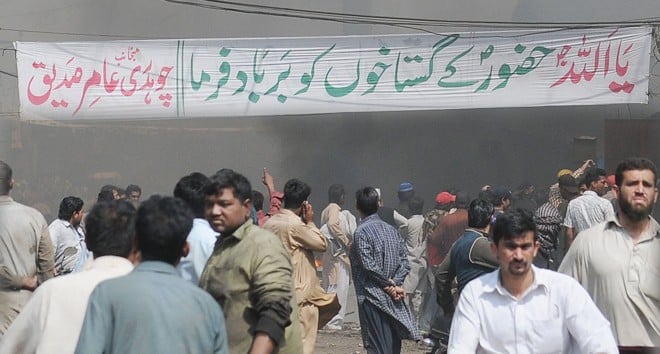
Dozens of Muslims, equipped with batons and sticks, attacked and plundered the low-income, Christian neighbourhood of Lahore at night in September 2007. They beat Younas Masih and his wife Meena Bibi, while many Christian families fled the area to save their lives.
The whereabouts of Younas, accused of uttering blasphemous remarks, are not known. In his early 40s, he was acquitted by the Lahore High Court in April 2013 -- after he spent eight years of his life in jail, waiting for his appeal to be heard by a local court.
The trial court sentenced him to death in 2007. The high court heard his appeal after six years, consequently declaring him innocent and ordering his immediate release.
By the time he was released, he had lost contact with his family. His wife had married someone else and had moved on. Leaving his five children at home, he quietly moved to an undisclosed location.
"Younas does not know what to do. He became a heart patient and contracted a skin disease in jail. He has become a psychological patient, too," says Nadeem Anthony, a lawyer and human rights activist who has been meeting him in jail and after his acquittal.
During his eight years of jail, due to security concerns, he was moved to three jails -- from Lahore to Sahiwal to Mianwali, from where he was released. His inmates used to pass hate remarks against him in jail, terming him a ‘blasphemer.’
"They don’t say sorry to a person who remained in jail amid security threats in the presence of such laws. Is this a service to Islam?" asks Anthony, while describing how upset Younas was on the false charges and spending years in jail.
A year ago, Muhammad Saqib, a mentally challenged person who claimed to be a prophet, was brutally attacked by a death-row prisoner in the Central Jail, Gujranwala.
Attacks on the blasphemy accused in jails and under police custody are not rare in Pakistan. In 2003, a Christian Samuel Masih, was booked for blasphemy and later killed by a constable in police custody. In 2009, the Gujrat police arrested composers of an alleged blasphemous book. A few days later, one guard fired at and killed one of them in police custody.
In 2009, a young Christian, Fanish Masih, was arrested in Sialkot. A few days later, he was killed in jail. In 1997, a Muslim cleric, Yousaf Ali, was charged of committing blasphemy. He was sentenced to death but was shot dead in jail in 2002. All these victims were under trial or waiting for their appeals to be heard by the high courts or the Supreme Court.
"There is no module in the jail staff’s training which tells them about taking special measures for inmates who are under-trial for committing blasphemy," says Masood Khan, a former director general of Pakistan’s central jail staff training institute.
He says such inmates are vulnerable and overcrowding jails. The jail staff is not allowed to keep them separate from others. The jails in Punjab are three to five times over-crowded while in other provinces at least three times.
Aasia Bibi, a Christian woman, was accused of blasphemy in 2009. She was sentenced to death by the local court after a year. Her appeal is scheduled to be taken up in the Lahore High Court in coming days, after a period of four years. After serious life threats in Sheikhupura Jail, she has been moved to a women jail in Multan a few months ago.
Salmaan Taseer, serving governor of Punjab and a former federal minister for minorities, and Shahbaz Bhatti were killed for raising their voice in her support of Aasia and calling to revisit the law to stop its misuses.
There are around 1,300 reported cases of blasphemy since 1987. In most cases, people are sentenced by lower courts but freed by the appellate courts. There have been more than 50 extra judicial killings, according to various reports.
"While dealing with a blasphemy case, we face pressure on every step. This is the only crime where the police report is written without any hesitation or delay because of the pressure. The investigation and court proceedings are also conducted under immense pressures," says Shaukat Javed, former Punjab police chief.
He says the situation of the accused remains vulnerable throughout and there is no rehabilitation or compensation offered by the state if the person is proved innocent. He suggests noted religious scholars of different sects should sit together to discuss how to stop the misuse of this law to end the miseries of under trial or under appeal blasphemy inmates.
Shaukat criticises delays in judicial procedures. He suggests "the government must appoint a senior rank police officer rather than referring the case to a junior staff, which is the routine."
In March 2013, a Muslim mob attacked the Joseph Colony, setting fire to more than 170 houses and two churches, as revenge to an alleged act of blasphemy by a young Christian, Sawan Masih, who has been awarded death sentence by a local court a week ago.
Sawan, a sanitary worker, is said to be a close friend of Shahid Imran, the complainant. The accused has denied the charges and termed them fabricated to get their colony vacated and taken over by local trader groups. Sawan has filed an appeal before the Lahore High Court against the sentence.
His father terms him innocent and a victim of a conspiracy.
The Christian locality is divided. A large section of the locality has boycotted the family of the victim, holding him responsible for the attack on their houses -- which were rebuilt by the government to tackle the situation.
"The government has reconstructed the houses in days but it would take years for Sawan to come out of jail for an alleged crime which he has not committed," says Chaman Masih, father of the accused. "Is this justice in the name of Islam?" he asks.