Print Story
X

In Pakistan, there are around 6.7 million people with diagnosed diabetes and almost the same number of people at high risk of becoming diabetic. The projections are that this number will rise to 12.8 million by 2035, which puts Pakistan among the top countries with the highest number of population suffering from diabetes. An alarming fact for public health experts in this regard is that 10 people die every hour in Pakistan due to diabetes-related causes. Besides, the incidences of heart attacks and strokes have increased due to the prevalence of this disease.
Other complexities related to the disease are limb amputation, kidney damage or blindness which limit patients’ abilities to function as normal human beings as well as lead to increased financial burden on their families. If the patient is the main bread-earner, his income suffers and a lot has to be spent on the treatment of the disease. Even if he is not, the treatment of family member(s) has to go on for the rest of the life and may consume large chunks of savings as well.
The worst part, however, is that despite all this diabetes is not seriously taken by people and very few of them bother to go for a diagnostic test. For this very reason, diabetes is referred to as a silent disease because many who suffer from it do not realise the fact until complications begin to develop. Surveys have revealed that 3.4 million people living with diabetes are unaware of their condition and a result they are not receiving any treatment.
So, the foremost challenge at the moment is to increase awareness among the masses on what the word diabetes mellitus means, what its symptoms and causes are and how can the complexities caused by it can be avoided. Health sector experts stress that every individual should have access to diagnostic facilities and the state should made arrangements to screen the vulnerable populations. This will be a public service as well as a means to reduce the burden on public healthcare system which has to deal with far complex diseases caused by diabetes.
Asif Ali, a Lahore-based academic in his early 40s, is a perfect example. He never bothered to get himself tested for the disease despite emergence of several symptoms associated with it. It was only when he had to go for complete pathological tests as part of conditions to qualify for a life insurance plan that he came to know he was diabetic. Without delay, he consulted an endocrinologist who prescribed medicines and suggested changes in lifestyles and eating habits. Today, he is doing well and agrees had he not been diagnosed in time his condition would have been far worse.
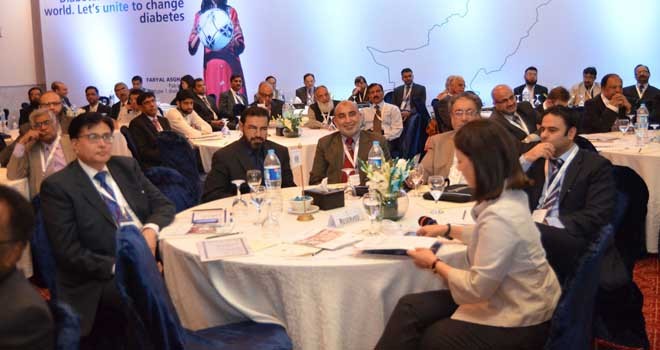
Against the backdrop of this situation, where diabetes is low on the priority list of stakeholders, a large number of experts gathered in Islamabad to attend a two-day international conference titled "Pakistan Diabetes Leadership Forum (PDLF) 2014". The event was organised by the Ministry of National Health Services, Regulation and Coordination, Government of Pakistan, in joint collaboration with the International Diabetes Federation (IDF), the World Diabetes Foundation (WDF), the Diabetic Association of Pakistan (DAP), the Baqai Institute of Diabetology & Endocrinology (BIDE) and others with support from Danish Embassy and the Danish global healthcare company Novo Nordisk.
The participants were convinced that the emerging global epidemic of diabetes can be traced back to rapid increase in obesity and physical inactivity. They dispelled the impression that diabetics are doomed for life. Their point was type-2 diabetes (the common one) can be controlled by 30 minutes of moderate-intensity physical activity on most days and a healthy diet. The type-1 diabetes is characterized by a lack of insulin production and has to be treated with insulin intake.
TNS talked to several participants of the event on how to tackle the disease in the country and received valuable input.
For example, Prof. A. Samad Shera, Secretary General of Diabetic Association of Pakistan, suggests that healthy lifestyle combined with exercise could be a key to combating diabetes. He says there are a lot of misconceptions which have to be removed for the larger interest of diabetics.
Citing an example, he says, a patient of his who was well-educated and enjoyed a good position took three-days off to transfer his property to his legal heirs when advised to start taking insulin. He was convinced that insulin is the last remedy and anybody who starts taking it via injection hardly lives two to three years. It has been around 15 years since then and this person is living a healthy life, he adds.
Lars Rebien Sørensen, CEO & President of Novo Nordisk, says diabetes is a major challenge to the healthcare system in Pakistan as only around 3 to 4 per cent of people with diabetes reach their treatment targets. "We are here today to discuss concrete solutions for how to tackle diabetes in Pakistan, how to better prevent the disease as well as increasing access to care and treatment." He was glad that such a large number of stakeholders had gathered under one roof to discuss the issue threadbare and forward recommendations to the policymakers for implementation.
Dr Shahid Mehmood from Lahore says the government shall discourage the practice of misguiding patients. He tells TNS there are radio programmes, TV and newspaper ads, wall-chalking by quacks claiming to treat diabetes for good. They make people stop medication and injecting insulin but no one stops them from playing with the lives of people. The government must start with a ban on these advertisements if it is serious in tackling this disease, he adds.
Other suggestions include launching of outreach programmes to reach vulnerable communities and test them for diabetes, training of healthcare providers, including LHVs, to diagnose the disease and spread awareness about it, provision of low-cost lab equipment at Basic Health Units (BHUs) to conduct tests and dialogue with fast food and beverage companies to make their products nutritious and healthier.
An encouraging development shared with the participants was that the KPK government had taken practical steps in this regard. As per the announcement of KPK Health Minister Shaukat Ali Yousufzai, the KPK had decided to provide free insulin to all diabetes type-1 patients and to lower income families with type-2 diabetes.
"Diabetes is more harmful to people than terrorism. We are taking it seriously and going from door to door to warn people about it," he concludes.