Print Story
X

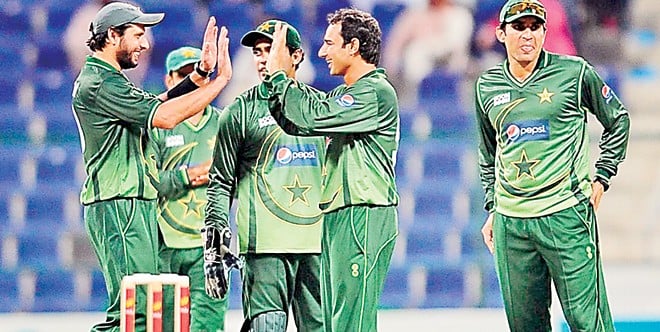
The 12th edition of Asia Cup is scheduled to take place after two days in Bangladesh, featuring five teams and 11 matches.
Pakistan will seek to defend their title under the new coach Moin Khan with the opening game against Sri Lanka on February 25. The final is scheduled for March 8, 2014.
Afghanistan will make their debut in Asia Cup this year. The other teams are hosts Bangladesh and India.
Pakistan won the last edition by beating Bangladesh by two runs in the final.
India have won the title five times, Sri Lanka four times and Pakistan twice.
The current Pakistan squad is quite capable of defending the Asia Cup, but the main worry of the new coach will be the team’s inconsistent performance with the bat, although the batting line-up is fairly long. And fielding is the other chief concern.
Pakistan are an unpredictable side; they might lose against Bangladesh and win against India and Sri Lanka on their day. Pakistani players have enough talent and potential to beat any team, but in one-day cricket, there are few second chances and only the sides that avail themselves of maximum chances on a particular day are successful. Misbah must be satisfied with his bowling strength consisting of Umar Gul, Junaid Khan, Bilawal Bhatti, Muhamamd Talha, Anwar Ali, Saeed Ajmal, Abdul Rehman, Shahid Afridi and Muhammad Hafeez.
The finalists are most likely to be from among Pakistan, India and Sri Lanka.
Although Bangladesh are playing at home, they will need to beat at least two of these three big sides to reach the final, which will be a tough task for them.
The Asia Cup idea was conceived by the Asian Cricket Council (ACC) in 1983. The first edition of Asia Cup was held in April 1984 at Sharjah in which only Pakistan, India and Sri Lanka participated and Indian skipper Sunil Gavakar lifted the trophy.
The second Asia Cup was held in Sri Lanka in 1986. Bangladesh were inducted for the first time in the Asia Cup as defending champions India did not participate.
The Imran Khan-led Pakistan won both their league matches against Sri Lanka and Bangladesh, but unfortunately lost the final against hosts Sri Lanka by five wickets.
Bangladesh hosted the third Asia Cup in 1988. In the absence of Imran Khan, Javed Miandad was the captain of Pakistan team. Pakistan won against the hosts by a huge margin of 173 runs, but lost against Sri Lanka by five wickets and India by four wickets. Sri Lanka won all three matches but lost the final against India by six wickets.
Pakistan did not participate in the fourth Asia Cup held in India in 1990-91. Azharuddin’s side successfully defended the title, beating Arjuna Ranatunga’s eleven in the final by seven wickets.
The fifth edition of the Asia Cup was held in Sharjah in 1995. For the first time four teams -- Pakistan, India, Sri Lanka and Bangladesh -- participated in the tournament. Wicket-keeper Moin Khan led the Pakistan side. At the end of the league round, India, Sri Lanka and Pakistan had two wins and one defeat each. But on the basis of better run rate India and Sri Lanka qualified for the final in which India, led by Mohammad Azharuddin, beat Sri Lnaka by eight wickets.
After winning the World Cup in 1996, Arjuna Ranatunga’s side also won the sixth Asia Cup, on home soil in 1997. Pakistan, under the captaincy of Rameez Raja, again failed to qualify for the final. Hosts Sri Lanka won their all four matches, including the final against India by eight wickets. Sachin Tendulkar was captain of the Indian team.
Finally, the dream came true for Pakistan in the seventh Asia Cup in 2000 when Moin-led team won the Cup for the first time in Dhaka, beating Sri Lanka, who were led by Sanath Jayasuriya, in the final by 39 runs. Pakistan remained unbeaten throughout the tournament. Sourav Ganguly led the Indian team who won only one game, against hosts Bangladesh.
The eighth edition of Asia Cup was played in Sri Lanka and Marvan Atapattu lifted the trophy for the hosts. Inzamam-ul-Haq’s side beat arch-rivals India by 59 runs in the league match, but lost against Sri Lanka by eight wickets. India qualified for the final against Sri Lanka on the basis of better net run rate. But the home side remained unbeaten and clinched the title with a 25-run victory in the final. During this tournament, Bangladesh won their first game in Asia Cup, against newcomers Hong Kong.
In 2004, Sri Lanka lifted the Asia Cup for the third time when they beat favourites India by 25 runs in the final.
Sri Lanka retained the Asia Cup in 2008, once again beating India in the final.
India took revenge in the next Asia Cup when they beat hosts Sri Lanka in 2010 by 81 runs. This was their fifth Asia Cup triumph.
In one of the most thrilling finals of the Asia Cup history, Pakistan beat hosts Bangladesh by 2 runs in 2012 in Dhaka.
Pakistan were restricted to a modest 236 for nine, but held their nerve to stop the spirited hosts at 234 for eight, shattering Bangladeshi hopes of notching up their maiden Asia Cup title.
It was a case of so near yet so far for the Bangladeshis who had reached the final for the first time.
Pakistan’s 385-7 against Bangladesh in 2010 is the highest total from any team in Asia Cup so far. India’s best total in the tournament is 374-4 against Hong Kong in 2008.
Sri Lanka scored their best score of 357-9 against Bangladesh in 2008.
Bangladesh’s biggest total is 300-8 that they scored against the UAE in 2008.
Bangladesh’s 87 against Pakistan in Dhaka in 2000 is the lowest team total in the Cup.
Former Sri Lankan captain Sanath Jayasuriya is the most successful batsman in Asia Cup with 1220 runs in 25 matches, at an average of over 53. He scored six centuries and three fifties in the tournaments.
For Pakistan, former skipper Inzamam-ul-Haq scored the highest 591 runs in 15 appearances with the help of six half-centuries.
Muttiah Muralitharan’s 30 wickets in 24 games, at an average of 28.83, are the highest by any bowler in the tournament. Former leg-spinner Abdul Qadir is the most successful bowler for Pakistan with 17 scalps in 8 matches.