

Print Story
X

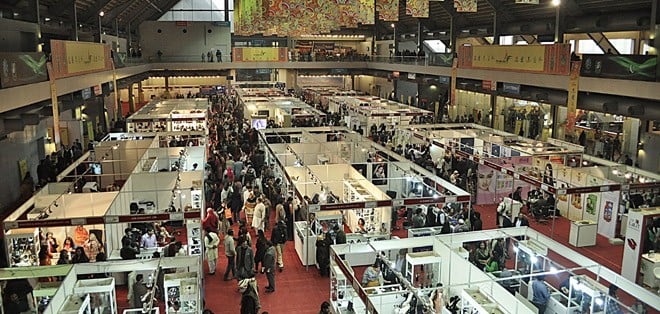
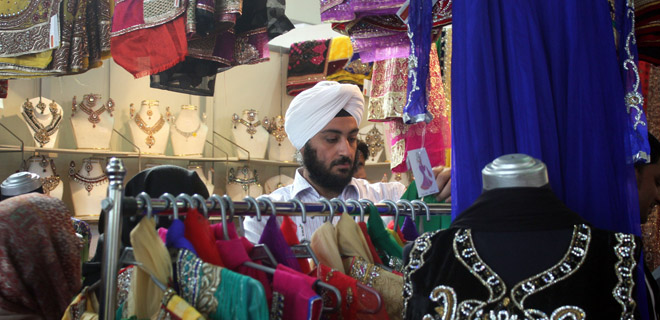
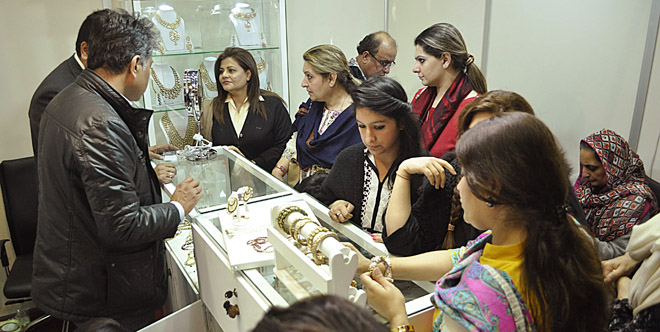
Salma, a housewife apparently in her late 30s, was impressed by the quality of pashmina shawls at a stall but was speechless as she heard the price of the item she had found interesting. It cost around PKR70,000 and the seller was Baskara Tangail -- a leading Indian manufacturer and exporter of handloom made-ups and handmade products such as silk shawls.
The company was here at the Lahore Expo Center last week to exhibit its products at the three-day Made in India exhibition.
The walk-in customers may have thought it was a rip-off but the fact is that such shawls take six months to one year to complete and cost a lot. The salesman tried to explain this to the bewildered visitor at the stall. "We have paid heavy duties, up to 60 per cent in some cases, which have pushed the prices higher."
He added that the products on display were of export quality and meant mainly for high-end markets in the UK, Europe, the US and other countries.
"These products can be more affordable if they are produced in bulk for Pakistani customers according to their needs," he said.
Shahid Sheikh, a jeweller, had a similar experience at a jewellery shop where he came across highly attractive designs. He expressed his desire to import some low-cost jewellery items in the near future but felt depressed when told it is on the negative list and cannot be sent to Pakistan from India.
"What is the purpose of displaying products which cannot be imported here?" he asked.
This was a common feeling at the show which had been organised jointly by the Trade Development Authority of Pakistan (TDAP), Ministry of Commerce and Industry, Government of India, the Federation of Pakistan Chamber of Commerce and Industry (FPCCI), Federation of Indian Chambers of Commerce and Industry (FICCI), and the Lahore Chamber of Commerce and Industry (LCCI).
One saw around 100 stalls on the ground floor of the Expo Center of which 75 offered sales of consumer goods to visitors where the others had set up site offices to hold meetings with the local businessmen.
Dr Dhruv Kumar from BLK Liver Transplant Clinic was one such representative who welcomed the approaching visitors and briefed them about the possibilities of liver transplants for patients at less than half of what was quoted by big groups which had their representatives in Pakistan.
He told TNS that the high cost of liver transplant that the Pakistani patients pay was because they did not have access to a large number of service providers. "The price automatically comes down when there is competition," he said.
Muhammad Arif, a textile industry professional, termed the currency exchange rate as "another reason for the high prices of the Indian products. Their currency has gained over the years, which means a designer kurta that costs Rs3,000 in India will cost between Rs6,000-7,000 here when you apply the exchange rate and add customs duties and transport costs to the price."
Despite all this, the exhibition drew huge crowds as the government of Pakistan had allowed Indian exhibitors to showcase even those items which fall under the negative list.
A lot of Pakistanis believed the plans for the exhibition had been finalised months ago and there were hopes that a large number of products in the negative list would be removed from it before the exhibition started. But this could not happen due to slow progress in bilateral talks, giving the impression that it was needless to display prohibited items in such an exhibition.
Aftab Vohra, LCCI convener on Indo-Pak trade, had a different stance. He called the event highly successful and added that the businessmen of both the countries had discussed business ventures amid hopes that the situation would improve in times to come. He also hoped the items falling in the negative list would soon become an importable item.
He said granting permission to display and sell products which are on the negative list was a friendly gesture on the part of the Pakistani government. India, he said, had extended similar favours to Pakistan in the past.
Furthermore, Aftab said, the 400-plus Indians who visited Lahore for the event had returned with pleasant memories of the times spent this side of the border. "They will be our ambassadors and help to improve our country’s image abroad."
He said that contrary to apprehensions they had felt safe in Lahore and enjoyed the traditional hospitality of the locals.
One highlight of the event was that despite hindrances a spirit of optimism ran high and there were Indian parties offering warehouse facilities on both sides of the Indo-Pak border. It seemed they were very sure the obstacles would go away soon, paving the way for heavy movement of merchandise across the border.