Print Story
X

He has just taken on the Mighty Mukesh, the richest billionaire in India, by ordering an investigation into Ambani’s energy giant Reliance, accusing it of creating artificial scarcity and corruption in the ranks.
He wants the final session of Delhi Assembly to be held in the Indira Gandhi Indoor Stadium for the passage of his pet anti-corruption Jan Lokpal Bill.
Last month, he turned a protestor in his own city, demanding the suspension of police officers allegedly involved in a sex-and-drug racket, and slept a night out in the open sky to make his point. The next morning he and his cabinet colleagues worked the regular files sitting on the road!
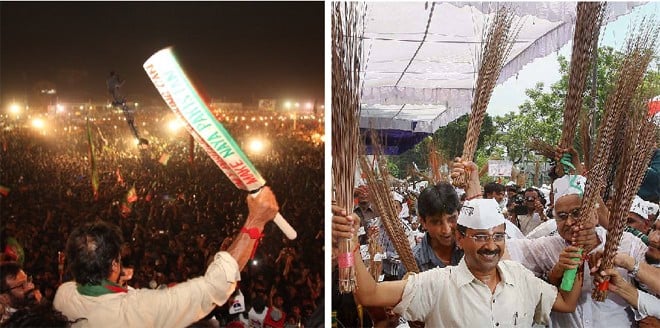
He is none other than Arvind Kejriwal, the chief minister of Delhi, who has set the cat among the pigeons, so-to-speak, with little more than a jhaaroo (broom) to beat.
The ‘sweeping’ phenomenon of Aam Aadmi Party has caused alarm in the ruling, but shaky, Congress Party (shades of our own secular Pakistan People’s Party) and the wannabe ruling Bharatiya Janata Party (the same status enjoyed by the conservative Pakistan Muslim League-Nawaz) at this time last year -- with the alarm bells provided by Pakistan Tehreek-e-Insaf this side of the Indus.
Hence, the keen interest in Pakistan over AAP’s prowess and the sometimes amusing debate surrounding who is what: Is the AAP India’s PTI or the PTI, AAP of Pakistan -- a bit like the Bollywood pantomime Hum Aapke Hain Kaun? (Who Am I to You?)
But are the AAP and PTI really similar? Is there a nodding acquaintance between the agendas of Arvind Kejriwal and Imran Khan? And even if they are different in form and style, will they, as anti-status quo forces, eventually succeed in heralding a change in the neighbourhood?
The jury is still out on the long term future of both the AAP and PTI in India and Pakistan, respectively, given the near gravitational pull to a whimsical one-man leadership. It might even seem like an adventure to find similarities, but there’s no harm trying, given the interest their arrival on the political stage has aroused.
Even though the AAP was formed only last November and the PTI has been around nearly 18 years -- which is a daylight gap in terms of experience -- the two do have an unmistakable footprint where their raison d’etre is concerned: to bring change.
Even though the AAP’s major plank is the eradication of corruption, and its decision to spread its wings as a broad-based national party only recent, in hindsight, Kejriwal may have paved the way when he founded a movement back in 1999 whose very name was Parivartan, meaning change.
The PTI was founded in 1996 and interestingly, one of its main planks was also rooting out corruption.
The PTI-governed Khyber-Pakhtunkhwa became the first province to enact the updated Right to Information law recently, something that Kejriwal also struggled for in his individual capacity to fight corruption, and now, with the Jan Lokpal Bill.
But while AAP has been able to make an almost immediate impact by winning 28 of the 70 seats on offer in last year’s Delhi Legislative Assembly elections, which also saw Kejriwal upend the record reign of Congress Party chief minister Sheila Dixit, the PTI remained in political wilderness for nearly one-and-a-half decade.
However, once the PTI held a "game-changing" rally in October 2011, whose reverberations were felt across the political divide, the mantra of change fired the imagination of Pakistanis fed up with the existing order.
Kejriwal’s victory, on the other hand, swiftly gave birth to the idea of broadening the Aam Aadmi horizon -- the party will now be contesting the forthcoming Lok Sabha polls.
The one obvious corollary of both the AAP and PTI’s populist slogan of ‘sweeping’ change -- in the former’s case, sweeping assumes literal proportions given that broom is the party’s poll symbol -- is that the other mainstream parties were forced to lift their game, rethink strategy and at least make a modicum attempt to look like the new kid on the block in the embrace of hoi polloi.
However, it would be stretching the imagination to conclude the two parties are entirely similar entities despite the apparent shared goal of fighting the status quo.
The Oxford-educated Imran Khan is inspired by the Bihar model of chief minister Nitish Kumar. Despite being a clean politician set against rivals who are seen as corrupt, Khan has enjoyed the high life, and notwithstanding his high voltage public profile, still wears an "elitist" veneer.
Kejriwal, on the other hand, has no problem literally, brandishing the broom, and wearing the mantle of aam aadmi (common man) as he goes about his business in both personal and public spheres.
The genesis is ‘similarly’ different. The PTI is basically an urban phenomenon, whose centripetal force is its youth. The AAP is more representative of the relatively deprived segment -- with or without urban base -- left at the mercy of a corrupt order.
As well as deem Kejriwal a maverick -- no dearth of similar cynicism here about Imran -- many in the Indian polity, are concerned about his ability, like Imran’s, to rabble rouse.
Other interesting parallels also exist. While both the PTI and AAP are strong on the mantra of change, they haven’t been able to do justice to their pre-election promises in government -- although the AAP is relatively new to this role -- and, are generally, beset with confusion in their approach and ranks.
Married to populism and ever eager to hit the road, their leaders appear to wear a self-righteous halo, taking dictatorial decisions with little room for in-house consultation. The parties, too, are generally shy of debating issues inside the parliament or forging consensus.
When Vinay Kumar Binny, one of the 28 MLAs of AAP took on his party chief last month in Delhi and was eventually ousted, it reminded one of several such rebel yells in the PTI as well. In both cases, the dissent at heart was premised in not getting a ticket -- or the kind of ticket -- sought by the dissenter.
The one safe conclusion is that neither AAP nor PTI seem to have a concrete roadmap to convince their newfound constituencies of fashioning change even as they struggle to keep a fragile hold on their respective state/provincial governments. The PTI’s challenge is existential given the menace of terrorism. No such issues for the AAP.
But while the PTI has managed to make a mark as an alternative force (second largest political party in terms of votes) with all its inherent contradictions, the AAP is still to convince the electorate of its credentials as a national alternative to the Congress and BJP.