

Print Story
X




Trump threw a Gatsby-themed party. The event’s reception shows how the media has adapted to the president’s antics, with irony emerging as the editorial pick
| A |
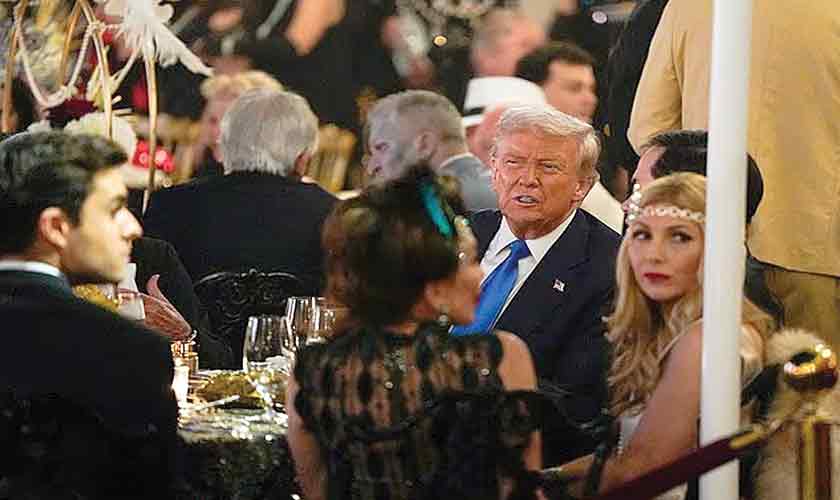
s millions of Americans faced the loss of their food benefits, Donald Trump hosted a Great Gatsby–the medsoirée at Mar-a-Lago. The spectacle not only revealed the detachment of a gilded political class but also highlighted the absurdity of the situation, as the American press now performs moral clarity through irony.
“The spectacle became a tableau in which the gilded self-image of power collided with the arithmetic of hunger.”
“They were careless people, Tom and Daisy—they smashed up things and creatures and then retreated back into their money or their vast carelessness.”
— F. Scott Fitzgerald, The Great Gatsby (New York: Charles Scribner’s Sons, 1925), p. 179.
Whether you’ve read The Great Gatsby or just watched a mayoral race in New York, the real syllabus of American politics is on display. On one coast, Donald Trump was throwing a Gatsby-themed fête at Mar-a-Lago, a masquerade of gold leaf and denial, while in New York, ZohranMamdani was being elected mayor without the usual neoliberal credentials or donor polish. In America, the humanities are often optional reading, except for politicians, who frequently mistake Fitzgerald for a public relations guide. The contrast could not be starker: one world intoxicated by spectacle and inheritance, the other driven by a language of justice and solidarity. If the former mistook Fitzgerald’s tragedy for a costume guide, the latter seemed to have read Baldwin, Debs and Nehru, understanding that politics, at its most human, is not a performance of wealth but an act of moral imagination.
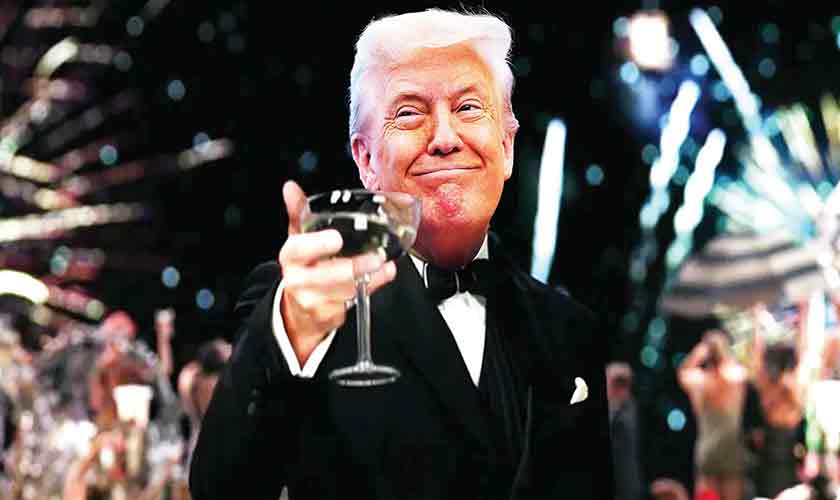
In the closing days of one of the most punishing years in recent American memory, Donald Trump hosted a party while millions of Americans braced for the suspension of their Supplemental Nutrition Assistance Program (SNAP) benefits. SNAP, the country’s largest food-aid initiative, sustains over forty million citizens through electronic transfer cards that allow them to purchase groceries with dignity. Once called the “Food Stamp Program,” it was renamed in 2008 to signal a modernised, digital approach to hunger. Yet the technology could not disguise a political failure: because of the congressional stalemate and a government shutdown, the program’s funding hung in limbo.
“The press no longer teaches morality; it stages it.”
Legal challenges ensued; courts ordered temporary relief and even the Supreme Court found itself drawn into the theatre. On the very day that justices extended a pause on a lower court ruling that would have compelled the administration to release $4 billion in aid, Trump was photographed under chandeliers, surrounded by sequins and champagne, the host of a soirée inspired by Fitzgerald’s cautionary tale of wealth without conscience. The ballroom shimmered with 1920s affectations: feathers, pearls, brass and laughter. A banner proclaimed, “A little party never killed nobody.”
The timing was not incidental; it was the story itself. The spectacle became a tableau in which the gilded self-image of power collided with the arithmetic of hunger. What might have been dismissed as a gaudy Halloween diversion quickly turned emblematic, a vivid scene from a republic losing its sense of proportion. The media coverage and commentary surrounding this episode raise the question of why it struck such a raw nerve.
The detachment of a siloed world
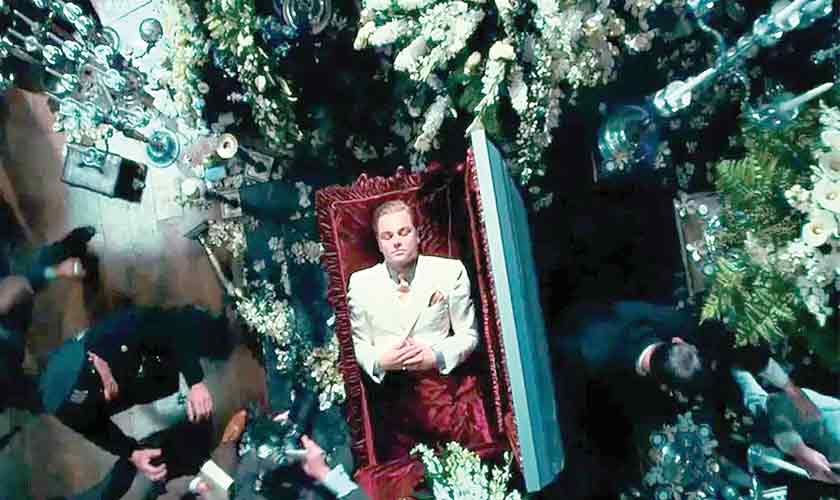
The irony was immediate to anyone who had once opened Fitzgerald’s novel. The Great Gatsby is not an ode to glamour but an elegy for a nation that mistakes excess for vitality. Its parties are masks for despair, rituals of longing that end in death. Behind every flute of champagne in West Egg lies the silence of exclusion, the futility of desire. Myrtle Wilson is run down on the road back from one such revel; Gatsby himself is killed soon after. The party quite literally kills.
Literature becomes brand identity, critique becomes ambience.
Jon Stewart captured this literary inversion with surgical precision. “Did you even read The Great Gatsby? Spoiler alert: the party killed somebody. Two bodies!” he said, compressing the entire moral architecture of the novel into a punchline. His anger was not only political but literary: to invoke Gatsby as décor is to annihilate the text’s argument. The dream Gatsby dies for, a world where wealth can purchase belonging, is the same delusion that animated Mar-a-Lago that night.
John Oliver put it more coolly: “The party seems to take only the décor, none of the critique.” The jazz, the feathers, the fizz—all preserved; the conscience, discarded.The setting itself offered a grim symmetry. Mar-a-Lago, that fortress of unreality, already functions as the stage of Trump’s politics of spectacle. To host a Gatsby party there, as food aid evaporated, was to literalise Fitzgerald’s metaphor: wealth sealed off from consequence.”
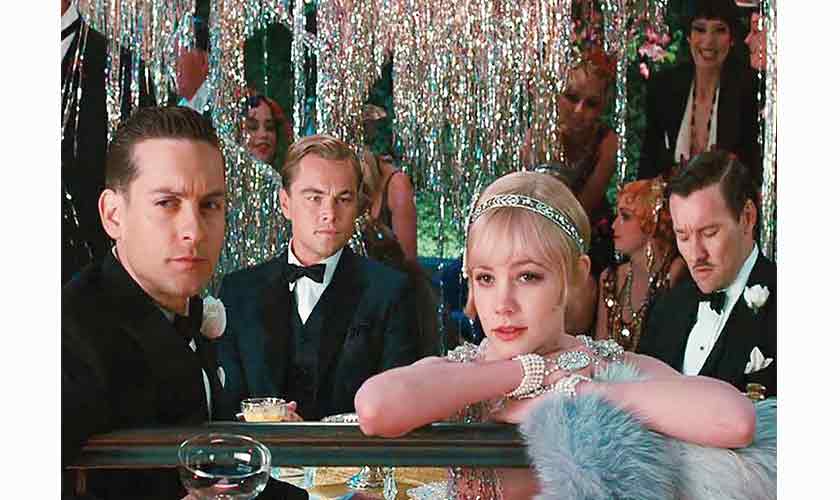
Jimmy Kimmel called it “the Trumpiest Trump move of all time.” Stephen Colbert added that no one should understand the importance of daily meals better than a man who lives to feed his ego. The satire, though barbed, was also weary. What they were mocking was not extravagance, but detachment—the inability of power to register the world beyond its own banquet hall.
If Fitzgerald’s Jazz Age chronicled reckless prosperity before collapse, the present moment mirrors it with unnerving fidelity. Economic precarity is once again masked by spectacle, inequality aestheticised through nostalgia. The Gatsby myth, once a mirror held up to a deluded generation, has been recast as a social media filter.
The politics of the
misread text
To transform The Great Gatsby into a party theme is not merely a lapse of taste; it is a parable about how culture is stripped of moral charge in the age of spectacle. Literature becomes brand identity, critique becomes ambience. Fitzgerald’s warning is not misunderstood but ignored because it interrupts the pleasure of consumption.
Stewart’s fury—half laughter, half lament—was the sound of exasperation with a political class that mistakes irony for aesthetic. His question, “Did you even read The Great Gatsby?” reached beyond Trump’s ballroom; it addressed a nation that quotes its cautionary tales without absorbing their warning.
In the novel, the green light across the bay symbolises Gatsby’s impossible longing for a future he cannot touch. At Mar-a-Lago, that light has been reversed. It no longer beckons the dreamer forward; it blinds those within to the darkness outside. The critique of moral vacancy now glitters as decoration above a new age of inequality.
To host a Gatsby party in 2025, amid hunger and shutdown, is to prove Fitzgerald right in ways he could scarcely have imagined. The party has outlived the dream; the spectacle has eclipsed the story. The boats no longer beat against the current; they drift, moored in a lagoon of denial, lit by chandeliers instead of conscience.
Laughter as lament
Yet the true revelation lay not in the party itself but in how the American press responded to it. The coverage was unanimous, incredulous and oddly elegiac. Across platforms—The Daily Show, The Guardian, Rolling Stone, The Daily Beast, even People—the tone converged: outrage tempered by irony. What emerged was a portrait of a press that now performs moral clarity through wit.
Once, the editorial and the sermon shared a vocabulary of ethical seriousness. That age has passed. In its place, the American press has found another register—irony as conscience, laughter as the last surviving form of moral authority. The age of solemn editorials has yielded to the age of the scathing monologue. The moral voice now laughs because laughter is the only sound that carries over the noise.
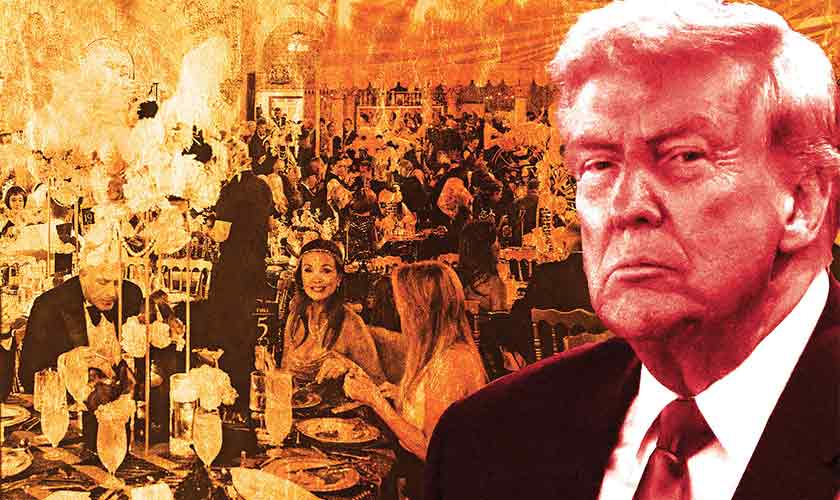
The Gatsby coverage crystallised this transformation. The story itself was absurd: a president revelling in 1920s fantasy while forty million citizens queued for food aid. Yet the reaction—Stewart’s incredulity, Oliver’s precision, Colbert’s mockery—turned farce into moral reckoning. Their humour was not diversion but diagnosis. Laughter has changed into the language of disbelief.
“Laughter has become the language of disbelief.”
To speak plainly in an unserious age is to invite ridicule, so the press has learned to veil sincerity in irony. Satirists like Stewart, Colbert and Oliver have become the conscience of the republic precisely because they can laugh where journalists cannot weep. Irony serves a dual purpose: it exposes hypocrisy and acknowledges helplessness. It allows the audience to inhabit moral clarity without the fatigue of instruction. In an economy of exhaustion, irony feels like mercy.
The nightly monologue now serves the same purpose as the editorial once did. It frames contradiction, a Gatsby party amid hunger, a climate summit sponsored by oil firms, in a single incredulous line that says more than a thousand op-eds. This is not irony as detachment but irony as endurance. It carries the moral charge that conventional commentary lost to partisanship. Every laugh is shadowed by futility; every joke is a confession of complicity. The audience is not merely entertained; it is implicated.
Journalism after gravity
The Gatsby episode made visible the merging of reportage and satire into a single moral theatre.The Guardian and The Daily Beast supplied the facts; The Daily Show and Last Week Tonight translated them into feeling. Together they produced a kind of moral choreography: fact stated, irony applied, meaning restored. The press could once again say what cannot be said earnestly without seeming naïve, that inequality has become obscene, that power no longer pretends to virtue.
The irony itself became judgment refracted through incredulity. Where Walter Lippmann once offered reasoned detachment, there is now Stewart’s raised eyebrow; where Edward R. Murrow closed with grave reflection, Colbert closes with a smirk that means the same thing. The gestures differ, but the impulse endures: to hold power accountable through performance.
“The great American novel has become a prop, and the great American tragedy a photo-op.”
Irony has become the house style of the American conscience. It is the only tone resilient enough to survive cynicism without succumbing to it. The nightly joke, repeated across platforms, carries a truth beyond comedy: that power’s absurdity now exceeds parody. To mock it is to measure its distance from meaning. To laugh is to grieve.
When the Gatsby story broke, the laughter that rippled through the media was not frivolous; it was disbelief hardened into art. The press no longer teaches morality; it stages it. Through irony, timing and tone, it restores the possibility of conscience to a weary public. The great American novel has become a prop, the great American tragedy a photo-op, yet the laughter that follows still bears the weight of recognition.
In the end, irony performs what solemnity no longer can. It reminds a fatigued nation that conscience still speaks, even if it must disguise itself as laughter.
Narendra Pachkhédé is a critic and writer who splits his time between Toronto, London and Geneva.