


Print Story
X




Proteas expose Pakistan’s fragile bowling and fading intensity, even on home soil
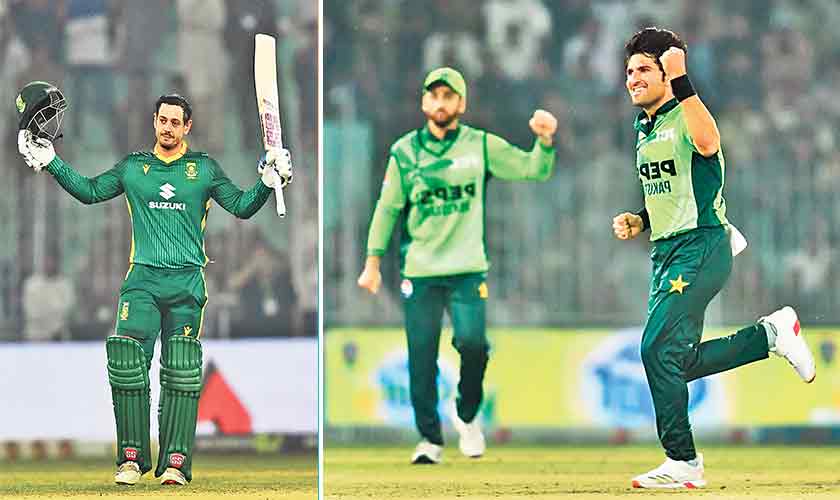
There are defeats that hurt, and then there are defeats that expose. Pakistan’s eight-wicket drubbing at the hands of South Africa in the second ODI at Faisalabad’s Iqbal Stadium was not merely a loss, it was a revelation of the growing mediocrity that has quietly seeped into the team’s structure. The series now stands level at 1-1, but the gulf in quality between the two sides was far wider than the scoreline suggests.
Just days ago, Pakistan had edged out a nervy two-wicket win in the series opener, feeding fans a flicker of hope that the side had rediscovered its fighting spirit. But in Faisalabad, those hopes were crushed under the weight of South Africa’s clinical precision, led by Quinton de Kock’s masterful unbeaten 123 and Nandre Burger’s destructive spell of 4 for 46.
If this series has shown anything, it’s that South Africa learns from its mistakes. Whether in Tests or ODIs, the Proteas have a way of absorbing lessons and striking back with intent. Pakistan, on the other hand, continues to repeat the same errors, tactical rigidity, sloppy fielding, and lack of mental resilience, turning potential victories into predictable disappointments.
Chasing a target of 270, the visitors dismantled Pakistan’s bowling attack with alarming ease, cruising to 270 for 2 in just 40.1 overs. The opening stand of 81 between Lhuan-dre Pretorius and de Kock set the tone. Pretorius’s 46 off 40 balls was fluent and fearless, while de Kock’s knock was a study in controlled aggression, every shot calculated, every risk measured.
Once Pretorius fell to Mohammad Wasim Jr., Tony de Zorzi joined de Kock to unleash a partnership that utterly broke Pakistan’s spirit. Their 153-run stand off 137 balls was a display of how well-prepared and tactically astute modern batting can be, contrasting painfully with Pakistan’s reactive and disjointed bowling effort.
Pakistan’s bowling attack, once its greatest strength, looked toothless. The lack of variety, poor execution, and unimaginative field placements turned a defendable total into a mere formality for South Africa. Shaheen Afridi, captaining the ODI side for the first time, appeared bereft of ideas once the Proteas began their assault. The bowlers’ inability to maintain consistent lines and lengths reflected not just poor form, but poor planning.
Dropped catches and lethargic fielding compounded the misery. It’s a pattern that has become alarmingly common-moments that demand intensity are met with indifference, and games slip away not because of brilliance from the opposition alone, but because of Pakistan’s own carelessness.
Pakistan’s innings had flickers of resilience but no foundation of dominance. After a shaky start, the middle order found brief stability through Saim Ayub and Salman Agha, whose 92-run stand offered a glimpse of fightback. Ayub’s strokeplay was promising, Agha’s maturity commendable. Yet, once that partnership broke, the familiar collapse followed.
Mohammad Nawaz played a counter-attacking knock of 59 off 59 balls, laced with five sixes and three fours, while Faheem Ashraf’s quick 28 added late momentum. Naseem Shah’s six off the final ball lifted the total to 269, but it always felt 30 runs short of a truly competitive target.
South Africa’s Nqabayomzi Peter made history by claiming three caught-and-bowled dismissals in a single ODI innings-an incredible feat that underscored both his control and Pakistan’s inability to rotate strike. While Peter and Burger thrived on discipline, Pakistan’s batters floundered under pressure.
Quinton de Kock’s performance was more than just a century, it was a statement. Having retired from ODIs after the 2023 World Cup, de Kock spent nearly two years away from international cricket before returning this October. His unbeaten 123 in Faisalabad was his first hundred since his 114 against New Zealand in Pune during that same World Cup, a gap of 735 days.
For a man who had every reason to rest on his past laurels, de Kock’s comeback embodied hunger and renewed purpose. “I’ve come back with a newfound energy that I think I lost over time,” he said after the match. His decision to take a break, reflect, and return rejuvenated speaks volumes about professionalism and self-awareness, qualities Pakistan’s senior players could learn from.
Shaheen Afridi, still new to captaincy, faced an uphill battle. His words after the match “It was a little bit tough, drop catches cost us” reflect honesty but also helplessness. A captain’s job is not only to set fields or rotate bowlers, but to ignite belief. On that front, Shaheen has yet to find his rhythm.
Leadership is not about reputation or pace, it’s about presence. Pakistan’s body language on the field tells its own story: shoulders drooped, bowlers uninspired, and fielders often reacting instead of anticipating. Contrast that with South Africa’s energy, every run saved, every shout synchronized. It’s not talent Pakistan lacks; it’s conviction.
It’s been 17 years since international cricket returned to Faisalabad, yet the homecoming felt hollow. There was little to cheer for, no spark from the stands, and even less from the field. The “home advantage” that once inspired Pakistan sides to ferocity now feels like an outdated myth. Playing in front of home fans should ignite pride, but for this team, it seems to add pressure they can’t channel.
South Africa’s captain, Matthew Breetzke, summed it up perfectly: “It was an all-round display from the team. We fielded brilliantly and saved so many runs.” In that one line lies the difference between a team building momentum and one slowly losing its way.
This defeat should not just sting, it should provoke introspection. Pakistan cricket has long lived on nostalgia: of Wasim’s magic, Waqar’s fire, and Misbah’s calm. But in modern cricket, reputation means nothing if systems don’t evolve. Where is the bench strength? Where is the accountability for repeated fielding lapses? Where is the spark that once defined Pakistani cricket?
The upcoming series decider is more than a match, it’s a test of character. Pakistan can either continue in denial, wrapped in excuses of dropped catches and “bad days,” or they can face the reality that mediocrity has become normalized. The ball, quite literally and metaphorically, is in their court.