

Print Story
X

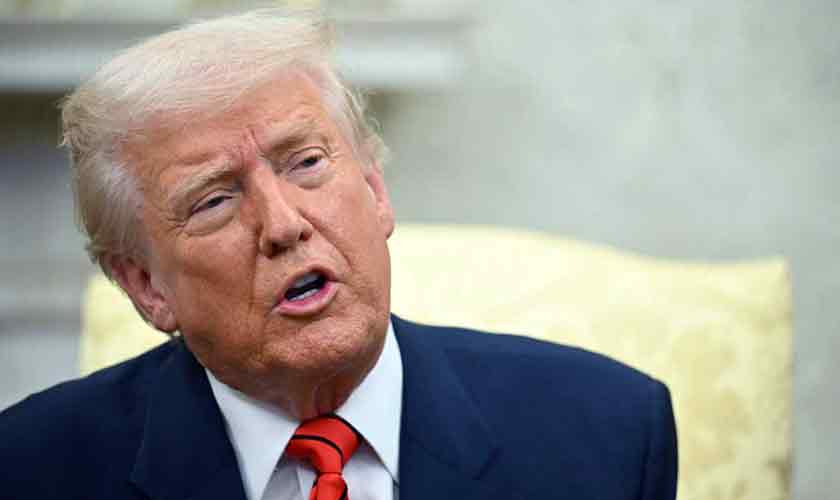
“His behavior… is completely solipsistic. He sees the world through his own sense of self… and he couldn’t be more erratic or scattered or dangerous.”
— Robert Jay Lifton
Donald Trump’s first term as president of the United State disrupted some long-held assumptions about American leadership, transforming conflict, spectacle and unpredictability into defining features of political life. His administration was characterised by chaos—public feuds, rapid staff turnover and combative press briefings - that deepened national polarisation. Trump’s disregard for factual accuracy and his tendency to distort reality redefined public discourse, undermining trust in institutions and eroding the very notion of objective truth. Politics under Trump became an arena of emotional loyalty, tribal identity and “alternative facts.” To his critics, he normalised deception and authoritarianism; to his supporters, he embodied authenticity, defiance and strength. This divergence reflects a broad psychological fracture in American civic life—one in which competing realities have supplanted a shared understanding of truth. This necessitates a dispassionate analysis of Trump’s personality because his decisions, even statements, can have a profound rub on the international events, from Gaza to China and beyond.
Trump’s personality has attracted unparalleled psychological scrutiny. Many scholars and clinicians have identified traits consistent with narcissistic, antisocial and paranoid personality patterns: grandiosity, aggression and a consuming need for admiration. His niece, psychologist Mary Trump, attributes these traits to a childhood shaped by emotional neglect and the dominance of his father, Fred Trump, who equated empathy with weakness and success with ruthlessness. These early lessons—never apologise; never back down; and always win—produced an adult personality that views relationships as contests of dominance. Whether understood clinically or politically, Trump’s behaviour—from his gas-lighting rhetoric to his indulgence in conspiracy theories—has forced Americans to confront unsettling questions about leadership, truth and the fragility of democratic norms in an age of performative power.
Trump’s performative style was evident long before his political ascent. In 2006, his negotiations to purchase Scotland’s Menie Estate revealed not just a businessman but a showman. As one observer remarked, it was “Donald Trump playing Donald Trump.” Writers such as Michael D’Antonio and Mark Singer have noted that this theatricality defines his identity: the boundary between persona and person all but disappears. Trump’s life operates as a continuous performance in which attention is both the stage and the reward.
Psychologically, Trump occupies extreme positions on major personality dimensions. In the Big Five model, he scores exceptionally high in extroversion—gregarious, assertive and tirelessly attention-seeking—while ranking extraordinarily low in agreeableness, reflected in his hostility, arrogance and impulsivity. This volatile combination produces both his magnetic charisma and his capacity for cruelty. His humour and energy engage followers, his aggression and lack of empathy alienate detractors.
At the centre of Trump’s worldview lies the schema of “the deal.” Life is a perpetual negotiation in which victory and leverage matter above all. Strength must be projected, weakness exploited and compromise avoided. What proved effective in business translated into a political philosophy grounded in dominance rather than deliberation, transactional gain rather than ideological conviction. His model of
leadership resembles a zero-sum
contest: one side must win, the other must lose.
Donald Trump’s psychological and narrative identity merges performance, narcissism and combat into a singular vision of power. His leadership style re-imagines politics as theater, truth as transaction and victory as virtue.
Psychologists argue that such traits yield a leader who is bold yet erratic—capable of decisive action but prone to risk, impulsivity and disregard for truth. Like Andrew Jackson, to whom he is often compared, Trump channels populist anger and appeals to those who crave order amid social change. However, unlike Jackson, Trump’s populism lacks a coherent national vision. It is fuelled not by ideology but by performance—a theatre of grievance in which conflict itself becomes the governing principle.
Narcissism stands at the heart of Trump’s psychological profile. Harvard psychologist Howard Gardner calls him “remarkably narcissistic.” Others regard him as a “textbook case.” His career has been a lifelong project of self-branding—his name emblazoned on skyscrapers, steaks, universities and reality television. Even at his father’s funeral, his eulogy centred on his own accomplishments as proof of paternal success. Narcissism, clinically defined, entails grandiosity, entitlement and an insatiable need for validation. For Trump, this surfaces in statements like his boast of being “the king of Palm Beach,” where he claims the elite “love me, kiss my ass, and then say I’m horrible.” Such remarks reveal both self-importance and an acute sensitivity to perception—an endless loop of self-promotion and grievance.
Unlike the psychoanalytic model that links narcissism to deprivation, Trump’s childhood seems to have amplified rather than compensated for self-regard. Fred Trump’s relentless praise for dominance and his contempt for vulnerability fostered an identity organised around winning. At the New York Military Academy, young Donald thrived on competition and command but struggled with intimacy and collaboration. These early reinforcements shaped an adult for whom attention equals existence and victory equals worth.
Research on presidential narcissism reveals its paradox. Grandiose leaders—such as Lyndon Johnson, Theodore Roosevelt and Andrew Jackson—often achieve historical prominence through confidence and daring. Yet their self-absorption can also breed ethical lapses and instability. Narcissism thus functions as a double-edged trait: it fuels boldness and charisma but invites recklessness and moral blindness. Trump exemplifies this dynamic. His charisma and audacity propelled him to the presidency, yet his volatility and lack of empathy undermined the institutions he led. As history and psychology both suggest, pride may drive achievement—but also precipitates downfall.
Every US president constructs what psychologists call a narrative identity—a life story that gives coherence to the self and symbolic meaning to the nation. George W Bush framed his life as redemption through faith; Barack Obama as liberation through hope. Trump’s self-story, by contrast, is one of perpetual combat. Raised to see the world as dangerous, he was taught that survival depends on toughness and domination. Fred Trump’s injunction—“Be a killer”—became his moral code. Sent to military school for discipline after youthful defiance, he internalised a worldview of conquest: never show weakness, never lose. The death of his gentle brother Freddy reinforced the lesson that compassion leads to defeat.
Trump’s personal mythology thus casts life as a ceaseless battle between strength and weakness, winners and losers. His greatest fear is humiliation; his highest value, triumph. Even in business and entertainment, his success is measured not by profit or purpose but by victory itself. The goal is not to achieve but to win—and to be seen winning.
In essence, Donald Trump’s psychological and narrative identity merges performance, narcissism and combat into a singular vision of power. His leadership style re-imagines politics as theatre, truth as transaction and victory as virtue. It is a form of governance rooted not in reflection or principle, but in the unending pursuit of attention and dominance. In Trump’s America, leadership is not about guiding a nation toward a shared purpose—it is about ensuring that the spotlight never moves away from the man at its centre.
(To be continued)
The writer is a professor in the Faculty of Liberal Arts at the Beaconhouse National University, Lahore.