Print Story
X

| I |
n the early morning light, the sky feels close above the coast of Thatta. Some of the old folks say the sea, once remote and gentle, feels a lot closer.
There is growing awareness in Thatta, Banbhore, Keti Bunder and Kharo Chan of climate change and its consequences. Some of the mangrove forests that once stood between the land and the sea are dying. With them jobs, memories and hopes of the people who had depended on these are being lost.
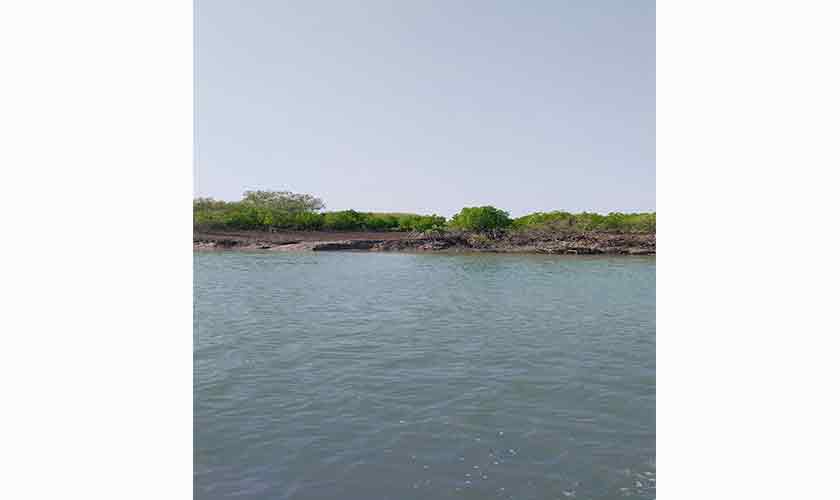
The Indus delta stretches across roughly 600,000 hectares. It is one of the largest arid-region deltas in the world. According to the Forest Department and FAO, Pakistan’s mangrove cover now ranges between 170,000 and 200,000 hectares. About 95 per cent of this lies in Sindh. The mangroves are a green wall against the Arabian Sea.
The trees held the sea
Mangroves are more than trees. They are nature’s coastal defence system. Their dense roots anchor the soil, absorb tidal surges and trap carbon at rates three to four times higher per hectare than most terrestrial forests. Without them, land and life unravel.
“Without mangroves,” says Professor Dr AW Gandahi, environmental and soil science expert at Sindh Agriculture University, Tandojam, “the coast is naked before the sea.”
He warns that their loss will accelerate both erosion and climate-driven displacement across southern Pakistan. Fertile lands, once rich with rice, are turning saline and barren through seawater intrusion. The effect is intensified by reduction in the freshwater flow and the mangrove barrier.
Unraveling coastline
In villages across Kharo Chan Island and Keti Bunder, displacement and despair are daily realities. The essential lesson here is to see the human condition as part of biodiversity — one vanishes with the other. Since the construction of the Kotri Barrage in 1955, the once-thriving delta settlements of Keti Bunder and Kharo Chan have steadily emptied. The barrage reduced the freshwater flow, letting seawater swallow farmland and villages. In Kharo Chan, the population dropped from around 26,000 in 1981 to 11,000 in 2023. 28 of its 42 dehs (revenue villages) have vanished under seawater. Across the Indus delta, more than 1.2 million people have been permanently displaced.
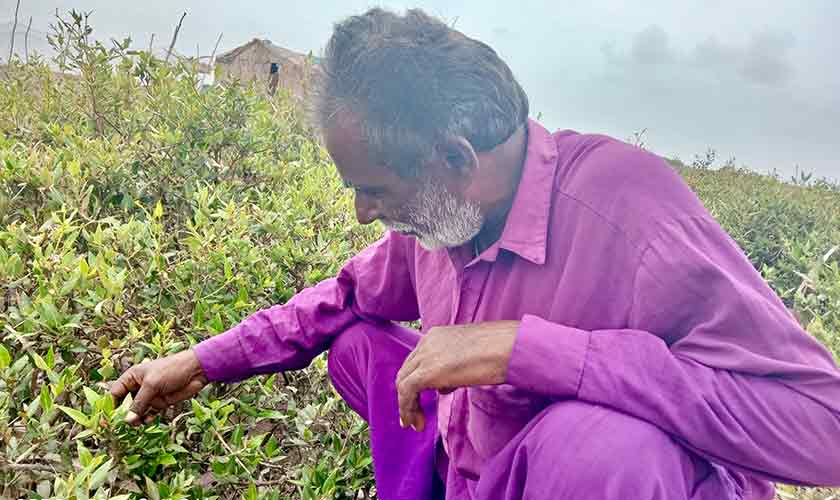
Ayob Dablo, a fisherman in his fifties, says he has moved eight times in his life. “We no longer expect rehabilitation; we are just surviving,” he says. “There was a time when we grew rice and lived with dignity. It’s over. Mangroves are being planted, but our lands are still vanishing. We have no idea what to do.”
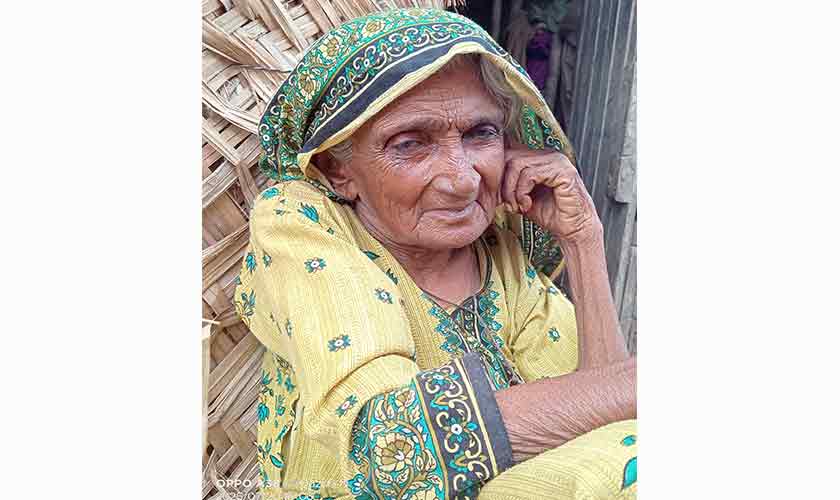
For older residents like Zulikha, 73, memories are soaked in grief. “There was grass and crops,” she recalls. “We used to harvest red rice. Now there are only sea waves where my home once stood.” She says, ‘’ I am about to bid farewell to this life, but the agony of displacement from my birthplace has made me miserable.”
Shakeel Ahmed Memon, social activist and president of United Communities Development and Welfare Organisation, has partnered with the WWF and the IUCN in the re-plantation campaigns. “We see catastrophe deepening,” he says. “Communities have migrated. My family had 800 acres before the sixties. Now there’s nothing but sea.”
Jan Muhammad Katiar, another fisherman from Banbhore, says, “The water we drink isn’t fit for animals and yet, we drink it.” Across the delta, marine and coastal species — shrimp, estuarine fish, river dolphins and migratory birds — have suffered drastic declines. The loss of mangrove roots collapses fish nurseries and allows saltwater to mix with groundwater.
How it happened
Experts say that this is both a natural and man-made problem. Decades of upstream diversion from the Indus for agriculture and cities have starved the delta of freshwater. The Kotri Barrage, completed in 1955, was the turning point. Since then, annual freshwater flow to the sea has dropped from around 70-80 million acre-feet (MAF) to less than 10 MAF, often averaging 5 MAF or less in the 2000s.
Urban waste, industrial pollution, illegal logging and unregulated shrimp farming worsen the decline. “The Indus Delta is dying not because of climate change alone,” says Tariq Ahmed Korai, a development practitioner. “It’s dying because we disrupted the flow of river water, stripped it of trees and ignored its people.”
The green shield
While most of the delta remains scarred by salt and silence, parts of lower Sindh are quietly rewriting a different story — one of recovery.
Satellite imagery between 1990 and 2023 shows that the mangrove area in Pakistan has increased from less than 86,000 hectares to over 200,000 hectares.
The Forest Department, supported by the WWF, the IUCN and the UNDP, has planted over 150 million mangrove saplings since 2009, one of the largest coastal reforestation efforts in the world.
Local participation has been critical. “We guard these trees like our homes,” says Allah Bux Murghar from Keti Bunder. “Because if they die, so do we.”
Beyond planting
Full restoration requires more than planting:
Guaranteed environmental flows — at least 10 MAF per year should reach the sea to restore salinity balance.
Community management —local cooperatives must be empowered to protect the forests.
Blue carbon finance — Pakistan’s mangroves store millions of tonnes of CO2, positioning the delta for international carbon credit markets.
Sustainable livelihoods — integrate conservation with eco-tourism, aquaculture, and carbon-based payments.
Monitoring innovation — remote sensing and AI-based tools now track mangrove survival rates accurately.
Some climate models suggest that by mid-century, up to two million Pakistanis could be displaced due to climate and water-related pressures. Cities like Karachi are increasingly vulnerable on account of the same ecological that destroyed Thatta and Keti Bunder.
In Keti Bunder, the tide is rising again. Ayob Dablo watches the sea claim another line of earth. “The sea is closer now,” he says. “Maybe if the Indus freshwater flow increases and the trees can be sustained, we can stay.”
The writer is a development practitioner in Hyderabad, Sindh. He has a master’s degree in English literature. He can be reached at qaxigm@gmail.com