

Print Story
X




Allowing impunity against journalists impacts not just freedom of the media and freedom of speech but also democracy
| P |
akistan has a serious problem of safety of its journalists and other information practitioners. Over 190 journalists have been killed in the line of duty in the country in the first 25 years of this century alone. Assassination—silencing someone permanently—is the worst form of censorship.
Of those murdered for their work, the killers of only two have been found and convicted: those of Daniel Pearl and Wali Khan Babar—albeit the assassins never served their sentences in full. Being able to murder journalists and not be punished for it is called impunity. If there is no fear of punishment and killers are not brought to justice, journalists will continue to be hounded and harmed and impunity perpetuated.
While in the decades past, harm and impunity have characterised the risks that journalists face in their daily professional life—irrespective of which of the several governments have been in power—there is hope towards the end of 2025 that that will change.
Relatively newly notified mechanisms—safety commissions—established under the special Protection of Journalists and Other Media Practitioners/ Professionals laws passed in 2021 first by the Sindh government and then by the federal government, offer hope for redemption for the long-suffering media community of Pakistan.
Saeed Memon in Sindh and Kamal Uddin Tipu at the federal level have been appointed to head the safety commissions for their respective jurisdictions in 2025. Both are competent, with experience in interacting with the media and retaining influence within the otherwise obdurate and indifferent bureaucracy. They may be motivated as their recent activism has shown but the proverbial jury will only judge the performance of their commissions—and them—in 2026.
They don’t have much time. The mandate of the safety commissions is urgent and stark: keep the professional journalists and other information practitioners in Pakistan safe and effectively combat impunity of crimes against them.
This, however, is easier said than done.
According to the latest annual impunity analysis report produced by International Media Support and Freedom Network covering the one year before November 2, 2025, on the International Day to End Impunity of Crimes against Journalists, there has been a staggering 60 percent increase in violations against media and its practitioners in Pakistan compared to the preceding year.
From Bad to Worse: Impunity Report 2025—Crime and Punishment in Pakistan’s Journalism World, while noting the “sharp rise” in attacks and violations against media practitioners, says that at least 142 cases of violations against the media were documented in the last year. This included at least 36 formal legal cases against 30 media practitioners under the controversial Prevention of Electronic Crimes Act, amended in early 2025 to make it more stringent, as well as the Pakistan Penal Code. Charges included alleged terrorism, sedition, hate speech and disinformation.
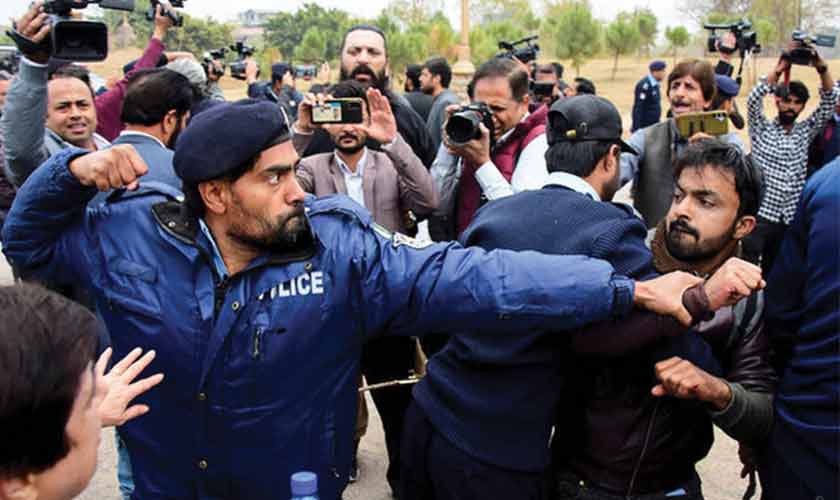
The Punjab and Islamabad, according to the report, have emerged as jointly “the most dangerous places” for journalists in Pakistan, each accounting for 28 percent of the violations, followed closely by Khyber Pakhtunkhwa, Sindh, Balochistan and Azad Jammu and Kashmir. No cases were reported from Gilgit Baltistan. The most targeted medium for journalists was television followed by print and digital media.
According to the latest annual impunity analysis report produced by International Media Support and Freedom Network covering the year before November 2, 2025, there has been a staggering 60 percent increase in violations against media and its practitioners compared to the preceding year.
With such high numbers of violations (one every second day) the question arises whether combating crimes against journalists is a matter only for the media or, in addition, for the government? This cannot be the case simply because the safety of journalists is essential for the media to be free and without free media and free speech, democracy cannot be sustained.
This reality is acknowledged and reflected in the UN Plan of Action on Safety of Journalists and Issues of Impunity instituted by the UN as a global instrument of action to combat impunity, in 2012. Pakistan was among the first five pilot countries chosen for its implementation and was quick to endorse the plan.
The plan prescribes a formal collaborative effort among a set of six key stakeholders—the media, civil society, academia, state institutions and political actors, UN agencies and relevant international actors such as IMS, RSF and CPJ—to push for the establishment of formalised national mechanisms on safety of information practitioners.
Remarkably, the strong tradition of media activism in the country ensured that in 2014 such an alliance came about with the Pakistan Journalists Safety Coalition, established with all these stakeholders working together to advocate for specialised legislation.
Remarkably again, in 2021, Pakistan became the first country in the world to legislate specifically on the safety of journalists—first, in Sindh, then at the federal level. Interestingly, the federal Protection of Journalists and Other Media Professionals Act, 2021, championed by PJSC, was one of only two laws passed by the previous federal parliament with unanimous, bipartisan consensus.
The only time bitter foes former prime minister Imran Khan and current premier Shahbaz Sharif and their parties—as well as all other parties in the previous parliament—agreed on something and voted for it was a special law on safety of journalists. That their respective governments did not let their collaborative legislation come in the way of instituting cases against journalists critical of them is ironic.
When it comes to combating impunity, the fact remains that the expressed commitment of the Pakistani state through the laws devised to keep journalists safe is not the same as actually combating impunity of crimes against them. It took years before safety commissions under these laws were established, and further still, until their chairpersons were notified.
So, more promise than action.
The safety commissions continue to operate without the required budgets and staff or proper offices to institutionalise the fight against impunity. Their real test will come when currently one of the biggest threat actors hounding media practitioners—the state and its functionaries—are resisted by these commissions. There is no harm in hoping.
Another litmus test would be that weeks and months go by without media practitioners in Pakistan being killed, kidnapped, attacked, injured or prosecuted. As the latest numbers of victims show, this will not be easy despite the priority and urgency required. It is not just individual journalists in the crosshairs but also the media and democracy.
All relevant stakeholders will need to continue to collaborate to change the unfortunate status of Pakistan as one of the planet’s worst places to practice what is a constitutional guarantee—freedom of expression and public interest journalism.
The writer is a media analyst and development strategist.