Print Story
X

| S |
itting in my small, dim room, the air heavy with smell of smoke, pitter patter of rain and the faint hum of passing trains, I feel a kind of loneliness that language cannot quite name.
It is not the loneliness of being alone, but of being elsewhere; of existing in the quiet gap between what was home and what is merely shelter.
The walls lean close, as if listening every time I stare into their face, hoping they’d talk back. Sometimes I wonder if they, like me, have journeyed across continents, hearts filled with the distant hopes and whispered memories of those who once yearned for another place carrying within them the faint traces of longing left behind by strangers before them.
It began, as it always does, with a message from girlfriends and family in Lahore. A voice half-lost in static, a laughter that breaks midway through a sigh. My friends speak of futures held hostage by uncertainty, of politics that stretch across borders like tall shadows. Pakistan trembles again at the edge of its unrest; Afghanistan bleeds quietly beside it. Their words reach me through the small screen of my phone, hurried and laden with worry. Suddenly, the world outside my window, mist-laden and cold, feels impossibly distant, not because of the miles, but because of what it signifies: imminent change.
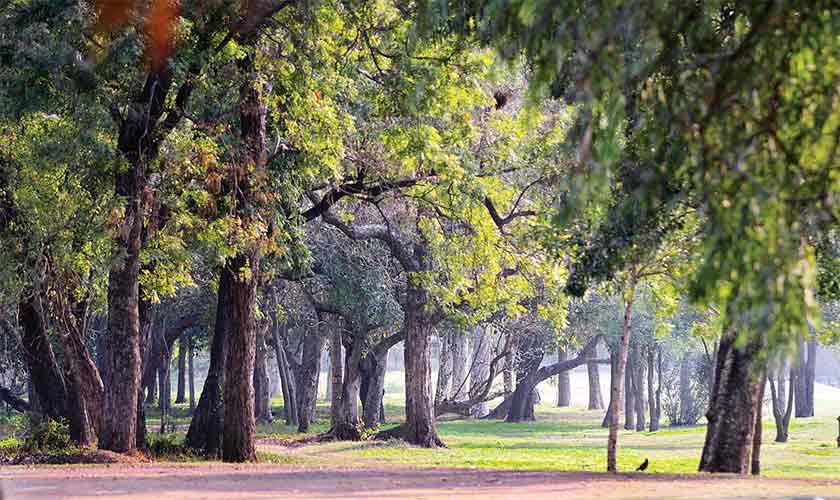
Here, in England, October makes its way into the landscape quite strangely. The trees whisper susurration, the poets call it. Leaves turn to soft flame like shades: copper, russet, gold. The air smells of smoke and endings in a place that was meant to open pathways to new beginnings.
I walk through the park and feel the earth letting go of its memories. And yet, I cannot. Nostalgia roots itself deeper than any tree. I see Lahore everywhere. In the fading light, in the puddles that mirror clouds, in the scent of rain as it begins to fall.
Lahore in October: alive, unrepentant. The amaltas must still be rattling their yellow pods against the wind; bougainvillea blazing defiantly across brick walls. Reminds me of Faiz’s
Gulon mein rang bharay,
baad-i-naubahar chalay
Chalay bhi aao keh gulshan
ka karobaar chalay
and of a koel singing somewhere unseen in Model Town. The city must still be moving with the sound of rickshaws and prayer, of street vendors and laughter, of voices that have known heat and heartbreak. There was always something un-bordered about Lahore; as if the city itself refused confinement, spilling over with scent and smog and life.
And yet, here I am, separated not by the vastness of waters but by the depth of silence. Migration, I am learning, was never meant to be merely a movement of body. It had to be a complete undoing of self. You carry the fragments of one place into another, and still, neither feels complete. You belong everywhere and nowhere at once. I pass people in the streets who look through me. I wonder if they, too, are haunted by the lives they’ve left behind.
Sometimes, I imagine a world without borders. A world where the sky does not end at a fence, where a child in Kabul and another in Lahore and another in Brighton look up and see the same unbroken blue hue. A world that recognises belonging not as ownership, but as an intimate bond shared unreluctantly between strangers.
Suddenly the winds change and I am again in my room, amongst the maple and the motia, stranded in a limbo between the East and the West.
Migration reeks of loneliness. It reverberates through the marrow of me, soundless yet deafening, sinking deep into that bottomless cavity where the self dissolves. Perhaps this is what it teaches most of all: home is not where we dwell, but the unseen force that carries us. Even across differences, we remain connected, bound by the ever-enduring thread of our shared humanity.
Qurat ul Ain Khalil is currently pursuing a post-graduate degree in education at the University of Sussex