Print Story
X




Aamir Hasan and Nadeem Hussain’s upcoming book examines how English continues to shape class and opportunity in South Asia
| T |
he English language has been accused of being a language killer and one of the primary sources of linguicide, as noted by Aamir Hasan and Nadeem Hussain in their book, The Identity Reconstruction of Subaltern English Learners: Language, Liberation, Leadership in South Asia. However, this wasn’t the case until a few centuries ago. The authors note that just a few million people living on the British Isles knew the language. This number has grown to more than 1.5 billion.
English is worn by the elite as a badge of honour. The speaker may be considered educated simply by speaking it fluently. The writers point out that this has led to the categorisation of the elite and the subaltern.
The book argues that English is more than a means of communication; it is a standard by which competence is measured. Those armoured with the language keep adding to their social capital. There is an “unbridgeable divide between the English-proficient haves and the not-so-proficient have-nots.” Proficiency in English has become an instrument of class stratification.
The writers say the British neither imposed nor encouraged Indians to study the language. Also, it wasn’t only the colonisers who were preventing the introduction of the English language. South Asian elites, Muslims and Hindus alike, too, wanted to keep the language exclusive for their circles. “These new English-speaking elites, who often wax eloquently about the importance of mother tongue, have played the greatest role in restricting the dissemination of English, which allows them to act as gatekeepers to all positions of power and privilege.”
The book features the voices of participants in a research study led by the authors, including those from India, Bangladesh, Pakistan, Nepal, Afghanistan and Sri Lanka. The research “is a qualitative study of the lived experiences of non-elite learners of English.” The book has been written for academic as well as lay audiences.It is replete with direct quotes from non-elites about their pre- and post-experience with English skills acquisition.
In the chapter on motivation, the authors describe the journey of certain non-elites in South Asia. The challenge that marginalised people and groups throughout face is to learn English “without access to English-speaking circles.” The subalterns strive to learn the language, while breaking through the gatekeepers of the English-elite circles. The authors label this as liberative motivation.
Chapter Four is about English as a sculptor of identities.The subaltern feelsthat once they learn English language skills, they can achieve dignity and acceptance. They see it as an upgradethrough which they can access the power corridors and be heard. Their needs are addressed by speaking the language of the former coloniser. Proficiency in English imbues their identities with a sense of empowerment.
With regard to Spivak’s seminal question, “Can the Subaltern speak?” some participants in the study highlighted the direct relationship between acquiring English language skills and receiving recognition and opportunities, thereby opening the doors to leadership development. One of the participantscalled it the “cherry on the cake of leadership.” Another highlighted the low credibility for those who doesn’t know the language.
The authors point to the power of the coloniser’s language through the words of Dr Ambedkar, a Dalit, who famously called English the lioness’s milk; “only those who drink it could roar.”
To be seen as an equal, Hasan and Hussain note, “English may be more important than almost any other qualification.” In the sixthchapter, they link the knowledge of English to Maslow’s hierarchy of needs.
In the last chapter, the authors raise the question: “Has English Become A Basic Human Right?” In a well-rounded discussion they attempt to answer Professor Robert Henry Lawrence Phillispon’s work, “whether English is lingua franca or lingua frankensteinia?”
Reading the book alone will be a privilege for many in the Global South. For the subaltern, who may have fought hard to break through the shackles of poverty, and gained a seat at the table of the powerful, reading it can be a source of liberation and empowerment.
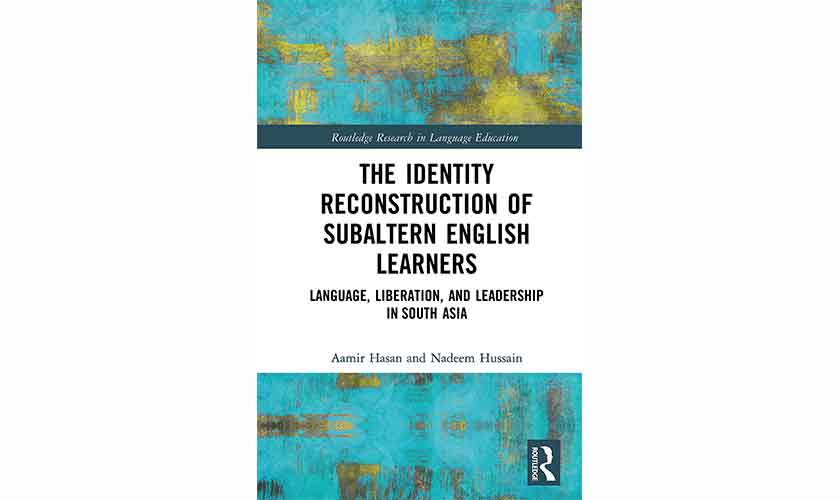
The Identity Reconstruction of Subaltern English Learners
Language, Liberation, Leadership in South Asia
Authors Aamir Hasan and Nadeem Hussain
Publisher: Routledge, Taylor and Francis Group, 2026
Pages: 200
Price: $152 (Hardback)
The reviewer is a communications professional at IBA Karachi. She has a master’s degree in international relations. She may be reached on X: @mariaamkahn