

Print Story
X



Sara Riaz Khan translates silence and memory into visual language
| F |
or a change, the artist’s statement by Sara Riaz Khan clearly communicates the painter’s ideas, reflections and processes. It stands out for its simplicity, all the more because reading one artist’s statement after another today feels like playing chess with language itself, while knowing from the start that you could never beat the master.
This fascination, or rather, obsession, with convoluted, jargon-laden and unnecessarily complex diction begins at degree shows. Like a permanent stain, it keeps smearing the explanatory lines artists attach to their work. It becomes an additional performance of charm, duty and labour.
The relationship between an artist’s words and their work is much like that between a key and a lock. Unless the key is mismatched, worn or rusted, it slides in smoothly, turns easily and opens the door to an artwork, leaving the viewer to discover whatever their eyes can or wish to see.
In our art world, however, perhaps because of an inferiority complex fostered by academic language, a kind of home-grown cultural colonisation, many visual artists feel compelled to produce texts that, compared with the Kabbalah, demand extraordinary effort, energy and exasperation to decipher.
This reminds me of an encounter with a student’s father, himself a lecturer in English at a local college, who, after reading all the final-year students’ statements, offered a gentle rebuke: “Wasn’t language invented for communication?”
Sara Riaz Khan’s words provide a subtle passage into her work. She describes her methods of making, the background of her imagery and her personal connection to visual form with great clarity. Her statement feels refreshingly free of verbosity. This restraint feels apt: her imagery invites silence, soliloquy and serenity. The scale of her works contributes to the effect.
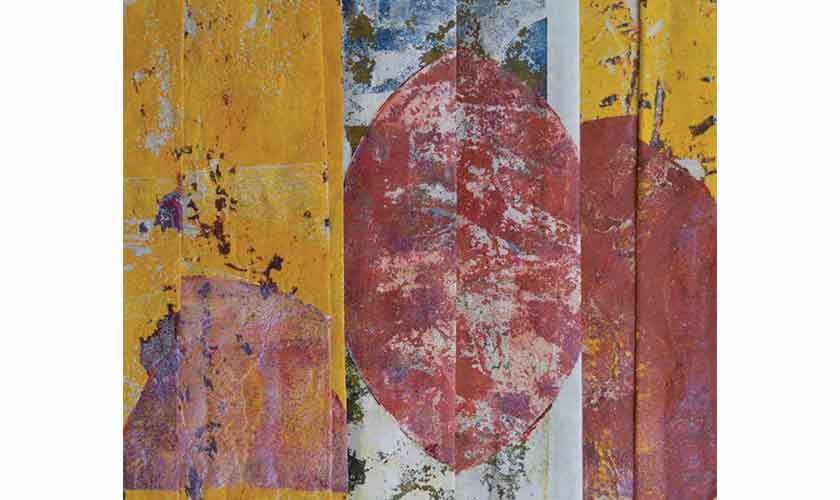
At her solo exhibition Crossing the Threshold (October 14-23, Canvas Gallery), several pieces measured just 10 by 8 inches. Created on rice paper, these acrylics and unique mono-prints revealed the artist’s private domain, reaffirming that, while an artist’s statement belongs to the public, the language of words still operates separately from the language of images.
This distinction is especially true in the context of Sara Riaz Khan’s visual vocabulary. Her abstract paintings, whether large or small, evoke sensations but avoid identifiable forms or nameable entities. In her practice, she seems to have withdrawn, almost completely, if not compellingly, from the world around us, to explore another dimension of being. Yet her process remains rooted in physical movement.
In her statement, Khan explains: “Inspired by stretching and twisting from my training, I created stencils with organic shapes and used them to make unique multi-layered mono-prints on paper.” But the physical act of making soon led her into a more introspective realm. As she adds: “During the process, I realised that, apart from physical and creative development, this was an opportunity for emotional growth. I could use this process of image-making to help me close an emotional door on a difficult memory.”
Her paintings resemble maps of lost civilisations, sought not for treasure, but for the sheer pleasure of discovering a site beyond sight.
Hence, her imagery is not abstract in the literal or dictionary sense, for it springs from a real source, one that is deep, hidden or concealed, and not always peaceful or calm. At times, it is uneasy and uneven; even violent, as seen in Being Visible and Bring My Selves Together.
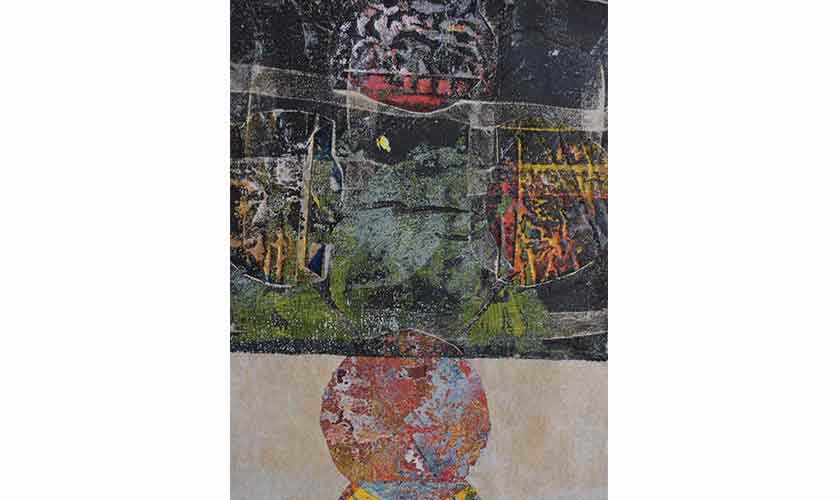
The pictorial content that appears on her surfaces may originate from the artist’s private observations, encounters and memories, but for the viewer, it conveys both peace and unrest at once, a feeling many can recognise and relate to. She achieves this balance through a sensitive handling of her medium: layering patches of colour, scattering tints, drifting marks and loosely arranged shapes across sheets of rice paper. The texture enhances the sense of tactility and intimacy in the smaller artworks.
In some pieces, when one connects the titles to the imagery, meanings begin to emerge, described or perhaps desired by the artist. For instance, the three circular shapes in uneven shades of red, placed side by side above a dark horizontal strip, seem to echo the work’s title, Camaraderie. Similarly, another work, Kick Open the Door, featuring a semi-spherical form, a world, perhaps, suggests the act of forging a softened path, a lyrical trajectory that complements the completeness of the circle.
Not referring to this piece directly, in her statement, Sara Riaz Khan elaborates: “Opening a door draws the shape of a quarter circle; I decided that every circle I made would be a positive step towards crossing the threshold from darkness into light.”
Along with these varied excursions into self, medium and image, Sara Riaz Khan’s larger works in oil on canvas demonstrate a rare balance of control and flow. Few artists manage this synthesis. Khan, who has pursued her practice for many years and exhibited widely in both group and solo shows, achieves it in her recently concluded exhibition.
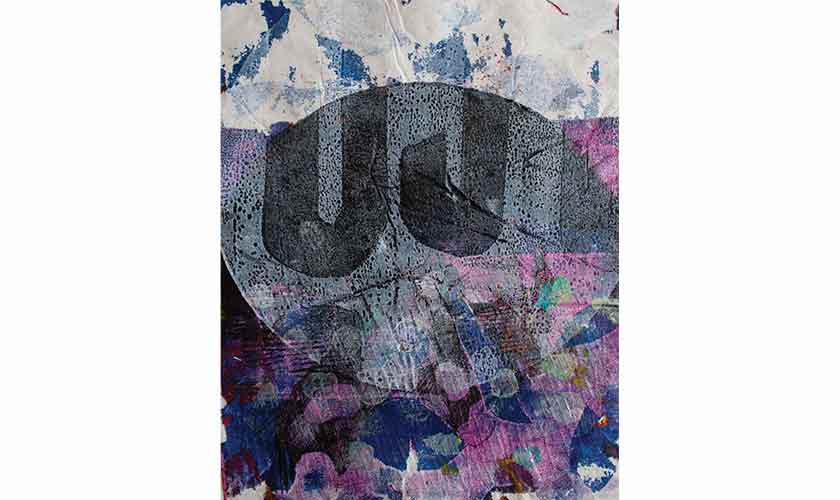
The oil paintings are built through indeterminate layers of pigment: floating, intersecting, overlapping and invading to create images that resemble atlases of unidentifiable, unreachable places. They evoke the map of a lost civilisation, one sought not for its buried treasure but for the sheer pleasure of discovering a site beyond sight, a realm that lies outside the limits of the five senses yet demands the full presence of the self.
For the gallery visitor, these paintings are far from static. They appear in motion, composed of forms that shift, converge and nearly collide. This quality of constant flux, seemingly effortless yet technically demanding, gives Khan’s canvases their distinct vitality.
One can gaze at these webs of colour endlessly, tracing countless possibilities: a fleeting emotion, a forgotten feeling, a forsaken desire. All that cannot be named, much like the imagery of Sara Riaz Khan itself, is elusive, absorbing and ultimately indescribable.
The writer is a visual artist, an art critic, a curator and a professor at the School of Visual Arts and Design, Beaconhouse National University, Lahore. He can be contacted at quddusmirza@gmail.com.