

Print Story
X




A chance encounter with Muhammad Yusuf sahib, the nonagenarian who set up his pharmacy in Old Anarkali 75 years ago
| O |
n a sweltering, humid day, I left my office for Old Anarkali to meet some friends. The Mall, to me, serves as a bridge — connecting the Lahore we once knew with the city we see today, held together by historical buildings, countless stories, and, most importantly, the people who have witnessed its various seasons and facets.
I had no intention to document any stories that day — I had a headache which wouldn’t let me — but by a stroke of fate, I chanced upon Muhammad Yusuf sahib.
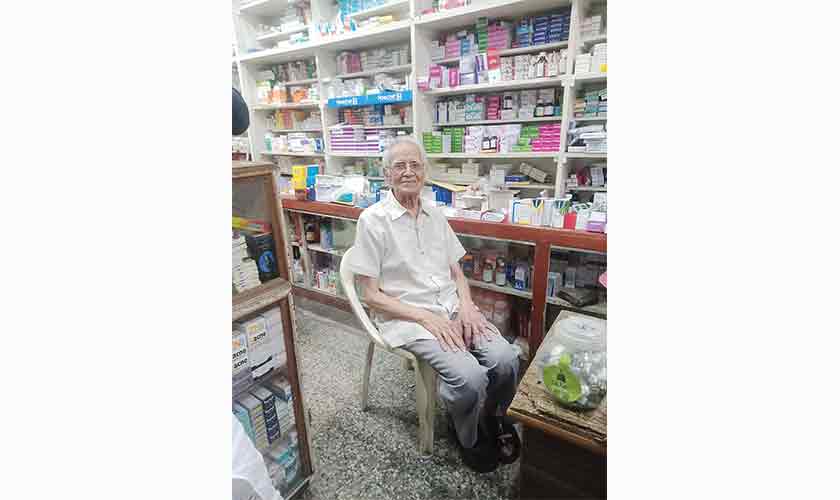
When I reached the Old Anarkali bazaar, I looked for a pharmacy to pick up medicine. Not far from Waris Tikka restaurant stood Prince Medical Hall. I went inside and asked for the desired meds. The shop was packed to capacity, leaving hardly standing room.
In the meantime, I heard a low, husky voice say, “Give him the other pill. That’s more effective for pain.”
I moved forward to see who had spoken. There sat a bespectacled Muhammad Yusuf sahib, dressed in a plain, sleeveless beige collared shirt and silvery-grey formal trousers, giving instructions to his subordinates from across his desk.
I greeted him to draw his attention, introduced myself, and asked, “May I sit with you for some time?”
He nodded, gently gesturing to his subordinate to arrange a chair for me. My interest was piqued the minute he mentioned he had set up the pharmacy some 75 years ago.
Muhammad Yusuf sahib was a thorough gentleman, his fine etiquette instantly apparent. He mirrored my language choice: responding in chaste Urdu if I asked a question in Urdu, and equally fluent in English. Over the course of our conversation, I learnt that he was a nonagenarian who had arrived in Lahore in 1950.
“When I opened this store, Anarkali Bazaar only had pharmacies and a couple of general stores,” he recalled. Back then, the bazaar ended at what we now know as the Tollinton Market, he added.
Customers kept coming and going and new details of Muhammad Yusuf Sahib’s life kept surfacing. He offered me a cup of tea, which I politely declined, as I had promised to join my friends at a café that evening.
He told me he had lived in Old Anarkali for the better part of his life. “We have a beautiful home not far from this store,” he said. “On my children’s insistence, we moved to a housing society about a decade ago.”
Muhammad Yusuf sahib hails from Kasur. He settled in Lahore the same year he set up his business. His father was a businessman with shares in flour and ginning mills. Unfortunately, both mills were destroyed in fires. Dejected and heartbroken, the family moved to Lahore. By that time, he was married and had built a house in the city for himself and his family.
As we discussed various aspects of Lahore, I asked if he would mind showing me his old place. “Why not,” he said, and sprang to his feet with amazing agility.
We shouldered our way out of the store and made for Street 9 in Old Anarkali. The street was called Gurdiyal Singh Street in pre-Partition days, he told me, and was part of Dhobi Mandi, which has now turned into one of the largest jewellery manufacturing markets in Lahore.
The streets in Dhobi Mandi were mysteriously wet. Perhaps they were still holding on to their legacy, I wondered, despite being inhabited by merchants rather than washermen.
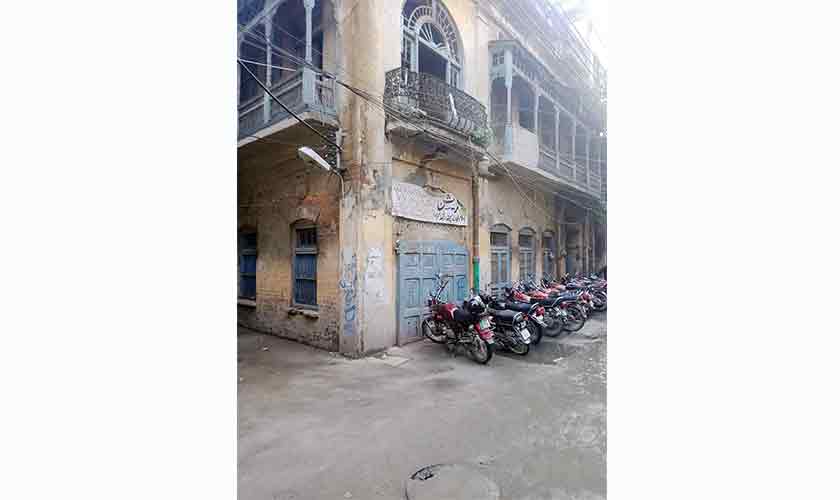
After a five-minute walk, we were standing in front of Muhammad Yusuf sahib’s iconic house.
There was a noticeable shift in his mood. At his age, most people can hardly move, yet he was out and about, eagerly showing me the façade with its intricately designed jharokas, wooden doors and windows, and the back end of the house. It was as though he was displaying his most prized and valuable possession.
“I want to spend the remaining years of my life here, in this house, in its rooms, and in these streets,” he said.
We stayed there for a few minutes before starting our walk back.
“My children got education thanks to my wife Waqar-un Nissa,” he said, placing his hand gently on my shoulder. “She is not with us any longer.” After a pause, he added, “If she were alive, it would have been much easier for me to persuade my children to continue living in our Anarkali home.”
Muhammad Yusuf sahib said he had studied up to matriculation, while his wife was a graduate in Islamic studies. “When my mother told me about her, I felt intimidated and wondered if I could spend my life with a girl far more educated than me. But my mother assured me that the girl was a perfect match for me.”
That he married her turned out to be the best decision of his life. He remains deeply grateful for the times they shared.
When we exchanged our final greetings, it was already Maghrib time. A few minutes later, the muezzin called the faithful to prayers. It really felt as though, in under two hours, I had lived another life.
I walked towards Gull Khan Tea Stall where my friends were waiting for me but in truth, a part of me was still wandering the streets of Old Anarkali.
Usama Malick is a storyteller with an MPhil in English