Print Story
X




The Hungarian novelist’s prose affirms the Nobel Committee’s faith in difficult, demanding writing
| S |
ceptics assume that the Swedish Academy relies on confidentiality to bolster its reputation. Fuelled by the spirit of secrecy, the Nobel Committee’s decisions are seldom the subject of transparent discussions and often attract baseless speculation. Be that as it may, guesswork wasn’t entirely off the mark in 2025.
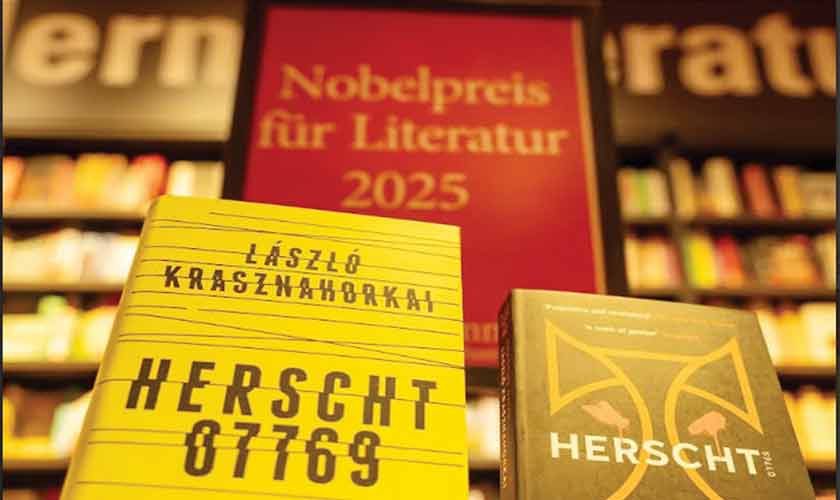
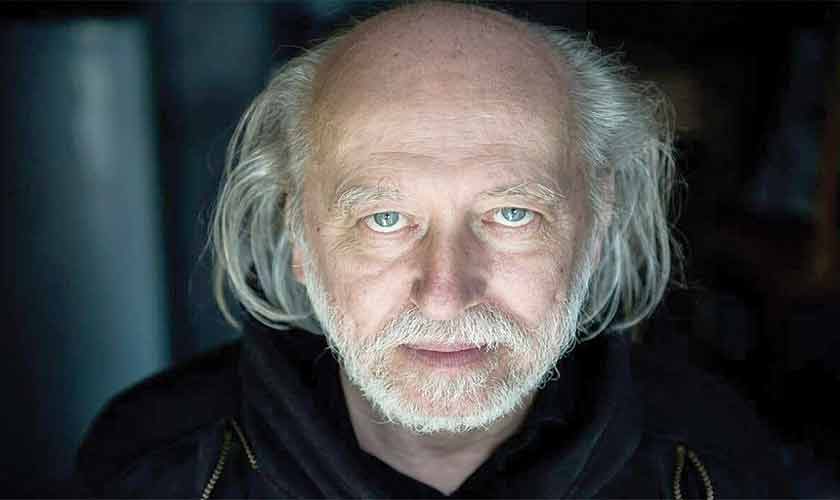
The Nobel Prize for Literature was clinched by Hungarian novelist and screenwriter László Krasznahorkai. For many years, the winds of conjecture have blown in the 71-year-old author’s favour. Krasznahorkai has been billed as a “perennial candidate for the Nobel Prize” by The Yale Review. In an insightful essay for Engelsberg Ideas, titled László Krasznahorkai’s universe, Jared Marcel Pollen argues that the Hungarian writer would have likely remained the Swedish Academy’s favoured choice even if he stopped writing after his first three novels. James Wood, who penned an incisive essay on the “difficult, peculiar, obsessive, visionary Hungarian author” for The New Yorker in 2011, wrote another glowing tribute for the magazine after Krasznahorkai’s Nobel win. “[I]t seems something straightforwardly just,” Wood states in his crisp, laudatory essay titled László Krasznahorkai and Contemporary Europe’s Perilous Reality, “like a well-deserved drink at the end of a day’s hard work.”
However, effusive praise often stands the danger of building a hype around false literary gods and should, therefore, be viewed with scepticism. The Swedish Academy’s choice must be appraised for both its optics and substantive merit.
At its core, the Nobel Committee’s decision to confer the prestigious prize on Krasznahorkai reflects its abiding support for non-Anglophone literary voices. Over the last four years, French, Norwegian and Korean writers have emerged as laureates. This is a counterpoint to earlier trends when nearly a third of the Nobel laureates in literature wrote in English. Incidentally, Krasznahorkai’s work did not appear in the language until 1998—almost 13 years after his debut novel was published in Hungarian. The Swedish Academy’s choice marks a triumph for the beguiling art of translation, which inevitably allows readers to access creative worlds without being encumbered by language barriers.
Some naive and optimistic observers might interpret this trend as a sign that the Nobel Committee could eventually choose a prospective laureate whose work bypasses the colonial legacy of the English language. Indeed, it would be a rare treat to witness translators undertaking the laborious task of rendering a book into English only after it has received the Nobel Prize.
Beyond linguistic considerations, we must also account for the political affinities of the Nobel laureates for literature. Some recipients of the prize have attracted censure for espousing problematic political values. Austrian writer Peter Handke, who was the Nobel Committee’s selection for the 2019 award, faced backlash for defending Serbian dictator Slobodan Milosevic’s actions during the Balkan wars in the 1990s. Handke also denied the genocide and war crimes orchestrated by the Serbs, especially the July 1995 massacre of 8,000 Muslims in Srebrenica.
At first glance, Krasznahorkai doesn’t seem to endorse questionable values. If recent interviews are to serve as a gauge, he is a vociferous critic of Prime Minister Viktor Orbán’s far-right policies, especially his government’s neutral stance on the war in Ukraine. Even so, this year’s Nobel laureate for literature isn’t entirely free of controversy. Hours after the Swedish Academy announced its decision, independent critic Anita Zsurzsan issued a statement on X, saying that Krasznahorkai’s views align closely with Orbán’s xenophobic attitudes. In a separate post, Zsurzsan argued that the Nobel laureate also purportedly harbours anti-Arab sentiments.
If we regard Krasznahorkai’s controversial and unsubstantiated opinions as mere speculation, it becomes difficult to deny the literary merit of his work. The Hungarian novelist has been awarded the Nobel Prize for Literature for his “compelling and visionary oeuvre,” which reaffirms the power of art amid the fractured realities of a near-apocalyptic world. Krasznahorkai is an unusual choice as his prose defies the stereotypical mould of accessible writing that the Nobel Committee has previously lauded. Touted as a literary heir to Samuel Beckett and Franz Kafka, Krasznahorkai has penned experimental works that are intricate and intellectually intrepid. Laced with existential dread, his oeuvre stands out for fusing “absurdism and grotesque excess.”
In László Krasznahorkai’s European nightmares, critic Catherine Taylor states that the author’s early novels — Sátántangó (1985) and The Melancholy of Resistance (1989) — are rooted in the traumas associated with Hungary’s communist past. Sátántangó, which was adapted into a seven-hour film, features an enigmatic stranger who infiltrates a Hungarian farm collective and masquerades as a well-meaning saviour. In Melancholy, a travelling circus exhibits the carcass of a whale — a surrealistic allegory on the collapse of a long-standing social order. An archivist who discovers eternal truth in a manuscript finds himself at the heart of War and War (1999). Krasznahorkai’s protagonist travels to New York in a relentless effort to immortalise the text in cyberspace.
The Hungarian novelist evokes a milieu that is inextricably linked to the Eastern Europe, even when his stories are set in Germany, Croatia and America — locales where he has fashioned homes. His travels to Japan and China have also enriched the scope of his creative vision. In its bibliographical note, the Nobel Committee states that Krasznahorkai “looks to the East in adopting a more contemplative, finely calibrated tone.” Set in Kyoto, A Mountain to the North, a Lake to the South, Paths to the West, a River to the East (2003) explores a wanderer’s quest for a garden that he sees “in his mind’s eye without being able to touch its existence.” This text is a prelude of sorts to Seiobo There Below (2008), an accomplished collection of stories featuring a Japanese myth that offers a moving meditation on the complex process of producing art.
Krasznahorkai’s oeuvre examines the crippling effects of political oppression, social disintegration and authoritarianism — universal themes that inevitably take on a localised flavour in various political contexts. In Herscht 07769, the titular protagonist initiates a one-sided correspondence with Chancellor Angela Merkel to warn her of the complete annihilation of all physical matter. The 400-page novel comprises a single, breathless and labyrinthine sentence — a glowing testament to Krasznahorkai’s literary craftsmanship and sagacity. As the apocalyptic realities of our world threaten to decimate us, the full stop acquires a futility of its own. The punctuation mark bears the imprint of something godlike — a privilege that mere mortals cannot appreciate amid the chaos we must negotiate every day.
Krasznahorkai’s win serves as welcome proof that the award continues to prioritise serious literature in an inherently digital age where seeking popular approval is a perennial pastime. Even so, the Nobel Committee has succumbed to the trap of alternating between male and female laureates. Cynics believe this is a cosmetic move to secure a gender balance, possibly aimed at preventing another wave of sexual harassment and corruption allegations, which led to the cancellation of the prize in 2018. The Swedish Academy should refrain from being steered by such impulses, as it can easily select women laureates two years in a row without facing any major obstacles.
The writer is a freelance journalist and the author of No Funeral for Nazia