

Print Story
X




Julia Roberts and Andrew Garfield’s messy, topical drama stumbles in Tár’s long shadow
Starring: Julia Roberts, Andrew Garfield, Michael Stuhlbarg
and Ayo Edebiri
Directed by: Luca Guadagnino
| A |
lmost immediately into After the Hunt, you can tell that director Luca Guadagnino took inspiration from Woody Allen, even in the fonts used in the title cards. It’s obviously a deliberate choice from Guadagnino, toying with the numerous accusations that have been levied upon Allen, but it’s also letting the audience know that it is not presenting its subject matter as just a black-and-white issue. Similarly to how Todd Field’s Tár dissected the downfall of its esteemed and established title character, After the Hunt doesn’t want the audience to root for or against its embattled central character; it wants you to just be a fly on the wall.
Guadagnino may have become a more mainstream filmmaker, especially after the release of Challengers last year, but it’s important to remember that he’s always been one to toy with the lines of morality. Call Me By Your Name focused on a steamy romance between a 17-year-old and a 24-year-old, while Bones & All had its two attractive stars as cannibals being stalked by a predatory older man. Yes, After the Hunt may star your mom’s favorite movie star, Julia Roberts, in one of her juiciest roles in a decade, but her character, Alma Olsson, is a far cry from Erin Brockovich, or really any role that she’s played before. Much like its characters, After the Hunt is a messy movie, maybe even intentionally so, and as flawed as the movie is, it is memorable.
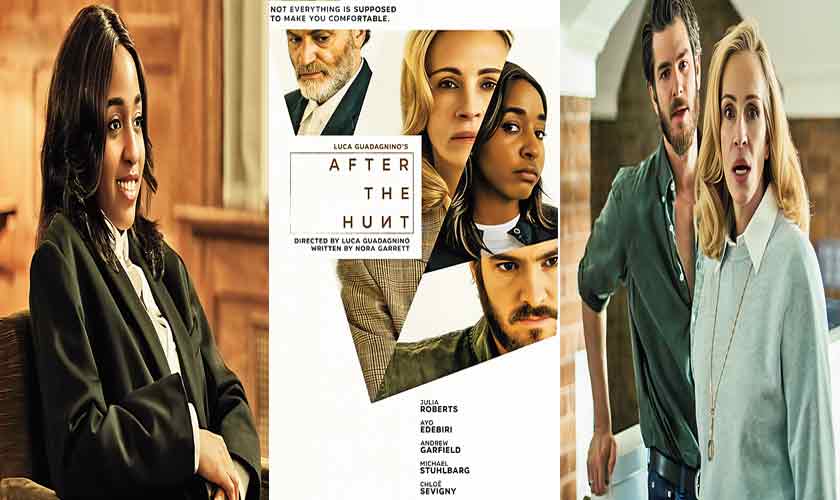
Alma Imhoff is a highly respected philosophy professor at Yale University who puts her career ahead of everything else. She’s also a very emotionally closed-off person, with plenty of buried secrets, which is very ironic, since she’s married to a psychiatrist (Michael Stuhlbarg). Alma is now in the running to become a tenured professor, with her sole competition being her close friend, Hank Gibson (Andrew Garfield). As the film unfolds, we learn that Alma is the kind of professor who plays favourites with her students. She thrives off of having a student wanting to be her. It fuels her ego and further hides her insecurities. At this point, her protégée is Maggie Resnick (Ayo Edebiri), the extremely liberal and socially conscious daughter of a billionaire couple who have given a lot of money to the university.
After attending a party hosted at Alma’s glamorous apartment, a very inebriated Hank offers to walk Maggie back to her apartment, where we learn that her trans romantic partner, Alex (Lío Mehiel), is away. The next day, Alma is concerned when Maggie doesn’t show up to class, and upon returning home, finds her waiting outside. Maggie confides in Alma that Hank “crossed a line” and sexually assaulted her, and is looking for counsel. Alma questions Maggie, unsure of how to feel, causing the young woman to storm off. Alma meets up with Hank the next day to confront him about the encounter, but he tells her that he confronted her after learning that she plagiarised her thesis, and she made up the story to get out of trouble.
As a result of all of this, Hank is fired from his position, causing Alma to be caught in the midst of a moral crisis. Not only does she not know whose side of the story to believe, but her own dark secrets from her past begin to re-emerge, further complicating things.
First-time screenwriter Nora Garrett is intent on making sure the audience understands the metaphors within After the Hunt, which ultimately makes the movie less believable as a whole. The film is constantly throwing out themes of being in positions of power and generational differences, but it never dives fully into them, complete with dialogue that is extremely on-the-nose. The metaphors are basic and muddled, merely presenting certain ideas before moving on without a second thought. The movie is trying to be real, from Alma constantly misgendering Maggie’s partner to Hank initially acting like the accusations are no big deal, but the characters talk with far too many metaphors, even if they are experts in philosophy. It’s as if it is desperately trying to be the Tár of academia, but it forgets what made that movie work so well.
Nearly every single character in After the Hunt is designed to get under the audience’s skin, which the movie does prove to be effective at. Trent Reznor and Atticus Ross’ score does more to put the audience on edge than Guadagnino’s direction or Garrett’s writing. Edebiri’s Maggie isn’t portrayed as someone who is without flaws. In fact, she’s nearly as unlikable as Garfield’s Hank. We see her stealing from Alma, and we hear her lying on numerous occasions, which helps create an even more uncomfortable atmosphere. Every single character exists in the grey, and while it is an admirable effort, it culminates in an ending that leaves you unfulfilled.
It‘s not that After the Hunt is unremarkable; it does keep your attention long after the credits roll, but the questions it raises aren’t just about what really happened, but also the numerous plot holes scattered throughout the film. Ultimately, After the Hunt is like a collection of ideas and thoughts that Guadagnino and Garrett presented not to discuss within the movie, but to just poke and prod at you, kind of like what the characters do to each other within the film.
It’s not controversial to say that Roberts hasn’t had the greatest run of movies in the past two decades. She’s always been a terrific actress, but the roles she was choosing, with a few exceptions, just never felt challenging or all that compelling, at least on the big screen. When you first hear that Roberts stars in a film that takes clear influences from Tár, you might expect a more showy and abrasive performance from her. Instead, Roberts is surprisingly restrained, which makes her character rawer, despite the clunky screenplay. It’s Garfield who gets the louder performance, despite having far less screentime. From screaming in the hallways to just meeting up with Roberts at the bar, Garfield makes Hank volatile. Both Roberts and Garfield weaponise what the audience would typically expect from them and use it to their advantage, which makes their characters all the more captivating.
Stuhlbarg is amusing as Alma’s husband, and helps deliver some of the film’s few humorous moments, including a bit that sees him repeatedly walking in and out of the kitchen as Alma and Maggie have an important conversation. He’s also one of the few characters who has a bit more of a moral compass than everyone else. Sure, he might seem like a bit of a snob at times, but there’s charm to him. Edebiri isn’t nearly as effective as her co-stars, but it’s not fully her fault. Her character is supposed to be prickly and high-strung, but she never once seems human. While Roberts and Garfield are given more layered characters, Edebiri’s Maggie is one-note. The film tries to explore her connection to Roberts, including speculating whether or not she is attracted to Alma, but it never commits fully.
After the Hunt has a rich premise that could have led to a film that basks in moral complexities and conversation, and while the movie does give us a lot to digest, it also fails to fully commit to the kind of story it wants to be. It presents you with themes using big fancy words, only to move on minutes later. It features terrific performances from Roberts and Garfield, but even they are not enough to save the film from being too muddled and morally ambiguous for its own good.
– Courtesy: Collider.com