Print Story
X




The case for STEM and digital education in Pakistan
| P |
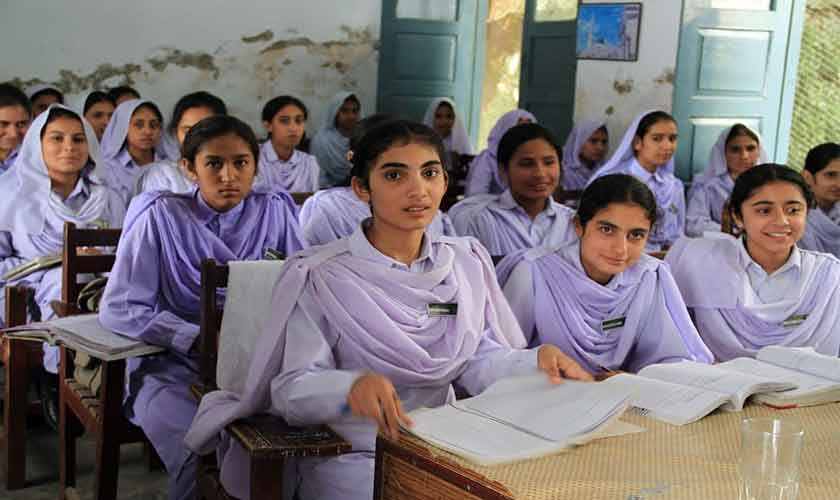
icture a 12-year-old girl in Pakistan who dreams of building bridges to connect her community to the world — but whose village has no secondary school for girls. Too often, such dreams are extinguished long before they can ignite. Pakistan has the world’s second-highest number of out-of-school children — 22.8 million between the ages of 5 and 16, a majority of them are girls. When girls are left behind in education, especially in science, technology, engineering and mathematics (STEM), the whole nation loses potential innovators, doctors and entrepreneurs who could help shape a stronger, more resilient future.
The good news is that Pakistan has started taking important steps forward. The prime minister’s declaration of an education emergency earlier this year signals a recognition that education must be placed at the heart of our national priorities. The Punjab chief minister has launched initiatives on foundational learning. Other provinces are developing their own policies to strengthen equitable education. All four provinces now have early childhood education policies, alongside a federal education and ECE policy that helps align implementation with national planning and management. These are encouraging signs of political will and create the momentum needed to address the learning crisis and invest in skills for the future.
The British Council, too, has decided to contribute by sharing global expertise and supporting solutions that enable Pakistan’s young women and girls not only to enter classrooms but also to thrive in digital and STEM fields.
The case for this investment is both moral and economic. Education is every girl’s right and denying it limits their choices and silences their voices. But equally, it is a smart economic decision. Countries with higher female participation in STEM and digital industries are more competitive and innovative. Currently, fewer than one in four women in South Asia participate in the formal workforce. Even fewer are in high-paying STEM careers. Pakistan cannot afford to perpetuate that imbalance if it hopes to prosper in the digital age.
Evidence from around the world shows that when governments invest in girls’ education — particularly in science and technology — the returns are transformative. Educated girls earn more and contribute to healthier families and communities. When they work in STEM fields, they not only secure better futures for themselves but also help drive innovation that benefits entire economies.
There are already strong examples within Pakistan. The British Council’s English and Digital for Girls’ Education programme creates safe community-based clubs where adolescent girls from marginalised areas gain digital skills and English proficiency. Over 25,000 girls across South Asia, including Pakistan, have benefited. Many participants who did not have computer proficiency before can now use the internet and productivity tools, and they leave the programme more confident and ready to use technology for earning income sitting at home.
Evidence from around the world shows that when governments invest in girls’ education — particularly in science and technology — the returns are transformative. Educated girls earn more and contribute to healthier families and communities. When they work in STEM fields, they not only secure better futures for themselves but also help drive innovation that benefits entire economies.
At the tertiary level, initiatives like the British Council’s Women in STEM scholarship scheme are giving young women the chance to pursue advanced degrees at world-class universities. Since 2020, over 300 women globally have been supported, including Pakistanis who return with new expertise to apply in their communities. Through the Scotland-Pakistan Scholarships for Young Women and Girls, about 15 per cent of awards have gone to STEM students, with interest in these fields rising annually. These alumni are living proof that given the chance, Pakistani women excel as scientists, engineers and technology leaders.
They have also partnered with the EU and GIZ on high-tech digital skills projects through the TVET Sector Support Programme. This work is helping thousands of women and girls in Balochistan, Khyber Pakhtunkhwa and Gilgit-Baltistan gain access to industry relevant training and employment opportunities. Importantly, these efforts build on — and complement — government policies and provincial strategies.
Moving forward, policy and practice must go hand in hand. That means ensuring every new school is built with facilities for girls, every curriculum reform addresses gender bias and every teacher is trained to create inclusive classrooms. It also means scaling up what already works: expanding successful pilot projects nationally, strengthening scholarship pathways and continuing to invest in partnerships that link government, private sector and civil society.
One significant way to enhance the interests of female students in STEM subjects is to introduce enquiry-based learning in early years of education. In addition to that we must develop community engagement programmes with the communities and provide counselling to parents and students so that the students are able to make choices without compromising.
Provincial governments are also taking innovative steps to expand access. In the Punjab, over 14,000 schools have been brought under the school outsourcing initiative. In Khyber Pakhtunkhwa, more than 1,400 schools are operating through public–private partnerships. In Sindh, the Education Foundation and the School Education and Literacy Department are developing frameworks under the PPP law to integrate out-of-school children and improve literacy rates.
None of this will happen overnight, but the momentum is building. With political will, strong partnerships, and continued investment, Pakistan can unlock the potential of millions of girls who stand ready to lead in STEM and digital fields.
The writer is the Head of Education, British Council, Pakistan