Print Story
X




The Punjab is adding to its arsenal for the fight against smog
| T |
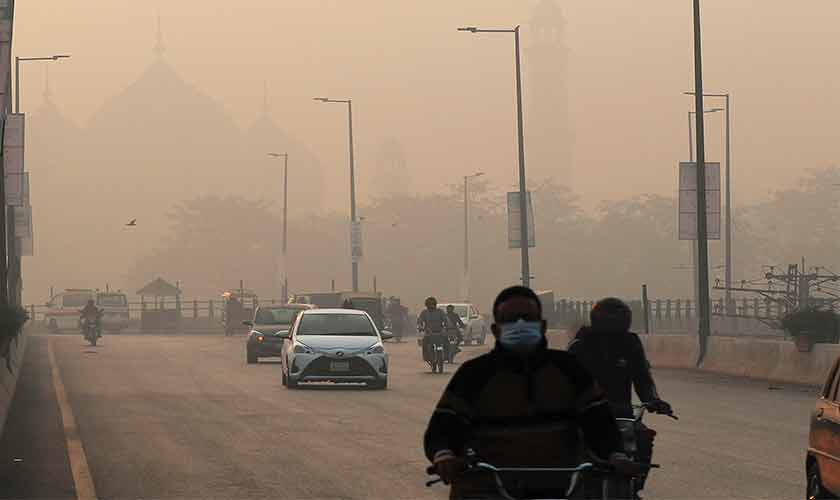
he month of October signals the arrival of the dreaded smog season in Lahore. That’s been the case for almost a decade now. For government agencies such as the Environment Protection Department, it brings harsh criticism from urban planners and the civil society, who blame the smog on government policies.
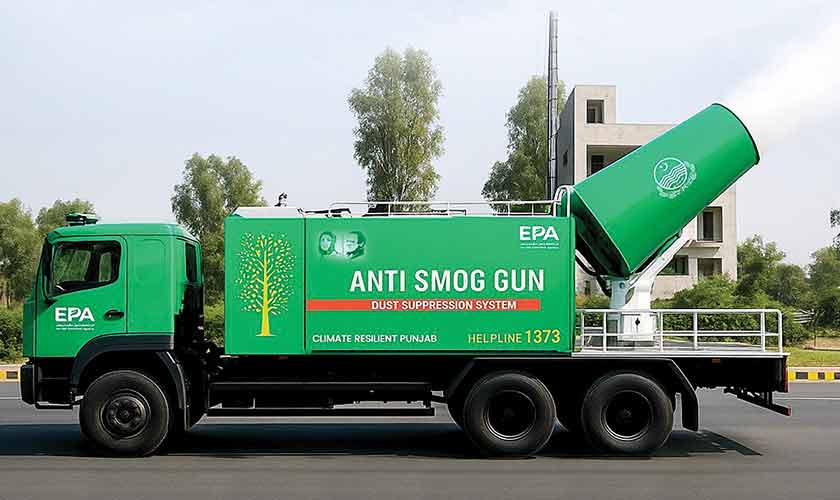
Early this year, the Punjab government geared up its pre-smog drive. This included mandating obtaining a green certificate for motor vehicles. Last week, it launched what is being termed as “Pakistan’s first-ever fog cannon fleet” to fight smog and improve air quality. The ultra-fine mist spray technology is expected to reduce air pollution levels by settling the harmful PM 2.5 and PM 10 particles. The fog cannons will be employed in smog-prone areas.
Ali Ijaz, an assistant director at the EPD, calls it an ambitious, technology-driven plan that rests on “five pillars, each designed to tackle a specific dimension of Punjab’s environmental crisis: technological interventions, enforcement, awareness, collaborations and carbon sinks.”
He mentions installation of liquid trees that use microalgae in a bio-reactor to absorb carbon dioxide and act as an air purifier in urban spaces.
Drone surveillance will monitor industrial emissions, stubble burning and other pollution sources in real-time. The Urban Real-time Observation System will collect air quality data across the province.
Silwat Saeed, the EPD secretary, highlights the AQI Predictive Model being developed “to forecast pollution trends and an advanced planning support system to guide policy interventions based on scientific data.”
Further, public interaction platforms, including social media, the Green Punjab app and the 1373 helpline, are being integrated to allow citizens to report violations, lodge complaints and access air quality updates.
Saeed says aggressive enforcement is the “second pillar” of the project which focuses on strict actions to ensure compliance across all sectors.
| T |
The EPD is taking legal action against polluting industries, brick kilns and pyro units, while monitoring construction sites, transport emissions and agricultural burning.
The authorities are intensifying a crackdown on fugitive dust from construction sites and unpaved roads. Fuel quality testing drives have already begun — out of 158 fuel stations checked so far, 19 percent failed the quality test and were fined.
The provincial government has also launched a campaign to check the widespread use of non-biodegradable materials that worsen air and land pollution.
Public awareness raising campaigns have expanded through the I’m4Climate Initiative, stakeholder engagement sessions and targeted communication campaigns. Regular advisories on air quality and precautionary measures will be issued to the public during the smog season.
Public interaction platforms, including social media, the Green Punjab app and the 1373 helpline, are being integrated to allow citizens to report violations, lodge complaints and access air quality updates.
Schools are being brought into the loop through programmes such as Green School Certification and Waste-Wise School, which promote waste segregation, tree plantation and clean campus drives.
In all its initiatives, the EPD has partnered with major institutions for technical and operational support, including the Punjab Safe City Authority, the Pakistan Meteorological Department, SUPARCO, IQAir and the Chinese Research Academy of Environmental Sciences. Universities across the Punjab are also being engaged to support scientific research and innovation.
| T |
To offset carbon emissions, the Punjab aims to create new carbon sinks by connecting major carbon hotspots with plantation zones. Industries are being encouraged to contribute to afforestation drives under a dedicated programme. This initiative is expected to both absorb carbon dioxide and enhance the province’s green cover, making the Punjab more resilient to climate challenges.
Saeed says the year 2025 will mark a major step forward in the institutional strengthening of the Environment Protection Agency. A series of digital and structural measures have been rolled out since January, to improve monitoring and enforcement capacity.
A highlight of the 2025 plan is the Central Smart Surveillance System, featuring over 8,500 CCTV cameras that will monitor industries, incinerators, car wash stations and dust hotspots.
The live feed is transmitted to the EPA headquarters and analysed using artificial intelligence to detect smoke. Violators are automatically reported to the Smart Enforcement Units at tehsil level.
This system ensures “inspector-less inspection,” a critical step in minimising corruption and human error in enforcement.
Another major digital intervention is the Eco-Watch App for digital inspections of industries and brick kilns. The app ensures thorough analysis and minimises malpractice by using unique facility IDs, GPS tagging of actions and maintaining transparent, verifiable records.
As regards the vehicle emission testing, an agreement with the PSCA enables the issuance of digital direction slips to track and penalise non-compliant vehicles. Vehicles failing to meet standards risk fines, impoundment and possible route permit cancellations.
Three mobile fuel testing stations are already operational. Two more are in the pipeline.
Ahsan Raza is the editor of Minute Mirror. He can be reached at ahsanbudh@hotmail.com