Print Story
X




After an AAC protest was dispersed near the National Press Club, police entered the club and beat up media workers
| T |
here was an alarming situation at the National Press Club after the police dispersed protestors aligned with the Jammu Kashmir Joint Action Committee, a coalition of traders, grassroots activists and civil groups demanding an end to elite privilege, free education, healthcare, infrastructure development and structural changes to the parliament.
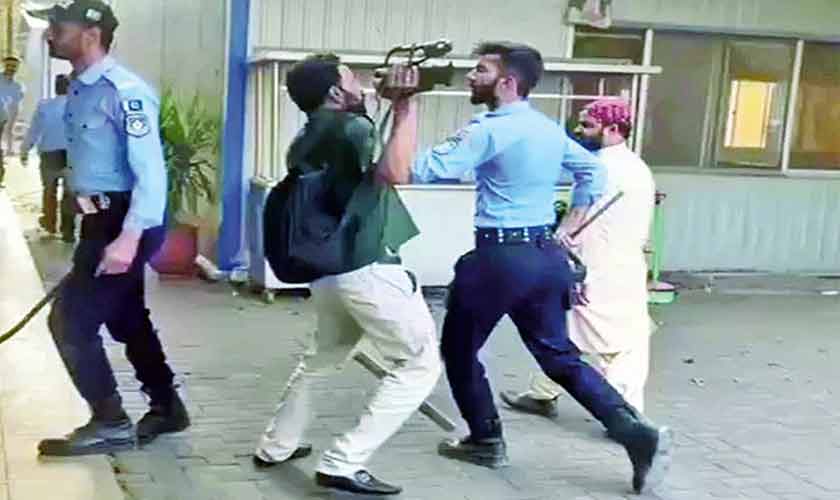
On October 2, several policemen wielding batons, stormed the club. They claimed that they were chasing after fleeing protestors who had “sought refuge at the press club.”
The policemen beat up those sitting in the cafeteria. The club members who tried to stop the cops and demanded an explanation were also attacked. Some of them were dragged out of the cafeteria. Some journalists later claimed that their equipment was snatched and broken.
Many Islamabad journalists have said the episode was one of the worst of its kind.
The footage captured by some journalists, which went viral on social media, showed about a dozen furious policemen enter the press club and ruthlessly beat anybody who tried to stop them or document their actions.
“The police entered the premises by mistake. They were chasing some protestors who ran into the building,” Minister of State for Interior Talal Chaudhry told some media workers after the episode. He also apologised for the incident. The press club admisnitration did not lodge a formal complaint with the police.
The Pakistan Federal Union of Journalists called a nationwide Black Day protest against the police violence. A joint action committee formed by the NPC and the PFUJ presented a charter of demands to the Ministry of Interior last week urging the government to take action taken against those responsible for violating the “sanctity of the press club and the constitutional right to freedom of expression and for protection given to journalists across Pakistan.” It also demanded an urgent inquiry into the matter.
The demands included formal, institutional protection for press clubs. It was argued that Pakistan’s constitution, like that of most countries, guarantees freedom of the press and freedom of expression.
The charter said that to prevent such incidents in the future a committee should be formed under the chairmanship of the interior minister. It proposed that the ministers of information in the four provinces, Azad Jammu and Kashmir and Gilgit-Baltistan; the information secretaries; and the presidents of press clubs in the federal and provincial capitals be included in the committee.
The JAC presentation followed widespread condemnation across the country over the police raid.
“The press club is regarded as a place that enshrines the freedom of expression.”
Some journalists also criticised the current leaders of the union and the club, accusing them of showing weakness in protecting the freedom of expression. Some of them recalled that in the past, the club has cancelled scheduled programmes under alleged pressure from the district administration, certain religious groups and other agencies.
There have been instances of scheduled events to raise a voice against alleged human rights abuses, misuse of blasphemy laws and exploitation by powerful groups being cancelled. A press conference by the Ex-servicemen Society was also disallowed over its criticism of the incumbent military leadership.
Journalist Matiullah Jan condemned police brutality at the NPC. He said the press club was a place that enshrined the freedom of expression. He said that the government must not only form a commission but also take serious action against the growing incidents of assaults against journalists.
“Everybody, from the government and the administration to the media leadership is trying to hush up the matter at the moment, it appears,” he said.
“…then there’s the union and office bearers of the club trying to benefit from this event rather taking stern and concrete measures,” said another member of the club.
“See, their response has been so weak. I feel that the union has not been firm in its stance either. In addition to demanding action against the policemen, the union should have lodged a formal complaint against them,” he said.
PFUJ leaders and the NPC declined comment.
Press clubs exist in most cities of the country. These have been traditionally considered safe spaces for most media workers. They are also social centres for media persons, including reporters, press staff, editors and photojournalists.
The press clubs are important for non-journalists, too. Civil society members, aggrieved citizens and demonstrators visit the press club to be heard and share their grievances and demands. In this way, there is always information being shared between the journalists, the protestors and the common people.
The space next to the press clubs is where protestors often march, stand in silent protest or hold sit-ins. It is where there are always many press workers. The press club hold a political significance; it is where many people come to demand justice.
Before this incident, the National Press Clubs had been considered safe. On some occasions officials from security agencies were known to have avoided breaking such protests.
The author is a staff reporter. He can be reached at vaqargillani@gmail.com