

Print Story
X




What is good and what needs to improve about the newly-launched electric bus service
| M |
uhammad Talha, a resident of Pensra, 32 kilometres northwest of Faisalabad, and an employee of the Agriculture Department, has witnessed a remarkable change in his daily commute.
“Until last week, I used to spend around Rs 300 a day traveling to and from work,” he says. “But ever since I started using the Punjab government’s new electric bus service, my daily travel cost has dropped to just Rs 100,” he says.
“Earlier, I used to take a coaster from Pensra to Chenab Club for Rs 100; then ride a motorcycle rickshaw to my office for another Rs 50. Now, I pay Rs 20 to reach the bypass by bus and Rs 30 for the rickshaw ride home. Big relief.”
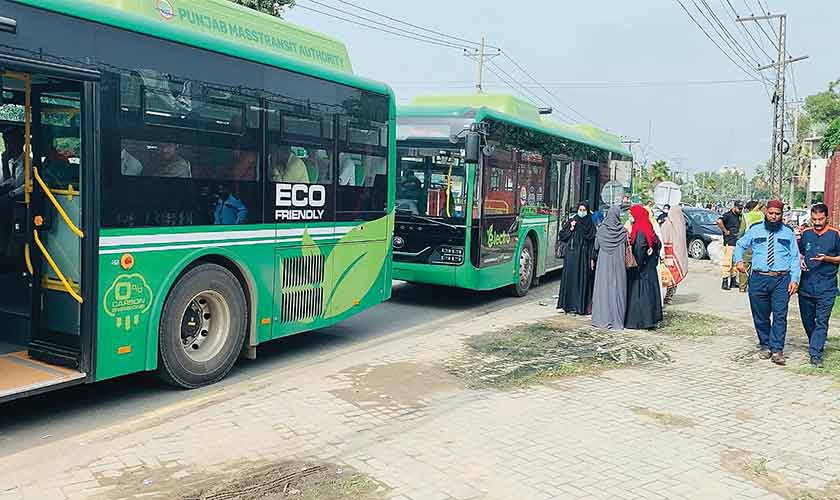
After nearly 27 years, Faisalabad has finally seen the beginning of a modern, affordable public transport system. The government has launched 30 state-of-the-art, eco-friendly, air-conditioned electric buses equipped with Wi-Fi. These buses feature wheelchair access and special seating for senior citizens and persons with disabilities. CCTV cameras have been installed to ensure safety during travel. Travel is free for women, students, senior citizens and persons with disabilities. Other passengers pay Rs 20 per trip.
The service is planned on seven major routes. However, for now buses operate only on Jhang Road and Samundri Road. The routes along Canal Road, Sargodha Road, Satyana Road, Millat Road and Jaranwala Road have yet to be activated.
Among the biggest beneficiaries of this initiative are university students. Ali Raza, a student at Government College University’s Environmental Sciences Department, says the new buses have made commuting easier and cheaper.
“Previously, I relied on motorcycle rickshaws or bikes that were costly and inconvenient. Not only is this bus service budget-friendly, it is also environment friendly since it produces zero emissions. This is a truly commendable initiative.”
Ali says that the electric buses will help reduce traffic congestion, noise and air pollution by lowering the number of motorcycles and rickshaws on the roads. “I save money on petrol, avoid the traffic mess and use the free Wi-Fi on board,” he says.
He suggests that the government increase the number of buses and ensure that the number of passengers does not exceed capacity. “Faisalabad is a big city — 30 buses are not enough. For this service to remain sustainable, the system must ensure safe and disciplined travel,” he adds.
The service has made commuting easier for female students, too. However, many say they are not entirely satisfied.
Standing at the University of Agriculture bus stop, Saira Amin, a working woman, shares her experience: “Traveling by the electric bus is convenient, but the staff sometimes exhibits unprofessional behaviour. The early shift drivers leave at around 2 pm, but the replacements usually arrives by 2:30. Yesterday, I waited for half an hour and had to leave without the bus moving. Today, it’s been 20 minutes already, and there’s still no sign of the driver.”
Saira, who previously relied on an auto-rickshaw costing her Rs 10,000 per month, says she now prefers the electric bus due to the free travel facility.
A university student, Areeba Usman, says the bus service is good overall but punctuality remains an issue. “The buses are rarely on time. They are often crowded, so that most of the time I have to travel standing,” she says.
The government has launched 30 state-of-the-art, eco-friendly, air-conditioned electric buses equipped with Wi-Fi. These buses feature wheelchair access and special seating for senior citizens and persons with disabilities. CCTV cameras have been installed to ensure women’s safety during travel. Travel is free for women, students, senior citizens and persons with disabilities. Other passengers pay Rs 20 per trip.
Areeba wants Chief Minister Maryam Nawaz to introduce dedicated buses for women and students during peak hours. “Transportation is one of our biggest challenges. Traveling in motorcycle rickshaws is unsafe and most girls can’t afford private auto-rickshaws. Many of my friends have had to give up their education because of these difficulties,” she adds.
Although the electric bus service is still new, social media reports suggest that several buses have already been grounded following accidents. Concerns have also been raised that some of the drivers may have been hired without transparent testing or certification and that most have no prior experience of driving electric buses.
Journalist Hammad Ahmad of Geo News says the service was apparently launched without adequate preparation.
“Most buses are operating without a proper schedule. Sometimes passengers have to wait for hours. On other occasions, one sees four or five buses standing idle,” he says.
Hammad says some of the basic facilities, including sheds and workshops, are missing at the Ghulam Muhammadabad depot, built for charging and maintenance.
“Drivers and other staff complain about a lack of drinking water, food and accommodation. The frequent accidents are largely attributable to traffic congestion, violations of traffic rules and encroachments on the city roads,” he says.
Asif Ali, one of the drivers, agrees.
“These buses are large. Most of Faisalabad’s roads are congested. Rickshaws, carts, cars and motorcyclists don’t yield way to the buses,” he says.
Asif says while there have been a few minor incidents, none has been serious enough to force a vehicle out of service.
“We urge all road users to give buses way and avoid brushing against them. Many rickshaw drivers seem intent on scraping the buses. I appeal to the government to take action against such behaviour,” he adds.
Some motorcycle rickshaw drivers says they are concerned that the introduction of electric buses will threaten their livelihoods. For nearly 27 years, Faisalabad has lacked proper public transport, resulting in 15,000 to 20,000 motorcycle rickshaws operating across the city.
Mian Ijaz Hussain, president of the Pasban Rickshaw and Taxi Drivers’ Union, says that while he supports quality public transport for citizens, the government must also consider the impact on existing workers.
“There should be every kind of public transport in the city. Let citizens decide how they wish to travel,” he says. “The government should also think about rickshaw drivers who have been serving the public for years. If their livelihoods are affected, they deserve alternative employment opportunities.”
Muhammad Rashad, secretary of the Regional Transport Authority, rejects reports that some of the buses had been grounded due to accidents. “All buses are operational. More than 16,000 passengers use them daily. Nearly 40 per cent of the passengers who previously relied on rickshaws or vans have shifted to the new bus service,” he states.
Rashad says that the number of buses will soon be increased from 30 to 90. He says 357 bus stops will be established along seven routes in a 120-kilometer radius.
“Construction of bus stops will begin within the next week or two. More routes will become operational as buses arrive,” he says.
Asked about alternative employment for rickshaw drivers affected by the project, he says the matters falls under the Punjab Transport Company.
The writer has been associated with journalism for the past decade. He tweets @naeemahmad876