Print Story
X

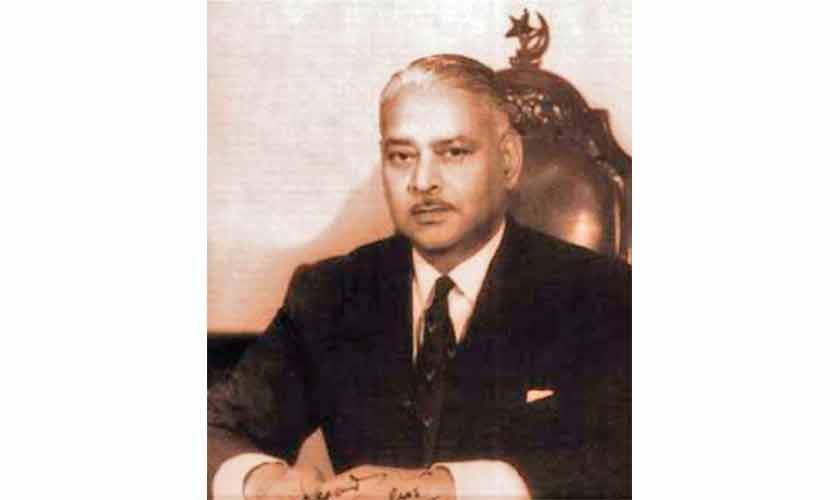
Of the fifty seven countries that have a Muslim majority only one has had a non-Muslim as the head of its judicial system. Justice Alvin Robert Cornelius was born in Agra, then part of the United Provinces of India, on 1st May, 1903. He was the eldest son of Israel Jacob Cornelius, a Professor of mathematics at Holkar College, located in the princely state of Indore (now part of Madhya Pradesh). The Cornelius Prize in Mathematics, set up in his memory, is still awarded annually by this college to its most outstanding student in the subject.
Justice Cornelius had an interesting ancestry. His father’s family were originally Hindus with the family name of Kait Pillay. They were landlords who had initially rendered military service to the East India Company (EIC) in Madras, and then to the British government after it had taken direct control of affairs following the EIC’s decline. Following the British annexation of Burma (now called Myanmar) in 1885, a member of the clan, Perayya Kait Pillay (1837-1907), who had fought in Burma, settled in the Central Provinces. He became a school teacher and converted to Christianity, adopting the surname Cornelius, the name of a Roman centurion who is mentioned in the Acts of the Apostles and who himself had been one of the early converts to the Christian faith. AR Cornelius’ father Israel Jacob Cornelius (1878-1935) was Perraya’s son and a devout practising Christian. Justice Cornelius’ mother was called Tara D’Rozario (1879-1966) and his maternal grandfather Michael D’Rozario (1845-1915) was a civil servant who held the post of Deputy Range Officer, Forests, in Central India. Like the Kait Pillays, the D’Rozarios were also Christian converts from Hinduism.
Justice Cornelius was raised as a Presbyterian but became a Roman Catholic after his marriage to Ione Francis in 1931. Like her husband, Ione, too, had an interesting ancestry. Both her grandfathers and her father were converts. Her paternal grandfather Said Shah Safi (1835-1904) was a Pathan who worked in the Foreign and Political Services department of the Government of India. Her father was Khushal Khan Safi (1875-1937), who took the Christian name Leo Francis after conversion. Her maternal grandfather was a Persian-Punjabi, Miran Baksh Utarid (1856-1939). He took the Christian name Marcus Benedict Utarid after entering the Christian faith. Utarid was a civil surgeon in the Punjab Medical Service as was Leo Francis.
Justice Cornelius initially studied at St. John’s College, an Anglican institution, in Agra. He then moved to Muir College, which was a part of Allahabad University, and graduated from there in 1924 with degrees in Mathematics and Civil Law. He was a brilliant student and ranked first in his class, winning a bevy of awards including the Homersham Cox gold medal for mathematics.
He next appeared for the Indian Civil Services (ICS) competitive examination and upon passing it was sent as a probationer for a two-year study period at Selwyn College of Cambridge University, from where he obtained his LLM degree. On his return to India in 1926, he began active employment in the ICS and was posted to Ambala district in Punjab.
In 1930, he was appointed to the judicial branch of the ICS with the rank of an assistant commissioner and served as a district and sessions judge in various districts of the Punjab including Amritsar, Jalandhar and Lahore. He was elevated to the bench of the Lahore High Court in 1946.
At the time of the partition of the subcontinent, he was one of the 158 Indian Civil Service (ICS) and Indian Police Service (IPS) officers who opted for Pakistan. He was one of only two non-British Christian ICS officers to do so, the other being SM Burke. His first assignment in his new homeland was to draft laws governing evacuee property, refugees and their rehabilitation. In April 1950, while still serving in the Lahore High Court, he was appointed as Secretary of the Ministry of Law and Labour which was headed by Jogendra Nath Mandal. In this position he played a crucial role in setting up a proper court system for the country and providing sound legal advice to both the law minister and the prime minister. He retained this portfolio till May 31, 1951, and was subsequently elevated to the Federal Court of Pakistan (later, the Supreme Court of Pakistan) in November 1951, where he eventually served as chief justice from 1960 to 1968. Following his retirement as CJP he was also inducted by Yahya Khan into the cabinet as the Minister of Law, a post he held until the dissolution of the cabinet on 16th December, 1971.
Justice Cornelius had a multi-faceted personality. He left an indelible mark as a jurist through many principled decisions even when heavily outnumbered and under pressure, with his dissenting note in the famous Maulvi Tamizuddin Khan case being his best remembered display of judicial courage.
He also played a key role in the establishment of cricket in Pakistan. An ardent fan of the game, Cornelius was a reasonably skilled club cricketer who batted in the middle order and bowled off-breaks. He represented Jalandhar Cricket Club during his posting in that city in the 1930s, being the only non-European apart from Agha Ahmed Raza Khan (uncle of Javed Burki, Majid Khan and Imran Khan), to play for them.
At the time of partition, there was no Test cricket ground in Pakistan, nor was there any first class competition. There were only two turf wickets in the country, both located in Lahore. The Board of Control for Cricket in India, the BCCI, led by Anthony DeMello made serious attempts to ensure that at least as far as cricket was concerned the two nations fielded one common team. To complicate matters further they even got the Sindh Cricket Association to support this stance.
Pakistan however, was determined to establish its own cricketing identity. Justice Cornelius, along with Dr. Jahangir Khan, Agha Ahmed Raza Khan, Mian Mohammad Saeed and Syed Fida Hasan, arranged a meeting in the pavilion of the Lahore Gymkhana cricket ground on 1st May, 1948 during which the Board of Control for Cricket in Pakistan, the BCCP, was officially founded. Khan Iftikhar Hussain, the Nawab of Mamdot was chosen as the first president of the Board. There were three vice presidents: Justice AR Cornelius from Punjab, Lt. Col. Baker from the North-West Frontier Province, or NWFP, and Mr. Britto from Sindh. KR Collector, the secretary of the Sind Cricket Association, was also made the Board secretary while Prof. Mohammad Aslam of Islamia College Lahore became the honorary treasurer.
The driving force of the Board was Cornelius, who also became the chairman of the Board’s working committee. He provided the necessary intellect and organizational skill, and also drafted the BCCP’s constitution. Collector did the paperwork, and Mamdot managed the networking and official protection that was required to sustain the institution. In order to generate official support and funding, Cornelius also came up with the idea of asking the governor-general, the Quaid-e-Azam to become the patron of the BCCP. While the Quaid’s patronage was invaluable for the BCCP in its early days, subsequently this initiative left the door open for political interference with Board appointments and other decisions, with damaging consequences.
The West Indies were touring India in the winter of 1948-49. With an official board now in place, Cornelius invited the Windies to make a small detour to Pakistan during this trip to play a few side matches, and an ‘unofficial’ Test against the Pakistani national side. The matches generated great public enthusiasm and laid the foundation for international cricket matches in Pakistan.
The year 1951 was a momentous one in the history of Pakistan cricket. The MCC (as touring England national teams were then called) was on a five-Test trip to India and made a three-week de-tour to Pakistan in November and December to play two unofficial Tests and some side matches. As chairman of the selection committee, Cornelius took a step that was totally out of character for him, but one that would determine the fortunes of Pakistan cricket for the next decade. He sacked his friend Mian Mohammad Saeed from the captaincy and wrote to Abdul Hafeez Kardar, who was playing county cricket in England, offering him the national team’s leadership. Pakistan won the second unofficial Test under Kardar’s stewardship and sought full membership of the Imperial Cricket Conference (ICC) and entry into the comity of Test playing nations. Cornelius’ gambit paid off and on 28h July 1952, Pakistan was granted full ICC membership and all its attendant benefits.
After a successful inaugural tour of India in the winter of 1952, Cornelius now turned his attention to setting up a proper structure for first class cricket in the country. He pushed the Board to create a national championship which was named the Quaid e Azam Trophy in honour of the country’s founder. The inaugural tournament took place in the winter of 1953-54 and was contested between seven teams: Karachi, Bahawalpur, Punjab, Sindh, North-West Frontier Province, Services and Railways. The format was a knockout tournament of three preliminary matches, two semi-finals and a final. Under pressure from Cornelius, rules for the tournament were also hurriedly devised and were deliberately kept lax when it came to player qualifications, with no residency requirements to represent a team. This allowed patrons like the Amir of Bahawalpur to promote and sponsor the game and assemble their own teams.
Justice Cornelius was a man of great vision. He realized that cricket coaching facilities in Pakistan were rudimentary when compared to other Test playing countries and that an avenue for providing suitable training to young budding cricketers needed to be found. He, therefore, established the Pakistan Eaglets Society which arranged for young Pakistani cricketers to travel to England for advanced coaching. In 1950, Cornelius sent an initial group of four players to England for grooming and mentoring. Imtiaz Ahmed, Khan Mohammad, Rusi Dinshaw and Agha Saadat were the chosen ones. Two years later, in 1952, a full Eaglets team of fourteen players, captained by Mian Mohammad Saeed, toured England. They received a month’s training at Alf Gover’s cricket school in London and then played a number of matches against minor county and club sides.
The efforts Cornelius made began to bear fruit. When Pakistan defeated England at the Oval in 1954, Cornelius was present in the pavilion, striding around excitedly, saying: “Call Hutton, call Bedser , call Compton and tell them to learn from Fazal how to play cricket.”
There were some moments of sadness, too. Justice Cornelius was the head of a five member selection committee that had chosen Javed Burki to captain the national side on its 1962 tour of England. As the team stumbled from one ignominious performance to another there was great clamour to bring back Fazal who had not been selected for the tour. Cornelius met Fazal in his chambers and requested him to fly to England and join the team. Fazal promptly complied but his presence was unable to influence the team’s performance. The great man was well past his prime and the team continued on its poor trajectory.
In recognition of his great services to Pakistan cricket, Justice Cornelius was made an Honorary Life Member of the Marylebone Cricket Club (MCC) of London.
Justice Cornelius was an upright man of impeccable integrity. He lived simply, in fact frugally, with no ostentatious frills despite his high office. Until 1948 he lived with his family in officially allotted government accommodation. This was followed by a year’s residence at Lahore’s Nedou’s Hotel, which was located at the site of the present Avari Hotel. His next abode was his mother-in-law’s house on 13-A Waris Road but when that was sold in 1952 Justice Cornelius and his family moved into rented accommodation at 6 Egerton Road. A year later Cornelius and his wife moved into a two room suite at Faletti’s Hotel which became his permanent dwelling. In November 1989, when his wife died after 58 years of marriage, Justice Cornelius vacated one of these two rooms and moved into just a single room where he lived out his final days.
A man who had held some of the most vaunted and premier posts of the country did not own a single inch of land or property. He never lived in the official house of the Chief Justice. He had no domestic staff or peons to assist him and till the end drove his own car, a green 1953 Wolsey. His often expressed view was “For our people, affluence is poison”. Such was the mettle of the man.
When Justice Cornelius became seriously ill in the winter of 1991 the government offered to treat him abroad. He turned down the offer and told a visiting friend, “I have never taken or accepted any favour from anyone in my life. Do you think I will tarnish my image at the very end of my life by accepting an offer like that? I have lived here and will die on this soil without going anywhere.’
And so he did, departing this mortal existence to meet his maker on 21st December, 1991, at the age of 88.
Dr Salman Faridi is a senior surgeon, poet, sports aficionado and an avid reader with a private collection of over 7000 books.
salmanfaridilnh@hotmail.com