

Print Story
X




Protests were called off after the government accepted popular demands
| I |
n a pivotal development for Azad Jammu and Kashmir, the government of Pakistan and the Jammu and Kashmir Joint Awami Action Committee signed a landmark agreement on October 4, ending six days of violent protests that had claimed at least 10 lives. Dozens of people were reported injured. Described by Prime Minister Shahbaz Sharif as a “resolution that buried the conspiracies,” the deal seeks to address long-standing grievances over economic hardship and governance failures. Whether this agreement proves a turning point or merely postpones a satisfactory resolution of the underlying conflicts will depend entirely on its implementation.
Following two rounds of talks, the delegation led by Planning Minister Ahsan Iqbal and including Kashmir Affairs Minister Amir Muqam and PPP leader Qamar Zaman Kaira, announced a 15-day mechanism to meet key demands. The agreement promised compensation for those killed in the violence, equivalent to that given to security personnel, and Rs 1 million for those injured in the gunfire. A government job for one family member of each deceased protester was also promised. The appointments would be made within 20 days. Cases under the Anti-Terrorism Act would be registered for acts of political violence. Judicial commissions would be formed where appropriate.
| |
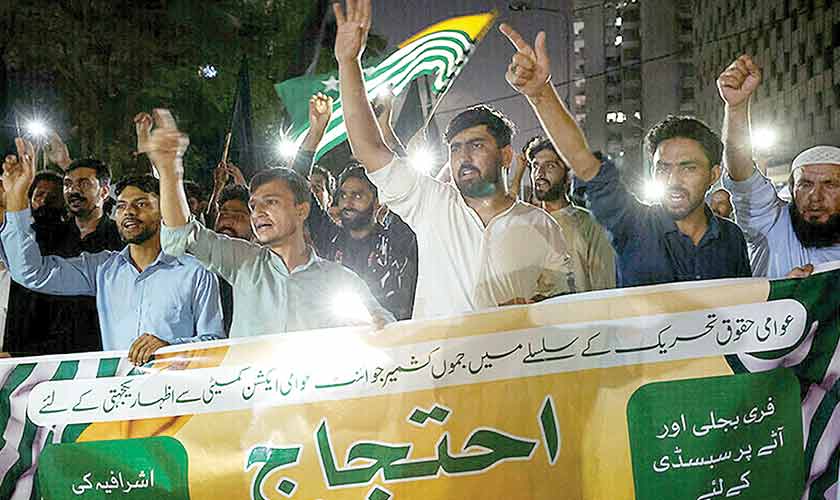
The unrest that paralysed the region had began on September 29, when the JAAC mobilised thousands of people across the Azad Jammu and Kashmir. Led by Sardar Omer Nazir, Raja Amjad, Shaukat Nawaz Mir and Anjum Zaman Awan, the committee presented a 38-point charter of demands. These ranged from free education and healthcare to major infrastructure projects. At the heart of the movement were two deeply political issues: discontinuation of elite privilege for top officials and the abolition of 12 legislative assembly seats reserved for refugees from Indian-administered Kashmir, the bloc JAAC leaders argue, has monopolised development funds and political power.
What began as a largely peaceful strike in support of the activists, quickly deteriorated into street violence. On October 1 and 2, clashes between rival protesters and police in Muzaffarabad and Dhirkot turned deadly. Gunfire and teargas use left at least 10 people dead and dozens injured. The JAAC condemned the deployment of Pakistan Rangers as unnecessary and unhelpful. The Human Rights Commission of Pakistan criticised the use of excessive force and denounced the information blackout that had followed. Pro-government rallies accusing the JAAC activism of being part of a foreign-backed conspiracy deepened the mistrust and polarisation.
The latest wave of mobilisation was neither spontaneous nor isolated. It marked the third major uprising in AJK in just two years and reflects a widening rift between the people and the government. In May 2024, widespread protests over electricity tariffs, taxation and resource distribution had forced the government to pledge reforms and a judicial review of elite privileges. In December, the JAAC led another region-wide campaign against the Peaceful Assembly and Public Order Ordinance that sought to criminalise active dissent. Sustained pressure eventually forced the authorities to dilute its key provisions.
The unrest that paralysed the region began on September 29. The JAAC mobilised thousands of people across Azad Jammu and Kashmir. Led by Sardar Omer Nazir, Raja Amjad, Shaukat Nawaz Mir and Anjum Zaman Awan, the committee presented a 38-point charter of demands.
This sustained pattern of mobilisation has transformed public discontent into a broad political movement. What began as issue-specific demonstrations has evolved into a challenge to the power dynamics between the AJK and Islamabad. The JAAC now cut across party lines and socio-economic divides, uniting citizens around narratives of dignity, accountability and democratic participation. In this context, the current wave of unrest is not a sudden eruption but part of a reckoning with decades of unresponsive governance. It also reflects the JAAC’s transformation from a pressure group into a decisive political actor capable of shaping state-society relations in the region.
A central driver of this mobilisation is the governments’ repeated failure to deliver on their promises. Successive leaders have announced reforms only to abandon or dilute them once public pressure subsided. This persistent gap between rhetoric and reality has eroded public trust and deepened the conviction that official institutions are unwilling or unable to address citizens’ concerns.
Beneath the immediate crisis lies a deep structural flaw in AJK’s political order. Despite its own institutions, the region’s administration functions largely as an extension of the government in Islamabad rather than being truly representative. As major decisions are taken in Islamabad, policies on resource allocation, development priorities and governance are rarely shaped by local considerations. The over-centralisation has weakened democratic accountability and entrenched political dependency.
The exclusion of local voices from policymaking has compounded the problem. Policies and projects that directly affect communities are often conceived without meaningful consultation, leading to poor outcomes and reinforcing the perception that AJK’s people are governed rather than represented. Until these structural imbalances are addressed, periodic protests are likely to persist, with each wave stronger than the last.
Treating grassroots dissent as a security threat or a foreign conspiracy may offer short-term political cover, but it does nothing to address the structural inequities driving public anger. Instead, such tactics deepen mistrust and push the region further from stability.
At its core, the JAAC movement is about far more than subsidies and infrastructure. It reflects a long-simmering demand for dignity, accountability and meaningful representation, demands that have gone unmet for decades. Unless these root causes are addressed, the 15-day mechanism and compensation packages will remain mere stopgap measures.
The stakes are higher than ever before. Addressing the crisis in the AJK requires more than short-term firefighting; it demands a fundamental rethinking of how the region is governed. If ignored, the growing public pressure could inspire similar movements elsewhere. Coercion can suppress dissent temporarily, but only genuine governance can resolve it.
The writer is a freelance contributor from Azad Jammu and Kashmir, currently pursuing an MS in development studies at NUST, Islamabad. She can be reached at hunainmehmud101@gmail.com and on X: @hunain_mahmood