

Print Story
X




Hamas is being read largely from the prism of Israel (if not exclusively from Netanyahu’s vantage point). Historical context that enabled the rise of Hamas is starkly missing when those sitting in Washington or Jerusalem and Tel Aviv analyse the conflict.
Recent maneuvers in New York and Washington have rekindled hopes for the endurance of the Abraham Accords, a framework that had appeared to falter under the weight of unrelenting Israeli intransigence. President Donald Trump, its self-styled architect-in-chief, seems to have breathed new life into the arrangement. Yet, whether this revival can last long remains doubtful.
During Trump’s earlier tenure, the Abraham Accords—hailed in Washington and lavishly applauded in Gulf palaces—were heralded as a “historic breakthrough” in Middle Eastern diplomacy, even as their foundations rested on fragile compromises and deferred justice. Beneath the choreography of handshakes and the rhetoric of peace lies not reconciliation, but the reconfiguration of power politics at the expense of the Palestinian cause.
Far from resolving a century-long struggle, the accords and their accompanying “peace plans” risk being remembered as the travesty of the epoch—a moment when expediency, selfish interests and imperial continuity triumphed over justice.
Trump’s 20-point proposal for Gaza promised an immediate cessation of hostilities, humanitarian relief managed by international agencies and the suggestion of a pathway to Palestinian “self-determination.” Its fine print revealed more: no genuine commitment to sovereignty, no reversal of occupation and no acknowledgment of the dispossession that lies at the heart of the conflict. The plan was designed to entrench Israeli security dominance, placing Gaza under an international trusteeship dominated by American allies. Tony Blair, the former UK prime minister, is said to be the likely person in charge of the new dispensation in Gaza.
As James M Dorsey has said, the proposal amounts to a “game of bluff poker.” Trump styled himself as the master dealmaker, but it was Benjamin Netanyahu and certain Arab leaders who extracted the real dividends. Netanyahu’s embrace of the plan was laced with caveats: Israel will retain security prerogatives, Hamas will be disarmed and the Palestinian Authority sidelined. In effect, Israel secured recognition of its war goals while portraying itself as pragmatic. Palestinians—whether Hamas or otherwise—were cast as obstructionist if they refused terms tantamount to surrender. Hamas is being read largely from the prism of Israel (if not exclusively from Netanyahu’s vantage point). Historical context that led to the rise of Hamas is starkly missing when those sitting in Washington or Jerusalem/ Tel Awiv analyse the conflict.
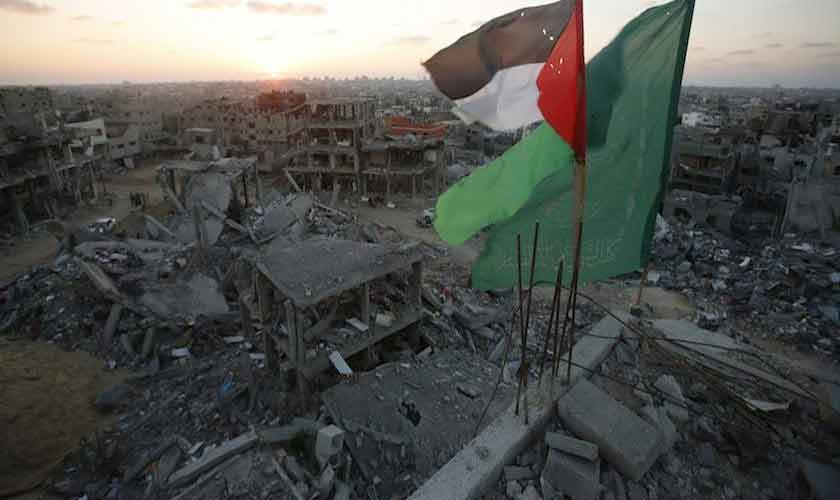
The proposal exemplified the hollowness of US-sponsored peace. Aid and reconstruction, dangled as carrots, are contingent on Palestinian acquiescence. Israel’s overwhelming use of US-supplied arms—leaving more than 60,000 Palestinians dead and Gaza reduced to rubble—has been overlooked. Reconstruction is to be financed largely by Gulf states; Pakistan and Indonesia are expected to provide security contingents that will not be deployed to guarantee Palestinian rights but to police them, ensuring that a battered population remains subdued and incapable of reclaiming its long-denied sovereignty.
Trump’s plan has thus created a grotesque inversion: the states and peoples historically aligned with Palestinian liberation are invited to be subcontractors in a US-Israeli project of containment. The Palestinian tragedy is repackaged as a humanitarian challenge to be managed, not a national cause to be realised.
Usama Makdisi reminds us that the Middle East’s crises cannot be separated from colonial legacies: borders imposed, identities manipulated and settler projects privileged over indigenous rights. The Abraham Accords reproduce this imperial grammar. By ‘normalising’ relations between Arab states and Israel while ignoring the dispossession of Palestinians, they institutionalise “peace without justice.”
Remember Edward Said’s critique of Orientalism. Western frameworks present Palestine not as the central injustice, but as a problem to be managed. Native voices are silenced and elites aligned with imperial interests are elevated. The accords reproduce this dynamic: rewarding compliance, punishing resistance and enshrining a distorted vision of stability that marginalises Palestinian aspirations.
Robert Fisk’s work chronicled the long arc of betrayal—from colonial carve-ups to Arab capitulations. In his view, the Abraham Accords represent yet another abandonment: Arab rulers trading Palestine for weapons, ‘legitimacy’ or US favour. For Fisk, the dissonance is glaring: peace feted abroad while Palestinians endure checkpoints, sieges and an apartheid regime at home.
Noam Chomsky’s decades-long critique of US foreign policy also resonates. He has shown how American “peace initiatives” often serve as smokescreens for securing geostrategic interests, propping up client regimes and safeguarding military-industrial deals. The Abraham Accords fit neatly into this template: consolidating an anti-Iran axis, embedding Israel as a regional security partner and locking Gulf states into the US orbit while sidelining Palestinian rights.
Dorsey underscores the transactional nature of the Gulf ‘normalisation.’ For regimes like the UAE and Bahrain, the accords deliver advanced weaponry, intelligence partnerships and protection against Iran. This state-centric pragmatism has stripped Palestine of its symbolic centrality in Arab politics.
Chomsky’s concept of “manufactured consent” is evident here. Gulf publics, who remain overwhelmingly sympathetic to Palestine, are presented with narratives of modernisation, prosperity and “peace dividends.” Beneath this packaging lies abandonment—an elite bargain that institutionalises a dangerous gap between rulers and the ruled.
Kishore Mahbubani places the Abraham Accords within the broader transformation from Western dominance to an emerging multi-polar order. Though the accords may be cast as a diplomatic triumph for Washington, they also expose the erosion of American influence. They represent an attempt to preserve a fading order by binding Israel and select Arab states into a US-anchored bloc.
True objectivity demands that China assume a more proactive role—one that goes beyond commercial caution—so that the Gaza impasse may be addressed with genuine justice for its beleaguered people. The moment calls for Beijing to shoulder greater responsibility and adopt a decisive stance in fostering peace grounded not in expediency, but in equity, in regions as conflict-prone as the Middle East.
The security architecture ignoring the sentiments of the Muslim peoples at large may prove brittle. In such a situation, China is expected to adopt a more assertive Middle East policy. There is a danger, of course, of the Middle East once again becoming a crucible of great-power rivalry, with Palestinians reduced to pawns in a contest between declining American hegemony and rising Chinese influence. For now it seems imperative as a balancing act.
The Abraham Accords represent not reconciliation but the institutionalisation of injustice. They recalibrate alliances around fear, power and expediency while ignoring the central question of Palestinian self-determination. From Makdisi’s colonial continuities to Fisk’s chronicles of betrayal, from Dorsey’s analysis of Gulf opportunism to Mahbubani’s vision of shifting global balances, from Said’s critique of Orientalist erasures to Chomsky’s exposure of imperial hypocrisies—the conclusion is inescapable: these accords displace justice and perpetuate instability.
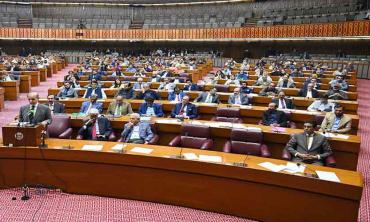
For Pakistan, any move to lend support to Trump and Netanyahu must be preceded by open national debate and alignment with public sentiment. To act in haste, without taking the people into confidence, is to court disaster.
The writer is a professor in the Faculty of Liberal Arts at the Beaconhouse National University, Lahore.