Print Story
X




The ongoing genocide in Gaza remained a major theme at the UNGA. What does this mean for Palestinians?
| A |
much-trumpeted, and as many argue, much delayed, stance of many European and other reasonably powerful states— dismayed by Israel and its arch ally, the United States—was that they would recognise the Palestinian state close to and during the United Nations General Assembly’s 80th session. This ‘recognition’ meant formal diplomatic recognition of Palestine as a sovereign state. Prior to this, Palestine had a non-member observer status in the UN, where it could only participate in debates and meetings but did not have voting rights in the General Assembly. It is for the first time that so many countries, especially Western democracies, have tendered recognition to Palestine. According to Al Jazeera, as of September 23, 157 out of 193 UN member states now recognise the state of Palestine.
Notable among the states that have accorded recent recognition to Palestine are the United Kingdom, Australia, France, Canada, Portugal and Belgium. The question remains: does it make any difference to the ongoing genocide in Gaza; the gross human rights violations; and the indiscriminate destruction of physical infrastructure in Gaza city? It may have been a diplomatic low for Benjamin Netanyahu to address a near-empty hall in the UNGA as a large number of delegates left to boycott his address; but on ground, Israel can only be deterred if pressured by the United States. President Trump appears, however, to still be extending all-out support to the Netanyahu regime.
In his most recent bid to substantiate his claim as a champion of peace and rightful claimant to the Nobel Peace Prize, Trump proposed a Gaza Plan, promising ceasefire, security, governance, reconstruction, humanitarian aid and future political horizon.
In a threatening tone, Trump declared that Hamas has “three to four days” to respond to his ceasefire proposal, which was said to have been accepted by Israel. Under the proposal, Hamas would be required to disarm and the US would work with Arab leaders and international partners to install a “temporary international stabilisation force,” and establish a Board of Peace. The plan requires that Hamas have no role in governing Gaza. Its members could be granted safe passage if they chose exile.
The Trump proposal envisions a transition government of Palestinian technocrats to deliver services in Gaza, self-governance, the return of displaced residents and an assurance that “the people of Gaza will not be displaced forcibly.”
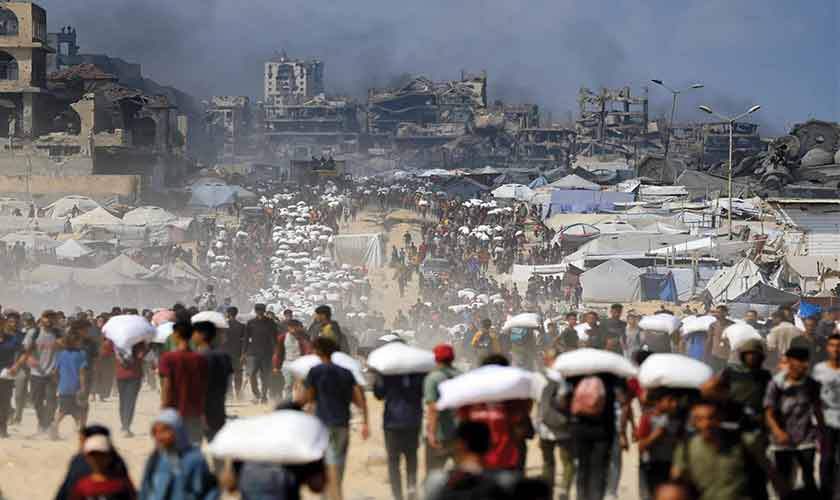
Gaza has witnessed an immensely destructive two-year bombing by Israel, with a staggering death toll of around 65,000 Palestinians. The coastal enclave has been left in ruins. The UN has declared it a genocide. The Trump administration has inserted some vague clauses in the proposal apparently to make it acceptable to extremely hostile adversaries. In the current context, the chances of the plan resulting in peace appear remote.
The UN Independent International Commission of Inquiry, in its report of September 16, concluded that “Israel has committed genocide in Gaza.” The finding is based on four of the five “acts” identified under the 1948 Genocide Convention: a) killing large numbers of a group; b) causing serious bodily or mental harm; c) deliberately inflicting conditions of life calculated to bring about the group’s physical destruction, in whole or in part; and d) imposing measures intended to prevent births in the group.
The commission also concluded that there was evidence of “genocidal intent” including statements by high-ranking officials, orders given, patterns of conduct and circumstantial evidence. Earlier in a report released on November 14, 2024, the UN Special Committee to Investigate Israeli practices stated that Israel’s warfare in Gaza is “consistent with the characteristics of genocide.” Significantly, the UN body found both actus reus (the acts themselves), and mens rea (the intent) of the Israel’s conduct as well as statements and orders of officials as evidenced perpetration of genocide.
Western democracies fall in a broad spectrum when it comes to their position regarding Israel’s genocide in Gaza. The reactions range from full support, through cautious agreement with parts of the reports, to complete rejection. For instance, the UK government has expressed serious concerns about human rights violations in Gaza and called for ceasefire and aid access, yet it has not accepted the genocide finding. The UK—like some other states such as Germany, Canada, Australia and Portugal—argues that, as far as genocide is concerned, the evidence or intent is not clearly established.
Some of the European Union member states (Belgium, Ireland, Luxembourg, Spain) have been very critical of Israel’s actions and loudly vocal about international legal accountability but have been reluctant to use the term “genocide” due to diplomatic, legal or political concerns or the risk of undermining negotiations and inflaming tensions. On the face of it, these states are trying to balance international law, political pressures and their traditional alignment with Israel.
However, the threshold of the term and its acceptance by the public as a crime committed by Israel is shifting due to increasing voices, including academics, activists and politicians, challenging traditional Western narratives. Resultantly, the ongoing situation in Gaza is, in fact, being described as a genocide, and Israel’s acts as genocidal acts. Recent recognitions of Palestine by the UK, Canada, Australia, Portugal etc suggest increasing willingness to assert Palestinian rights and shift policy postures. The shift has come about largely due to increasing public protests and civil society pressure in Western democracies, influencing discourse and pushing governments to be more critical of Israel’s actions.
The people in Western democracies, including the US, have proved themselves to be more vocal about human rights concerns than those in Middle Eastern countries. The tide is finally turning.
The writer heads the History Department at University of Sargodha. He has worked as a research fellow at Royal Holloway College, University of London. He can be reached at abrar.zahoor@hotmail.com His X handle: @AbrarZahoor1.