

Print Story
X




Centuries of liturgical song gave way to reinvention as the rababis adapted to life after Partition
| T |
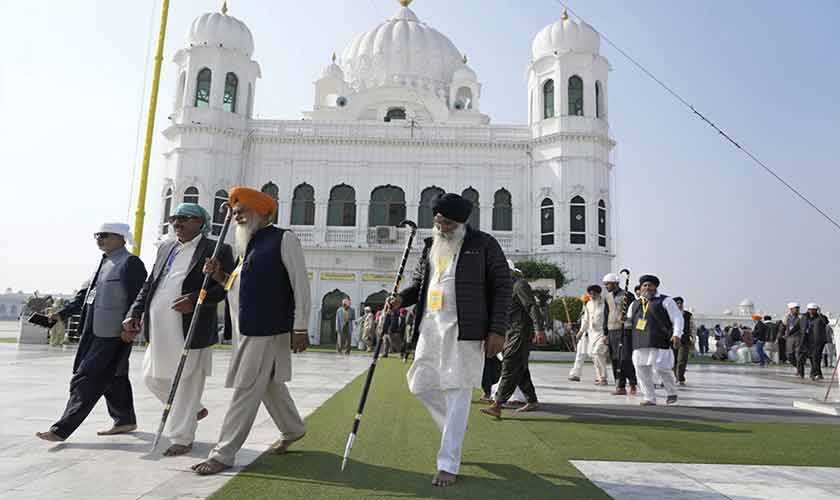
his year, Kartarpur saw very few yatrees owing to the Indo-Pak military standoff.
Bhai Mardana, a lifelong companion of Guru Nanak, played the rabab and is credited with composing the shabads and kirtans of Nanak, hymns still sung in gurdwaras today. His descendants, known as the rababis, preserved this sacred tradition of performing Sikh liturgical texts for centuries.
After Darbar Sahib Amritsar and Nankana Sahib, Kartarpur is regarded as the holiest site for Sikhs. Situated on the banks of the Ravi, it was inundated this year during unprecedented floods. The large-scale construction work there could not prevent the waters from surging inside.
The gurdwara had been rebuilt by the maharaja of Patiala in 1929 following another major flood. Guru Nanak is celebrated as the second great poet of the Punjabi language after Baba Farid. Much of Farid’s kalam has survived for posterity because Nanak included it in his own collection.
For centuries, the rababis have been celebrated as great musicians. In modern times, virtuosos such as Bhai Lal, Ghulam Hasan Shaggan, Master Ghulam Haider, Rashid Attre, Wajahat Attre, Sain Akhtar Hussain, Tufail Niazi and Hamid Ali Bela adapted to changing times and, in their own way, enriched the immense treasure trove of music over the last century.
The liturgical music of the Sikhs, however, suffered greatly following the migration of the rababis to Pakistan during and after Partition. Among the many cultural casualties of the division of the Punjab, this remains a largely unacknowledged tragedy. Sikhs themselves seldom refer to it with full candour, perhaps because when art becomes part of ritual, any critique of performance quality risks being perceived as a critique of the religious act itself, and can evoke different kinds of reaction.
Among the many cultural casualties of the division of the Punjab, this remains a largely unacknowledged tragedy.
This pattern is familiar in Pakistan, too, where aesthetic quality is often not treated as a critical factor in the assessment of ritual. Instead, music or performance is viewed as external to the religious practice, meaning that the observance of the ritual alone is taken as sufficient. The result is that quality is frequently ignored, while the act of ritual is considered complete once performed.
Punjabi musical expression was, and still is, deeply shaped by Sikh influence. From the mid-18th Century, when the Sikhs ruled the Punjab, through the British Raj, the princely state of Patiala emerged as one of the greatest patrons of music.
Musicians of the region often drew upon liturgical references, if not always directly, then with regular allusions. The Sikh Gurus had themselves designated a number of ragas and composed within them. Like the khanqah and the mandir, the gurdwara, too, became a sanctuary for musicians, offering a platform to develop and advance their art.
After Partition, however, the rababis in Pakistan were compelled to suppress their liturgical traditions and adapt to other, more socially acceptable forms of music. Many turned to folk and film music, where they not only found space but excelled, proving themselves no less accomplished than other maestros.
As Pakistan pursued a state narrative rooted in a more orthodox reading of religion, the rababis were forced to adapt further. Many altered their attire and distanced themselves from their musical ancestry; in some cases they even claimed different origins. Like many others, they reinvented their identity in terms of caste, baradari, religion and sect.
The writer is a culture critic based in Lahore.