


Print Story
X




Political significance of the latest Pak-Saudi agreement arguably far outweighs its immediate military utility
| S |
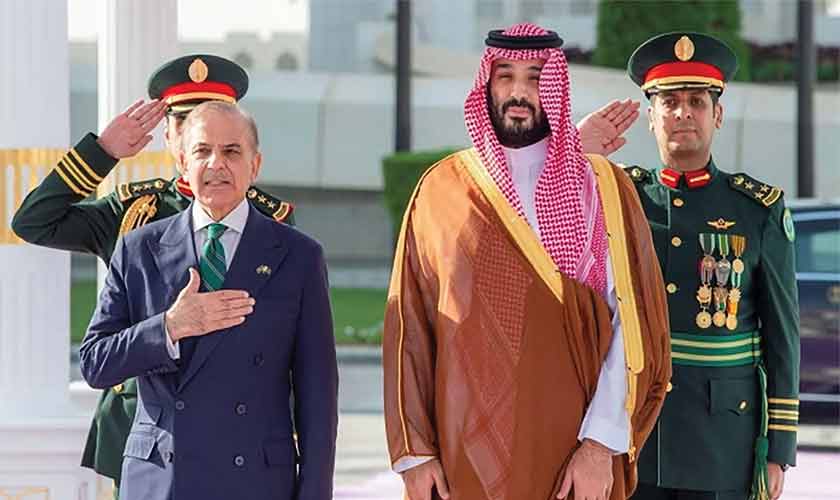
audi Arabia and Pakistan signed a Strategic Mutual Defence Agreement on September 18. Under the agreement, any attack on either nation will be considered an attack on both countries.
Sparked by Israel’s attack on Qatar, this agreement reflects a strategic pivot to counter the unreliability of traditional Western security guarantees. Hailed as a historic milestone, it establishes a reciprocal defence framework, committing both nations to helping each other counter foreign aggression. This alliance signals a transformative shift in regional geopolitics.
Will the pact automatically result in military support for each other whenever either nation is threatened? Such agreements are best understood in the context of historical experience. Pakistan has a long history of forming strategic alliances, particularly during the Cold War, when it joined US-led security arrangements including the SEATO and the CENTO. However, those did not result in automatic military support during its wars with India in 1965 and 1971. Talking to The News on Sunday, Ambassador Naghmana Hashmi cited Pakistan’s history of strategic restraint, noting that it refrained from Korean War deployment to avoid confrontation with China, just as it declined to join the 2015 Saudi-led intervention in Yemen. She indicated that, given Riyadh’s growing ties with New Delhi, Saudi support in an India-Pakistan conflict would likely be diplomatic or economic, not military.
She emphasised that Saudi Arabia’s trade volume with India is 10-14 times larger than with Pakistan, providing significant economic leverage to deter aggression. Analyst Michael Kugelman noted that while the agreement is unlikely to deter India from aggressive actions, it strengthens Pakistan’s position. The support of Saudi Arabia, China and Turkey can bolster Pakistan’s strategic standing, potentially forcing India to reconsider its regional policies to avoid economic repercussions. Therefore, the pact’s political significance arguably outweighs its immediate military utility. It serves as a multi-layered signal, reassuring Saudi citizens of Pakistan’s support, warning Israel and other actors that Saudi Arabia is not isolated, and potentially nudging the United States to take Gulf security concerns more seriously. “This is fundamentally a strategic political gesture and a deterrent signal, rather than an operational blueprint for military integration,” says Salman Bashir, the former foreign secretary. For quite some time now, Riyadh has sought a US defence pact and nuclear cooperation as a quid pro quo for normalising ties with Israel. Progress in this direction was disrupted by the Gaza conflict.
Bashir says that the pact does not signal a departure from Saudi Arabia’s longstanding security partnership with the United States. “The recent events do not mean that the US is no longer required for Saudi Arabia security,” he states. “The US remains close to Saudi Arabia. We believe that they understand the significance and context of this agreement between two of its allies.”
The pact’s primary purpose is to project solidarity and deter aggression by signalling that an attack on one nation is an attack on both. As Salman Bashir notes, “It serves as a strong declaratory warning to potential adversaries, emphasising that any aggression will face a unified response.” By addressing shared threats like regional instability and terrorism, the agreement aims to prevent conflicts and enhance stability through deterrence.
Defence cooperation between Saudi Arabia and Pakistan began in the 1960s with training agreements. It expanded after the 1979 incident, leading to troop deployments including a brigade in 1983 and over 20,000 personnel in the 1980s. Pakistan sent 11,000 troops during the 1990-91 Gulf War. Collaboration continued through arms purchases and the 2015 Islamic Military Counter-Terrorism Coalition led by a former army chief.
The pact responds to a collapsing regional security framework, particularly following Israel’s attack on Qatar, a non-NATO US ally, which exposed the unreliability of American security guarantees. “America’s security guarantee to Gulf countries failed in the Doha attack,” driving Saudi Arabia to seek alternative alliances. In the Middle Eastern context, where several nations lack the capacity to counter Israeli aggression, Pakistan has emerged as a natural, practical and credible choice. This perception is rooted not only in its military capability—having a battle-hardened, professional force—but also in the profound reverence its people hold for the Haramain Sharifain. For Saudi Arabia, this alliance supports Crown Prince Mohammed bin Salman’s domestic transformation agenda.
The publicly released text of the defence agreement employs general language such as “strengthening joint deterrence” and avoids referencing any specific weapon systems. The notion of a nuclear umbrella remains speculative. Salman Bashir asserts, “Pakistan’s nuclear doctrine remains exclusively oriented toward deterring India. There is no indication that this posture has changed... the pact is a diplomatic instrument designed to reinforce deterrence and stability, not to enable the sharing or deployment of nuclear capability.”
Ambassador Naghmana Hashmi suggests flexibility: “This agreement has been designed to keep the employment and deployment of strategic assets ambiguous... in case of an existential threat, depending on the situation at the time, nuclear option cannot be ruled out.” This tension between a rigid doctrine and ambiguity strengthens the pact’s deterrent effect by fostering uncertainty for adversaries. She clarifies that such assets are unlikely to be stationed in Saudi Arabia, noting US precedents of deploying nukes in Europe (including non-NPT signatories) while retaining full control. Pakistan, a non-signatory that respects the NPT nonetheless, mirrors this stance, unlike Saudi Arabia, which is a signatory. Ultimately, the nuclear umbrella’s extension remains uncertain.
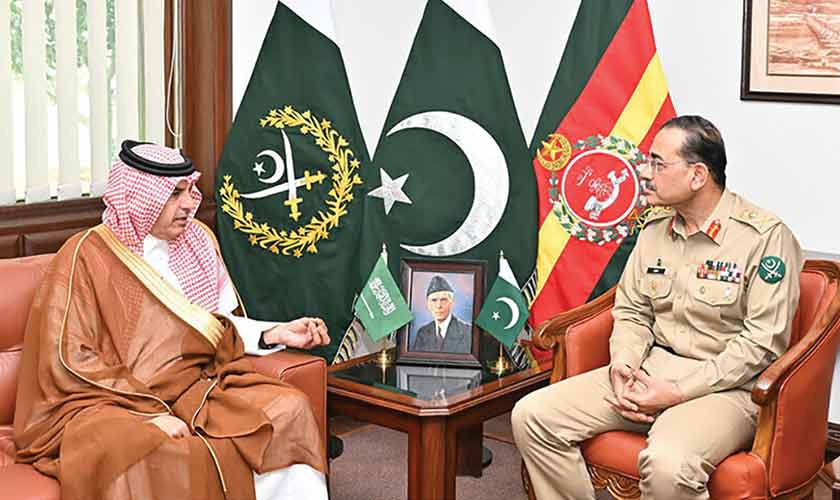
The publicly released text of the defence agreement contains no mention of nuclear weapons. It employs general language such as “strengthening joint deterrence” and avoids referencing specific weapon systems. The notion of a nuclear umbrella remains speculative.
The agreement acknowledges Pakistan’s vital role as a security provider and formally integrates it into the Middle Eastern defence architecture. Bashir says: “Essentially, it brings Pakistan to the fore in Middle Eastern situation. Pakistan becomes as much a Middle Eastern power as it is in South Asia.” This role carries risks. Moving forward, Pakistan must proceed with strategic caution to avoid entanglement in intra-Arab disputes. China’s mediation facilitated a Saudi-Iranian détente, with Iran now acknowledging Saudi and Pakistani support during its conflict with Israel. This was demonstrated by Saudi Defence Minister Prince Khalid’s urgent meeting with Iran’s Supreme Leader to pledge solidarity, and Riyadh’s successful lobbying against US-led regime change efforts advocated by Israel. Following a meeting between Iranian official Ali Larijani and Saudi leadership, Islamabad must actively address Tehran’s concerns to maintain this diplomatic momentum.
Ambassador Javed Hafiz reaffirmed Pakistan’s longstanding policy of never initiating aggression against Iran, a stance maintained for decades. “Confronted by India and Afghanistan, it has always been Islamabad’s policy not to have a hot border with Iran,” he said, noting that Pakistani armed forces have never been deployed along the Iranian border. He distinguished this from the occasional spike in counter-terrorism actions along the border, characterising those as a separate, issue of border management rather than a reflection of hostility. This clarification comes amid a recent thaw in Islamabad-Tehran relations, demonstrated by Pakistan’s full support for Iran in the Security Council. The ambassador also contextualiszed Iran’s own strategic challenges, pointing out that it operates in a tense neighbourhood bordered by Azerbaijan, GCC states and Pakistan. Even before the recent Israeli attacks, Iran had seen its regional influence diminish with the weakening of its proxy forces in Lebanon, Syria and Iraq.
Ambassador Hafiz warned that the defence agreement could make Pakistan a target for Israel, though attacking a nuclear-armed state with strong conventional forces is unlikely. Opposition to Muslim nuclear powers - as seen in its destruction of Iraq’s Osirak reactor and similar attempts against Iran – has been Israel’s policy. However, an Israeli attack on Pakistan could trigger a massive retaliation and risk all-out war. To mitigate this risk, Pakistan may have to reassure Israel via diplomatic back channels. It must also strengthen its counter-terrorism efforts and secure its national interests in light of intelligence suggesting Israel used Indian agents to prepare for attacks on Qatar and Iran.
“The calculus will shift dramatically if Israel contemplated an attack on Saudi Arabia. Such a move will ignite a massive, uncontrollable regional war, expanding far beyond previous engagements in Qatar and Iran.” Having already targeted several neighbours, Israel must now carefully reassess the prohibitive risks and consequences of initiating a conflict with a state of Saudi Arabia’s stature and alliances.
Preparedness
The historical rivalry between the PAF and Israel includes notable victories for Pakistani pilots. In the 1967 Six Day War, Flight Lieutenant Saif-ul Azam, flying a Jordanian Hawker Hunter, downed three Israeli jets (Dassault Mystère IV, Vautour IIA, Mirage III), setting a record for most Israeli Air Force aircraft shot down, per Air Marshal Arshad Aziz Malik (retired). In 1973, Flight Lieutenant Sattar Alvi, flying a Syrian MiG-21, destroyed an Israeli Phantom.
The PAF has for decades prepared and rehearsed contingency plans against a threat from Israel. Air Marshal Arshad Aziz Malik has said, “Israel has always been considered a potential threat in Pakistani military strategy to warrant dedicated contingency plans, which exist alongside the primary preparations focused on India.” Israel, he said, had at least thrice planned to attack Pakistan nuclear facilities. “Against this backdrop, the PAF regularly rehearses, with jets, airborne and ground-based sensors, for anticipated contingencies, practicing war plans designed to counter threats from all possible directions.”
“Pakistan has repeatedly foiled potential airstrikes by Israeli forces. On one occasion, a timely alert from an ally exposed an IAF strike package using a civilian airliner as cover for radar evasion. PAF fighter jets were scrambled immediately and forced the Israeli mission to be aborted. In another encounter, IDF jets reached Afghanistan along with a refueller aircraft to attack Pakistan. However, the PAF air controllers vectored pilots to the northwestern and western border areas to engage the incoming threat; the Israeli strike package quickly banked away.”
These successes have followed an earlier threat of a joint Israeli-Indian plan to attack the Kahuta facility in the 1980s. Ahead of the 1998 Chagai nuclear tests, too, the PAF kept its fighters airborne in a state of high alert.
“PAF jets also rehearsed sending a one-way strike package to retaliate against critical Israeli facilities and naval platforms with Exocet missiles to signal readiness to attack deep inside Israeli territory,” Malik says. This high-risk mission, conceived to demonstrate Pakistan’s strategic reach and resolve, was borne from necessity during an era before the development of long-range missiles. “It demanded a perilous, fuel-guzzling, low-altitude flight profile that all but guaranteed the aircraft would not return.”
Air Marshal Malik says an arsenal of missiles and integrated air defence now ensures Pakistan can project power with far greater assurance and sustainability.
“Since Israel is part of our threat spectrum, we have always prepared against them and have the intent, resolve and the capacity to hit where it hurts the most.” Quite recently, Israel’s support to India against Pakistan with Harop drones, IDF technical advisory, etc was evident.
Global reception
Regarding international reactions to the defence pact, Ambassador Hashmi says the agreement arrived with the tacit blessings of the United States and China. China sees it as a stabilising force for its huge regional investments under the Belt and Road Initiative. The US, which recognises Saudi security anxieties, may tolerate the pact given its alliance with Pakistan and Saudi Arabia. It is certain, however, that Washington will never permit an arrangement that could threaten or undermine Israel’s security.
A lot of diplomatic work starts now. It includes clarifying expectations and operational limits to ensure both countries understand how to manage future crises. Barring an extreme, direct threat to either nation, this pact is unlikely to force either country into military adventures instigated by the other.
The term ‘strategic’ has expanded beyond nuclear issues to include broad domains under Saudi Vision 2030’s economic and social transformation. Unlike Cold War alliances, this agreement could combine Saudi financing, Pakistan’s skilled workforce and Chinese technology. The pact opens defence collaboration avenues, with Saudi investment potentially funding joint production of Pakistani systems like Al-Khalid tanks and JF-17 fighter aircraft, reducing reliance on US supplies. This defence cooperation could catalyse Pakistan’s economic growth through job creation and vocational training, aligning with both nations’ development goals while promoting regional stability.
The pact integrates Pakistan into Middle Eastern security architecture, enhancing regional stability. By pressuring global powers like the US to prioritise Gulf security concerns and supporting China’s Belt and Road investments, it also serves as a strategic deterrent. However, Pakistan must clearly define its operational boundaries to avoid entanglement in Middle Eastern conflicts or unnecessarily becoming a target for Israel and its Western allies.
The writer is a senior The News staffer in Karachi.