Print Story
X




Commemorating Nanak’s death anniversary from Lahore’s vantage point
| E |
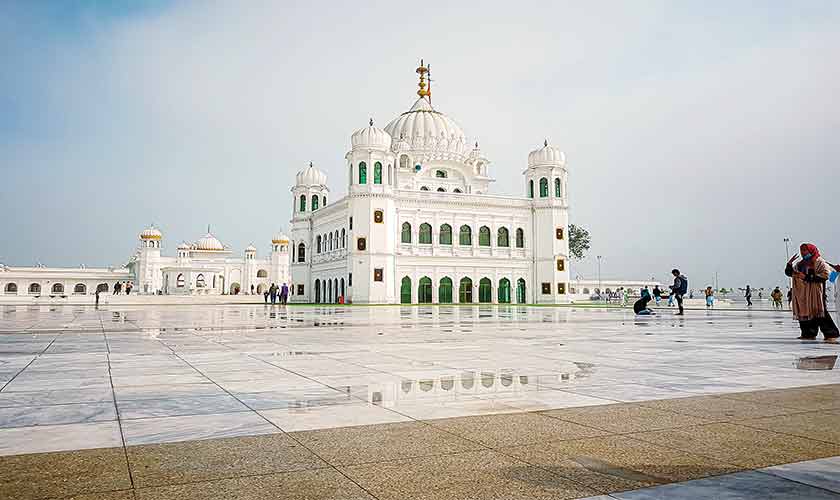
Every September, Guru Nanak’s passing is remembered by Sikhs across the world. The founder of Sikhism died in 1539. His ideas remain etched in Punjab’s cultural and spiritual fabric.
In Lahore, a city often remembered for its Mughal grandeur and colonial legacy, Nanak’s presence might be less visible. Yet his teachings echo through the city’s streets, its literature and its layered history of coexistence. To commemorate his death anniversary is to confront the plural roots of Punjab’s identity.
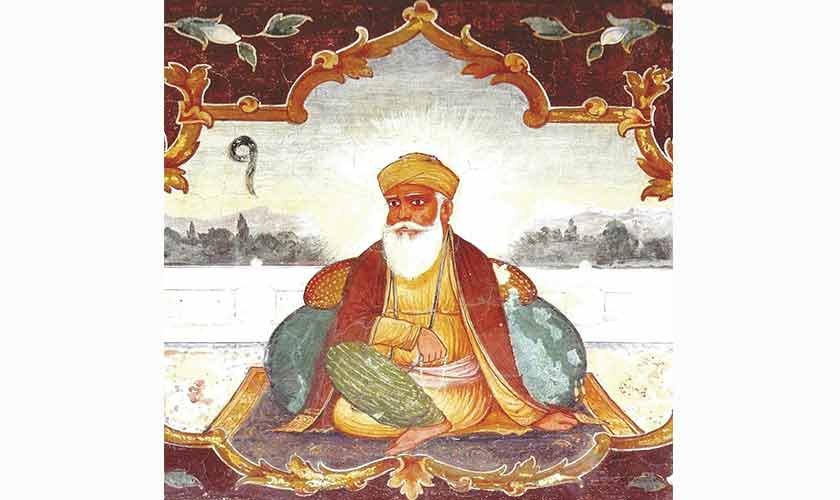
Born in Nankana Sahib, a short distance from Lahore, Nanak grew into a reformer whose message of equality cut across caste and creed. He sang of a divine unity that transcended ritual, caste hierarchies and sectarian boundaries. His institution of langar — a communal kitchen where all, regardless of status, ate together — embodied this egalitarian ethic.
He was, however, much more than a social reformer. He was a poet, composing hymns that would later become the bedrock of the Guru Granth Sahib (central holy religious scripture of Sikhism). He was a traveller, journeying from Bengal to Baghdad, from the Himalayas to Sri Lanka, taking the Punjab to places no one else did. Above all, he was a teacher of everyday discipline: through kirtan (devotional music), through sewa (service) and through an insistence that kirat karo (honest labour) was itself a form of worship. These practices were not isolated to Sikh spaces. In Punjab’s villages and cities, including Lahore, Nanak’s words mingled with Sufi poetry and oral traditions, promoting vocabularies of justice and inclusion that would later resonate with freedom fighters in anti-colonial movements.
Lahore, in particular, was a place where these values took root. The janamsakhis (narratives of Nanak’s life) were copied and circulated in the city’s literary networks. Shrines and gatherings in and around Lahore hosted Muslim, Sikh and Hindu audiences alike, blurring boundaries of devotion. Poets and chroniclers invoked Nanak not as a figure of sectarian separation but as part of a shared Punjabiyat, a regional culture that resisted narrow definitions of identity. Centuries later, Lahore’s reformist press and revolutionists drew on an egalitarian idiom reminiscent of Nanak’s insistence on human dignity.
Commemorating Nanak’s death anniversary from Lahore’s vantage point draws us into the complexities of memory and erasure. Partition uprooted Sikh communities from the city, leaving behind sad traces. Some of the city’s many gurdwaras turned into government offices, shrines fell silent, manuscripts scattered. Today, much of Lahore’s public memory tilts towards Mughal and Islamic heritage, often overlooking how Sikhism once shaped the city’s rhythms. To recall Nanak is to recover that plural inheritance and acknowledge that Lahore’s story is incomplete without its Sikh chapter.
Partition uprooted Sikh communities from the city, leaving behind sad traces.Gurdwaras turned into government offices, shrines fell silent, manuscripts scattered. Today, much of Lahore’s public memory tilts towards Mughal and Islamic heritage, often overlooking how Sikhism once shaped the city’s rhythms.
| N |
Nanak’s relevance extends beyond the past. In a South Asia fractured by sectarian politics, his teachings offer a reminder that religious and cultural identities are not meant for conflict. His insistence that the divine resides in everyday labour, in compassion, in rejecting hierarchy, still unsettles dominant logics of power.
For Muslims in the Punjab, Nanak was never a distant other. Historical records show Muslim fakirs attending his gatherings, Punjabi Muslims quoting his verses and reformers drawing parallels between his critique of ritual and Islamic reformist thought. These overlaps point to a history of solidarities that troubles neat religious binaries.
Some of the freedom struggles of the 19th and 20th Centuries bore traces of this shared inheritance. Punjabi revolutionaries, Sikh and Muslim alike, found common ground in resisting colonial authority, their idioms echoing Nanak’s emphasis on justice and equality. Commemorating his death anniversary this month, then, is less of a sectarian gesture and more of a reminder of how religious ethics infused the region’s political imagination.
What would it mean for the Punjab, in 2025, to truly commemorate Guru Nanak? Beyond ritual observance, it would require Lahore to recognise how its historical identity is built on multiple legacies. To tell Lahore’s story only through Mughal domes and colonial gardens is to flatten its richness. To bring Nanak back into the conversation is to restore balance and remember a Punjab where the sacred and the civic intertwined, where a Muslim could recite Nanak’s verse and a Sikh could revere a Sufi’s shrine.
We are no strangers to questions of identity and belonging, whether in curricula, public monuments or polarised debates. Nanak’s anniversary offers a pause. It invites us to recall a time when the city was porous, when solidarities were possible, when the divine was imagined as accessible to all. His egalitarian ethos remains both a historical fact and a future horizon.
Punjab’s heritage cannot be reduced to sectarian memory; it lives in Nanak’s insistence that truth lies in humility and shared humanity. As he taught:
Awal Allah Noor Upaya, Qudrat Kay Sab
Banday.
Ek Noor Tay Sab Jag Upjeya, Kaun Bhalay Ko
Manday.
(First, God created the Light; from this Light, all beings were born./From the same Light came the entire universe, so who is good, and who is bad?)
To remember Nanak, then, is to remember that our histories and futures are illuminated by the same light.
Kiva Malick, an academician and a writer, focuses on education, philosophy, music and culture