Print Story
X




Poetry, study circles, theatre and more to enjoy, as the city stirs awake from its summer-induced social stupor
| P |
Peshawar is an ancient city steeped in history, culture and diversity - a vibrant hub for literary and cultural activities. Nestled at the crossroads of Central Asia and the Indian subcontinent, Peshawar has long been a melting pot of civilisations, from the Gandharan era to the Mughal period and beyond.
This rich historical tapestry, coupled with its resilient Pashtun identity, has fostered a dynamic environment where literary and cultural activities thrive, serving as a bridge between tradition and modernity. The city has resumed literary and cultural activities after a long heat spell subsided.
Literary activities in Peshawar, such as mushairas [poetry recitals], book fairs and storytelling sessions, play a pivotal role in preserving the region’s linguistic heritage. These events provide platforms for poets, writers and scholars to express ideas, share narratives and engage with pressing social issues.
Pashto, Hindko and Urdu poetry is deeply rooted in themes of love, honour and resistance. Such poetry resonates with the city’s ethos. The literatures being produced in the region reflects both local and cosmopolitan influences. Institutions like the Abasin Arts Council and several literary circles foster intellectual discourse, nurturing young talent and encouraging creative expression.
Culturally, Peshawar is a kaleidoscope of traditions. Historically, the city’s pluralistic identity has been long celebrated. Cultural events not only entertain, but also strengthen communal bonds, offering a space for dialogue in a region, marked by conflict. Places like the Peshawar Museum, which houses a number of Gandharan artifacts and hosts cultural festivals highlight the city’s historical significance, attracting scholars and tourists alike.
Literary and cultural activities in Peshawar are more than mere entertainment; they are vital for preserving heritage, fostering resilience and promoting social cohesion. In a city that has faced challenges like militancy, these activities provide a creative outlet for healing and expression, ensuring that Peshawar remains a beacon of cultural richness and intellectual vitality in the region.
Halqa Arbab-i- Zauq, Peshawar, organised a literary conference recently to honour the services of Professor Dr Nazir Tabassum (d. 2025), a distinguished Urdu poet, scholar and teacher. His contributions to the corpus of Urdu literature were highlighted.
Born as Nazir Ahmad, Tabassum earned his MA in Urdu from Peshawar University in 1974 and a PhD in 2003. His doctoral thesis was on Urdu Ghazal Poets of the Frontier After the Creation of Pakistan. It won him acclaim for its scholarly depth. His students continue to enrich Pakistan’s literary and academic landscape.
Dr Tabassum’s poetry, marked by emotional depth and social reflection, resonated with vast audiences. His collections, Tum Udaas Mat Hona (1996), Kaisay Raigan Huye Hum and Abhi Mausam Nahin Badla, explore personal and cultural themes, often reflecting Peshawar’s ethos. His verses, carried on platforms like Rekhta, blend introspection with contemporary issues, and have earned him a revered place in Urdu poetry.
Literary and cultural activities in Peshawar are more than mere entertainment; they are vital for preserving heritage, fostering resilience and promoting social cohesion. In a city that has faced challenges like militancy, these activities provide a creative outlet for healing and expression.
As a member of Halqa-i-Arbab-i-Zauq, a literary movement founded in 1939 in Lahore, he engaged in poetic gatherings and critical discussions, contributing to the modernist Urdu literary tradition. Halqa-i-Arbab-i-Zauq, known for its non-political focus and innovative poetic styles, recognised Dr Tabassum’s work for its clarity and emotional resonance.
His untimely death from a heart attack during a mushaira at Peshawar Services Club in August 2025 was mourned as an irreparable loss. Prominent literary figures, including Khyber Pakhtunkhwa’s Culture Department secretary, Dr Abdul Samad and federal minister Aurangzeb Khichi, lauded his contributions. Halqa-i-Arbab-i-Zauq and Dosti Welfare Organisation organized an event to honour his legacy as a literary icon.
The Peshawar Circles, a group of university graduates, arranged its 51st study circle at the Incubation Centre. A book titled AI Snake Oil: What Artificial Intelligence Can Do by Arvind Narayanan and Sayash Kapoor was discussed. The book critically examines the hype surrounding the artificial intelligence, pointing out its limits and societal implications. The keynote speaker, Faisal Jamil, and the moderator, Hamza Bin Anees, highlighted salient features of the book and advised young readers to explore innovative ideas and find their practical uses.
The book categorises AI into two types: generative and predictive. Generative AI, like chat bots (e.g., ChatGPT) and image generators, excels in creating human-like outputs but struggles with factual accuracy, often producing “hallucinations” or plausible but false information. Narayanan and Kapoor highlight how AI’s allure stems from its “magic-like” versatility, resulting from exaggerated marketing by tech companies and consultants. The authors advocate a critical approach to AI adoption, urging stakeholders, policymakers, businesses and the public to demand evidence of efficacy and ethical considerations.
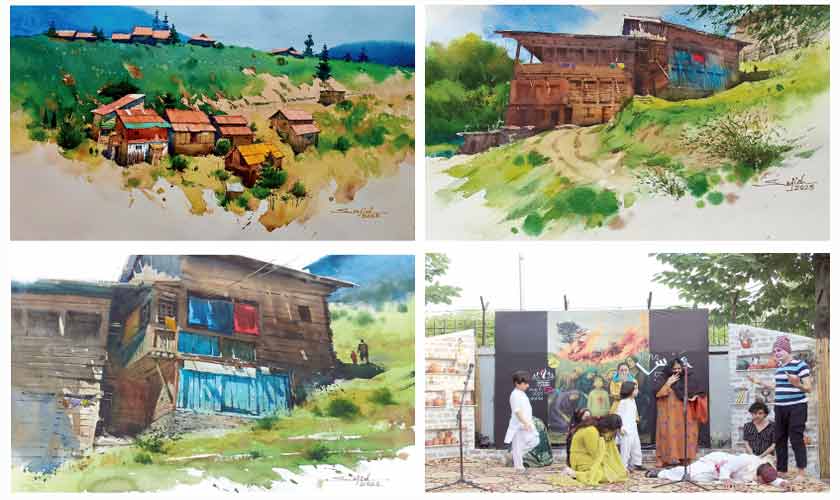
Mafkoora, a private organisation for research and development, staged a Pashto play on peace, climate change and the right to free expression. Hayat Roghani, the head of the organisation, said live theatre was part of a series of cultural activities the organization had planned this year. Roghani said that live performance was an effective medium for promoting the cause of peace, climate change and other social issues.
A session was also organised under the auspices of Mafkoora on Big Bang Theory.
Ali Sajid a noted water colour artist, based in Peshawar and president of National Artists Association of Pakistan KP chapter, released his latest work online. It included a painting of pre-flood Gurez Valley of Azad Jammu and Kashmir. Talking about the painting he said “the pre-flood images could help in rebuilding and reclaiming the landscape.”
The writer is a Peshawar-based journalist. He mostly writes on art, culture, education, youth and minorities. His X handle: @Shinwar-9