Print Story
X




The climate crisis is a an industrial product manufactured, packaged and auctioned to the highest bidder
| I |
t has been said that tragedy recurs in Pakistan, not because of some fate, but as a result of the actions taken by those who profit from it. If there is one sector where the country has achieved world-class mastery, it is not climate science or flood risk management—it is the fine art of turning disasters into donor-funded carnivals. Welcome to the parallel universe of Pakistan’s climate non-governmental organisations, where every monsoon can be an opportunity, every tragedy a press release and every flood a career boost.
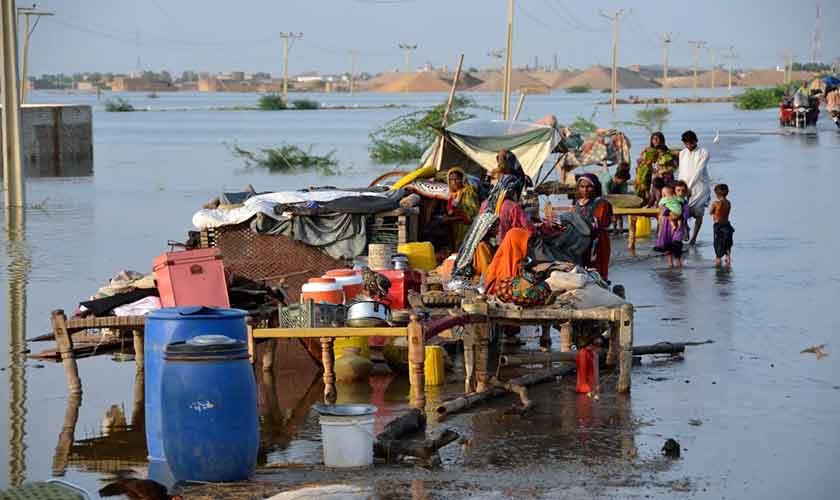
By mid September 2025, floods had killed 831 people, displaced over 1.8 million and affected 4.5 million people nationwide. Another rain spell in September, added to the numbers.
If you expected accountability, you have not been paying attention. Instead of facing tough questions, the top brass of many an NGO could be spotted on television talk shows, lecturing the public on “climate resilience” and “ecosystem-based solutions,” sprinkling technical jargon like confetti to impress an audience that cannot tell a carbon sink from a kitchen sink. Their expertise is not in hydrology or climatology but in buzzword management, where the right dose of “mitigation, adaptation and climate-smart” is calculated to fetch another round of international funding.
One such NGO, which proudly calls itself the “champion” of climate policy in Pakistan, double as a government contractor, despite being a defaulter of Benazir Income Support Programme.
The real expertise of some NGOs is not in climate modeling but in managing photo opportunities with the prime minister. These sycophants and charlatans have perfected the art of sensationalising climate change. They thrive on alarmism, presenting every problem as a catastrophe that can only be prevented by their NGO—provided, of course, that the donors release more millions. And yet, when pressed on basic science—say, how greenhouse gases are formed from burning hydrocarbons—they fumble like students caught cheating in an exam. Their knowledge begins with “climate vulnerability” and ends with “carbon neutrality,” the science in between is like a black hole in their résumés.
This is not accidental incompetence—it is ignorance by design. Here, the less you know, the better you can hide behind jargon, foreign conferences and glossy reports.
The projects advocated by such NGOs are never meant to solve Pakistan’s climate crisis; they are designed to keep the circus alive. Every flood, drought and heat wave is seen as an opportunity to apply for the next grant. While marginalised communities suffer, the climate elites prosper.
The so-called climate-smart agriculture projects, which exist only in donor brochures, are farcical. Farmers never saw the promised seeds; the communities never saw the promised water systems.
Even in the public sector, one may come across less climate adaptation projects – say in water management, flood protection and reforestation – then endless “capacity building” that may consist of foreign tours, training workshops and certificate collection. Sadly, despite the certificates accumulated by government officials in water-related capacity programmes, Pakistan’s rivers remain the untamed threats they have always been. They continue to swell uncontrollably, breach embankments and displace vulnerable people year after year.
The most lucrative component of flood response is procurement. From IT equipment to vehicles, from lab repairs to air conditioners for “climate offices,” almost every project carries a shopping list disguised as climate adaptation. The Ministry of Climate Change in one of its projects reportedly approved the purchase of equipment for 36 labs in the Punjab and 8 labs in Khyber Pakhtunkhwa.
Many of the so-called “climate-smart agriculture projects” too exist only in donor brochures and are quite a farce. Farmers never saw the promised improved seeds; the communities never saw the promised water systems; and forests never saw the promised trees. Yet the paperwork is often immaculate, the reports glossy and the impact evaluation glowing. Pakistan has an abundance of ghost projects—schemes that exist only on paper, with no footprint on the ground.
So, in 2025, as ordinary Pakistanis cling to precarious rooftops, climate NGOs cling to their TV slots and conference passes. While floods displace millions, NGOs displace logic with jargon. When donor millions vanish into ghost projects, the poor are left with mud, misery and the realisation that “climate resilience” in Pakistan means resilience for the NGOs, not for people.
This is a cruel joke on a country where more than 45 percent of the population lives in poverty. In a land where millions lack food, clean water and shelter, the elite NGOs have built an entire industry out of “climate change.” They do not act to mitigate it or adapt to it, but to profit from it. Every flood exposes their role, and yet, they remain ready to launch the next “resilience project.”
It is time for a thorough audit of all Pakistan’s climate change NGOs, the Ministry of Climate Change and the Planning Commission, not through their project reports but based on performance on the ground. The country has been misled for too long by self-appointed climate experts who thrive on jargon, donor junkets and ghost projects. The true champions of climate resilience are not the bureaucrats in Islamabad or the consultants in five-star hotels—they are the herdsmen in remote villages.
Without fanfare, without a penny out of donor funding, these men and women are installing solar panels, adopting battery systems, moving away from fossil-fuel generators and shifting to green energy—quietly, sustainably and honestly.
The climate crisis is no longer an entirely natural disaster; it is an industrial product manufactured, packaged and auctioned to the highest bidder. No donor millions, no court rulings and no international treaties can protect Pakistan from disaster after disaster until this racket is broken.
Dr Ikram-ul Haq, writer and advocate of Supreme Court, is an adjunct teacher at Lahore University of Management Sciences.
Engr Arshad H Abbasi, a water and climate change expert, is co-founder of Energy Excellence Centres at NUST and UET Peshawar.