

Print Story
X




Urgent government action is needed to protect historical buildings from flood-induced damage
| T |
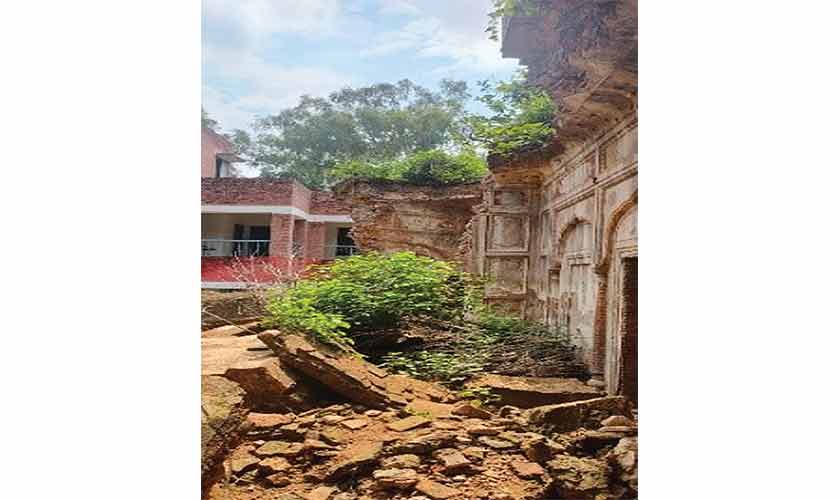
he octagonal base of the famous samadh of Maha Singh, the father of Maharaja Ranjit Singh, which was built in Sheranwala Bagh in Gujranwala in 1837, has partially collapsed. The Evacuee Trust Property Board, tasked with maintenance and preservation, has attributed the collapse to heavy rainfall. As a result, there is an imminent threat that the 80-foot-tall structure, having a dome atop its octagonal base, may fall onto a nearby school. This calls for immediate attention from the authorities concerned.
According to Umdat-ut-Tawarikh (the official court diary of the Sikh Darbar at Lahore), Daftar III, in 1836, Gen Hari Singh Nalwa of Gujranwala submitted designs for the samadh of Maha Singh to Maharaja Ranjit Singh, who sanctioned a grant of Rs 12,000 for its construction next to the fortified city. The samadh was constructed in 1837 at a corner of Sheranwala Bagh, formerly known as Hazuri Bagh. Along with the samadh, a baradari (a twelve-door pavilion) was also built within the Sheranwala Bagh under the oversight of Gen Hari Singh Nalwa. A subsequent reference to the samadh appears in Daftar III in 1838, when Maharaja Ranjit Singh sanctioned the allocation of a village to his son, Kharak Singh, for the upkeep of the Sheranwala Bagh and the samadh of his father situated within it.
John Murray mentions the samadh in his 1883 Handbook of the Panjab, stating, “At 1/4 mile beyond the station is the samadh of Maha Singh, father of the great Ranjit. It is a very handsome structure, 81 feet high to the top of the gilt ornament on the summit. It is an octagon, each side of which measures 25 feet. 13 steps lead up to the vestibule. The inner room, where there are the knobs that mark the places where the ashes [of Maha Singh] are deposited, is 27 feet 2 inches broad. The breadth of the whole building is 60 feet.”
Dhanna Singh, a Patiala inhabitant, visited Sikh gurdwaras throughout British India by bicycle from 1930 to 1934. He visited this historical location on October 9, 1932. He observed that the central chamber of the samadh had been converted into a gurdwara by the local Sikh community, featuring the parkash (daily display) of the Siri Guru Granth Sahib. He observed that, at that time, Sherawala Bagh remained in the ownership and designation of the samadh, although the local government administered it. These arrangements at samadh, baradari and Sheranwala Bagh persisted until 1947.
After the partition of the Indian subcontinent in 1947, the local government continued to maintain Sheranwala Bagh, despite its being registered under the name of the samadh. However, the stewardship and upkeep of these historical sites fell under the jurisdiction of the ETPB. The Board deserves acknowledgement for refurbishing the baradari, although some experts have taken issued with the ‘ostentatious’ nature of the project.
The samadh, meanwhile, was disregarded by the ETBP, except for the erection of a brick wall around it, thereby isolating it from Sheranwala Bagh. No significant maintenance has been conducted at the samadh since 1947.
The authors visited the samadh in 2024 and documented its lamentable state, providing photographic evidence of deterioration due to insufficient upkeep.
The ETPB’s attribution of the recent damage to the historical samadh to the torrential rains that have devastated both the Charrhda (East) and the Lehnda (West) Punjab in recent weeks is questionable. The principal reason for this collapse may be the prolonged neglect of the historical site, for which the ETPB may be held responsible. The recent rains only constituted “the last straw that broke the camel’s back”.
The ancient Arabic adage is pertinent in this context. The agency permitted the historical samadh to deteriorate for almost eight decades. This underscores the agency’s negligence regarding the upkeep and conservation of Sikh monuments in its purview. The ETPB must acknowledge responsibility for the collapse, attributed primarily to inadequate maintenance of the historical site. Meanwhile, the agency’s initiatives to deliver prompt aid and stabilise the site to avoid additional collapse from a safety standpoint are commendable.
The samadh was entirely disregarded by the ETBP, except for the erection of a brick wall around it, thereby isolating it from Sheranwala Bagh. There has been no significant maintenance since 1947.
A recent statement by the chairman of the ETPB mentions the he measures implemented at the site. It notes, “Consultancy has been sought from Expert Preservation Companies to restore the building to its original grandeur and elegance, considering its heritage value and significance.”
This is an official way of offering an apology: a pledge to restore the historical landmark to its original splendour. The actual outcome will be revealed in a year or two when the ETBP fulfils its chairman’s commitment to the people of Pakistan and the Sikh community by restoring the historical site to its “original grandeur and elegance, considering its heritage value and significance.”
The recent partial collapse of this samadh is not the first heritage Sikh structure under the ETBP administration to have seen such an event. In 2023, Gurdwara Roori Sahib, a gurdwara commemorating the visit of Siri Guru Nanak Sahib, situated on the periphery of the village of Jahman near Lahore, collapsed following a rainfall.
This shows that the inadequacy of repair and preservation of Sikh monuments in Pakistan may be systemic. Although the ETPB effectively maintains prominent historical gurdwaras in urban locales, it has made minimal efforts to preserve Sikh religious sites in rural areas, despite the substantial land and property associated with these sites that generate consistent income for the ETPB. It appears that the income is not allocated exclusively to site upkeep and is instead placed into Board funds. Gurdwara Boali Sahib (behind the Sunehri Masjid) in Lahore has been dismantled. The agency allegedly still maintains oversight of over 110 shops affiliated with the gurdwara and collects rent.
Dr Butalia, a co-author of this essay, analysed around 10 Gurmukhi texts created before 1947 that mention Sikh historical shrines situated in the current Lahore district (Sikh Historical Shrines in Pakistan: Lahore District, by DrTarunjit Singh Butalia, April 2025).
Over 40 historical shrines have been identified in the Lahore district. Of these, five shrines have operational gurdwaras. Another is well-preserved but no longer functions as a gurdwara. Fourteen sites remain intact but have been occupied by locals, repurposed as graves, or utilised for educational purposes, among other functions. Eight sites are currently in disrepair due to neglect, and fourteen sites have either disappeared or been replaced by modern structures. Their exact locations are documented in the publication mentioned above. The situation is regrettable considering that the ERPB claims to be the protector of historical Sikh holy sites in Pakistan.
The ETPB should first produce a comprehensive list of Sikh heritage sites in its jurisdiction, including the accompanying land and properties. The revenue generated from these properties is substantial and ought to be allocated for their upkeep, maintenance and repair.
Meanwhile, immediate restoration measures are necessary for historical religious monuments in deteriorating conditions. The areas currently occupied by Partition refugees, among others, should be cleared up and the buildings renovated.
Historical heritage markers ought to be installed at all pertinent locations, especially those that have been demolished, to educate the public regarding their previous existence and significance.
The failure of the ETPB to maintain these sites despite generating revenue from the associated land and properties, is concerning. It risks losing the Sikh community’s confidence in the ETPB for the protection of their holy historical places. Deeds will convey more meaning than spoken words.
Mazhar Abbas, author of The Aftermath of the Bangladesh Liberation War of 1971: Enduring Impact (Routledge, 2024), has a PhD in history from Shanghai University. He is a lecturer at GCU, Faisalabad, and a research fellow at PIDE, Islamabad. He can be contacted at mazharabbagondal87 @gmail.com. His X-handle is @MazharGondal87
Dr Tarunjit Singh Butalia is a faculty member at the Ohio State University and the director of Jeevay Sanjha Punjab. As executive director of Religions for Peace, USA, he has been a dedicated interfaith servant-leader for over 20 years. He can be reached via email at tsbutalia@gmail.com