

Print Story
X




Noor Jehan’s migration at Partition was a turning point that gave a struggling industry the confidence and glamour to survive.
| T |
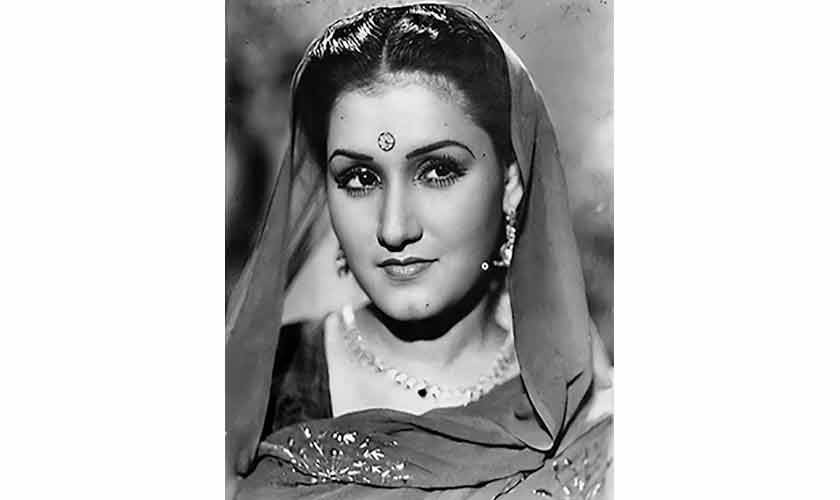
he most surprising aspect of Noor Jehan’s life was her decision to migrate to Pakistan at the time of Partition.
It was surprising because she was then at the height of her career as a playback singer. She was unmatched in talent and virtuosity, and since films relied heavily on music, particularly songs, her acting was accepted largely because of her extraordinary voice. No other vocalist came close to her. She carried forward the singer-actor tradition with grace, and her films such as Anmol Ghari and Jugnu, released shortly before Partition, were major successes.
Her decision to move to the new country was therefore seen as a huge loss to the Indian film industry, prompting many music composers to weep at her departure.
After Partition, the film world in Pakistan had been severely depleted by the migration of trained personnel. Film production, in many ways, had to begin afresh. Lahore was a much smaller centre of production compared with Bombay and Calcutta. Shori Studios was allotted to Noor Jehan and her husband, who renamed it Shah Noor, and production began again, though in a fragile fashion, with limited resources.
There were only a few film music composers, albeit highly talented. However, their careers lacked the versatile experience of their counterparts in Bombay. The industry, therefore, faced many obstacles and constant struggles against odds.
Even so, by the mid-1970s, Pakistan was releasing around 100 films a year. Much of the credit for this revival goes to Noor Jehan. Her migration gave confidence to a depleted industry, and her presence brought glamour and glitz.
She was unmatched in talent and virtuosity… No other vocalist came close to her.
Her talent was so formidable that she rallied personnel around her. With limited means, production was restarted, ensuring continuity in an industry badly shaken by mass migration, destruction and violence.
She was a woman of high calibre and faced all the challenges that the new order sought to impose. The arts and show business came under scrutiny, with some in authority dismissing such expression as being against the values of the new state. As always, the people defied this narrow reading. They continued to flock to cinemas, and despite the difficulties, the credibility of the industry was restored.
When radio was established, there was resistance. The same occurred when television was launched. But every time, the public countered opposition by actively embracing these mediums.
Noor Jehan was a pioneer of the film song as the talkies ushered in a new era and format. In those early years, singers had to perform on set, as playback recording was still some years away. Along with KL Saigol, she became a trendsetter who laid the foundations of this new form.
She was only a child when she began performing on stage with her sisters. Known as the Punjab Mail for their tayaari and full-throated ease, the group quickly drew attention. Soon, she caught the ear and eye of Master Ghulam Haider, who gave her a break in Sheela Pind Di Kurri. From there, she never looked back. In Khandan, another Ghulam Haider masterpiece, she cast off the mantle of a child performer to take on the role of heroine, cementing her place as the leading vocalist of the industry until her migration to Pakistan.
She was a fiercely independent woman who lived life on her own terms. Her only weakness was her children: the world could not have found a more devoted mother.
The writer is a Lahore-based culture critic.