

Print Story
X

It apparently began with disagreement over a perk. Lawmakers in Jakarta, already widely distrusted, had approved a new monthly housing allowance — a sum nearly ten times the minimum wage in the capital. In a country where millions of workers juggle multiple jobs just to cover rent, rice and transport, the revelation landed like a slap in the face.
Indonesia is no stranger to inequality or the sight of elite enriching themselves. What turned irritation into fury was the death of a 21-year-old delivery driver, Affan Kurniawan, killed when an armoured police vehicle ploughed into a crowd of protesters. Affan, clad in the green vest of a gig worker, was catapulted overnight from anonymity into martyrdom. His fate came to embody the gulf between rulers who indulge themselves and citizens who risk their lives in precarious work — and, now, in protest. That juxtaposition — the golden allowances of the few, the green uniform of the many — detonated something larger. Suddenly, what might have been another cycle of grumbling over corruption exploded into Indonesia’s biggest political unrest in years.
For many Indonesians, the turbulence has stirred uncomfortable memories of 1998, when student protests toppled Suharto’s three-decade New Order regime. Then, as now, students were on the frontlines, women’s voices became increasingly prominent, and outrage was sharpened by economic crisis. Suharto’s fall was preceded by years of corruption and cronyism, capped by a police and military response that left blood on the streets of Jakarta.
Today, the context is different. Indonesia is a democracy, not a dictatorship. President Prabowo Subianto, Suharto’s son in law, insists he is committed to reform and stability. Yet the symbolism of a young delivery worker’s body beneath a state vehicle recalls the darkest days of state violence. Protesters know their history, and many deliberately invoke 1998 in chants and banners: Reformasi belum selesai (reform is not finished).
Movements often require symbols. Indonesia’s agitation has found them in vivid hues. Affan’s green vest has become shorthand for working-class rage, a colour already charged with meaning in Indonesia, where ojol (online motorcycle taxi) drivers in green jackets have come to represent the precarious gig economy.
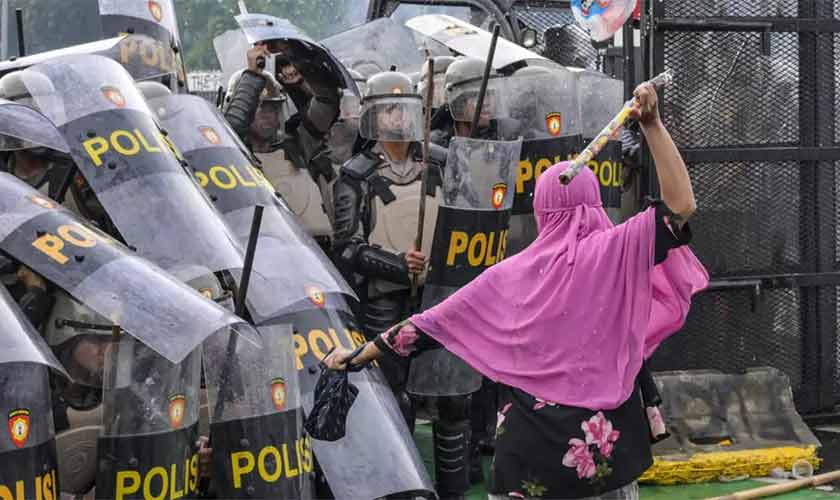
The second symbol, pink, emerged more unexpectedly. A woman in a pink hijab, standing with a broom in hand before the gates of parliament, was photographed and broadcast across networks. She came to represent the household — and women’s labour — sweeping away the rot. Pink signalled courage, not softness, and the broom became a weapon as potent as any Molotov cocktail. “Brave Pink, Hero Green,” journalists began calling the pairing, and social media turned them into a language of resistance: memes, avatars, graffiti and banners repeating the two colours as rallying cries.
Unlike some leaderless uprisings that fizzle in passion, Indonesia’s movement has articulated a set of demands. Packaged online as the “17+8,” they comprise 17 urgent calls and 8 structural reforms. The short-term goals are straightforward: strip back the perks, launch independent investigations into police violence, release the detained and keep the military out of crowd control. The longer-term demands aim at deeper surgery: overhaul the legislature, confiscate the assets of corrupt officials, reform the police and expand protections for vulnerable workers. The platform was assembled by student groups, sharpened by labour unions and amplified by influencers. In an era when protests often wither for lack of focus, the 17+8 gives coherence — a document that can be held against the government, a yardstick by which to measure whether concessions are real or cosmetic.
One might imagine that protesters would march their demands straight into parliament. Instead, political parties find themselves frozen out, treated with the same contempt as the perks that set this blaze alight.
The reasons are layered. First, legitimacy: the DPR itself is seen as ground zero of the scandal, the heart of elite indulgence. Second, collusion: many Indonesians believe business and political elites operate in a closed loop, enriching one another while ordinary people are left behind. Third, distrust: students and grassroots organisers fear that engaging parties will only sap momentum, co-opt leaders and dilute demands. Better to remain on the streets than to be absorbed into a system they see as designed to neutralise dissent.
Indonesia’s protests are not polite. Chants of Bubarkan DPR — dissolve the parliament — ring out alongside Polisi pembunuh (police are killers). Others call for a total re-set of the political system. The broom imagery, repeated in chants to “sweep the state,” captures the sense of wholesale cleaning rather than incremental reform. Unlike earlier protests focused on personalities, this movement’s slogans target institutions.
Some observers have drawn parallels with Bangladesh’s 2024 student and quota protests, which toppled political certainties there. The echoes are clear: youth-led movements, catalyzed by state violence, amplified by social media and infused with female leadership. Both confronted entrenched elites in societies marked by inequality.
Yet Indonesia’s path is distinct. Bangladesh’s movement spiralled into months of upheaval, dozens dead, thousands detained and a wholesale collapse of political legitimacy. Indonesia’s crisis, though deadly, has not yet engulfed the entire system. Whether it does will depend on whether Prabowo’s government treats this as an irritant to suppress or a reckoning to embrace.
The unrest has spilled across borders in symbolic ways. Indonesian Diaspora groups have marched in Berlin, New York and Melbourne. In Kuala Lumpur, Malaysians gathered outside Indonesia’s embassy. In smaller gestures, ordinary citizens across Southeast Asia have ordered food for Indonesian delivery riders in solidarity. There is no evidence of state interference, but there is plenty of evidence of regional empathy. Indonesians abroad and neighbours nearby recognise the universality of the struggle against elite impunity.
Global media and analysts frame this as a test of Prabowo’s young presidency. Reuters has called it his “biggest challenge yet.” The Financial Times sees deep economic discontent that could undercut growth if left unaddressed. The Associated Press reports grim human costs: seven dead, nearly 500 injured. The Carnegie Endowment speaks of a reckoning between ordinary Indonesians and a collusive elite. Credit agencies warn that prolonged turmoil could spook investors and squeeze the state’s finances.
In short, what began as an issue of housing perks has escalated into a question of Indonesia’s stability and credibility.
If there is to be a way out, it lies in tangible reform. First, there must be independent investigations into police killings, with results visible to the public. Second, perks must be rolled back not just temporarily but permanently, with legal safeguards preventing their quiet return. Third, the military must retreat from civilian policing — a demand rooted in Indonesia’s painful past under Suharto. Fourth, dialogue must expand beyond party elites to include students, workers and civil society. And finally, economic relief — subsidies, wage supports, gig worker protections — must ease the material pain that fuels this anger. Without these steps, concessions will appear tactical and temporary. With them, Indonesia could seize an opportunity to deepen its democracy.
The images of pink and green are not just aesthetic choices; they are moral colours. The pink broom reminds Indonesians of the unseen labour of women, sweeping corruption out of the house of the nation. The green vest reminds them of gig workers, delivering services without security, too often invisible until one of them dies beneath a police truck.
Indonesia is Southeast Asia’s largest democracy, its economic engine and a regional linchpin. What happens there will resonate across the region. If Jakarta can answer this movement with real reform, it may restore faith in democratic accountability at a time when many see democracy as hollow. If not, repression will breed only more fury, and the broom will sweep harder.
The protests say plainly: reform is not finished. The question is whether the government dares to complete the work.
The writer is a professor in the Faculty of Liberal Arts at the Beaconhouse National University, Lahore.