

Print Story
X

| I |
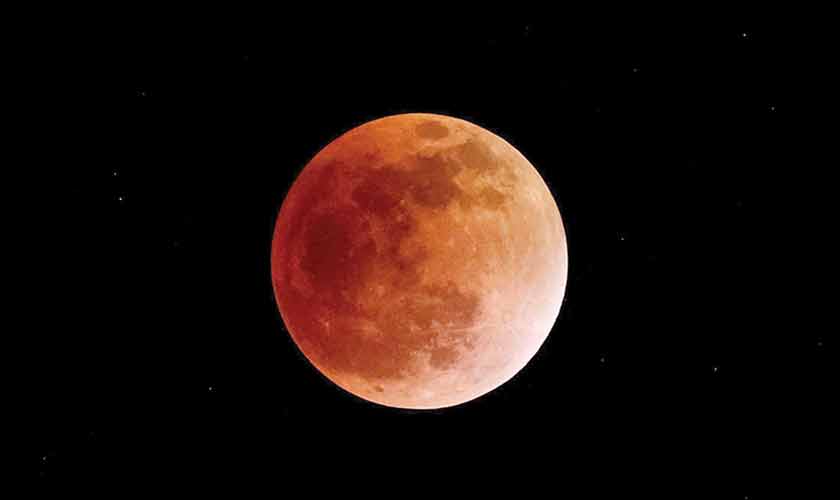
I feel lucky growing up in a house where the adults were always sceptical and critical of superstitions about the blood moon. It is not hard to recall my neighbours hushing each other and not leaving the house when there was a lunar eclipse. Some would say things like “pregnant women should not use a metal blade.” Others would whisper, “Cover the baby,” to save the infant from deformity.
The archaic cautions felt less like baseless superstition and were more of inherited, fostered family rituals carved to calm the uneasiness that followed experiencing anything strange and/ or unfamiliar.
Interestingly, literature and poetry in Urdu and diverse regional tongues treat the moon more as mood than motif. Classical ghazal and nazm writers indulge in the imagery of moon, be it the OG Mirza Ghalib’s “Mah-i-tamam kay saamnay/ Roshni kahan tak hai?” or Parveen Shakir’s “Chaand bhi kitna tanha lagta hai/Tum say mil kar bhi adhoora lagta hai.”
Moon is not just an ethereal body; it’s a metaphor for the beloved’s beauty, unattainability and aziyat-i-Ishq. “Blood-moon” narratives are rare in canonical Pakistani literature. What popped in my mind when I thought of blood moon was Garcia Lorca’s Blood Wedding. Here the moon assumes a character, all its own, embodying fate and death. “Let the moon come! Blood across the blades, blood in the stars.” Splendid.
The moon motif survives primarily in oral tales, local sha’eri and, more recently, in popular horror and self-published fiction that borrow the phrase as a shorthand for doom. The stories stitch together dated pan-Asian myths often resulting in hybrid folklore.
Beneath a red moon, old superstitions and modern scientific explanations coexist uneasily in my mind. Folklore shapes the fear while astronomy provides rational calm. Amidst the two, I stand silently, unsure yet respectful and a little unsettled.
It has quietly evolved from literal fear to symbolic melancholy where the red moon signals moral disturbance rather than literal catastrophe.
In rural communities across the Punjab, blood moon is more than a celestial event. It is deeply woven into the fabric of cultural and religious life. I discovered that people still connect lunar eclipses to religious observance, hygiene taboos and moral folklore. These practices, unrelated to astronomy, are part of reinforcing social order and reassurance.
Lunar eclipses are frequently seen as harbingers of bad luck. This reveals a worldview where natural phenomena are filtered through mystical interpretation. Such beliefs highlight how eclipses function not just as celestial events but also as instruments for upholding social norms and strengthening communal identity.
Over the years, the way people respond to the blood moon has changed. Where grandparents once insisted on staying indoors, urban Pakistanis now see it as an event to watch and photograph. SUPARCO’s recent images of the blood moon over Quetta, widely circulated, present it not as an omen but as a striking phenomenon.
I must confess that I never found the courage to fully dismiss the childhood warnings. Beneath a red moon, old superstitions and scientific explanations coexist uneasily in my mind. Folklore shapes the fear while astronomy provides rational calm. Amidst the two, I stand silently, unsure yet respectful, and a little unsettled.
Qurat Ul Ain Khalil is pursuing a post-grad degree in education at the University of Sussex