Print Story
X




As monsoon brings chaos across Pakistan, the Indus Delta is thirsty for the flood that many fear
| O |
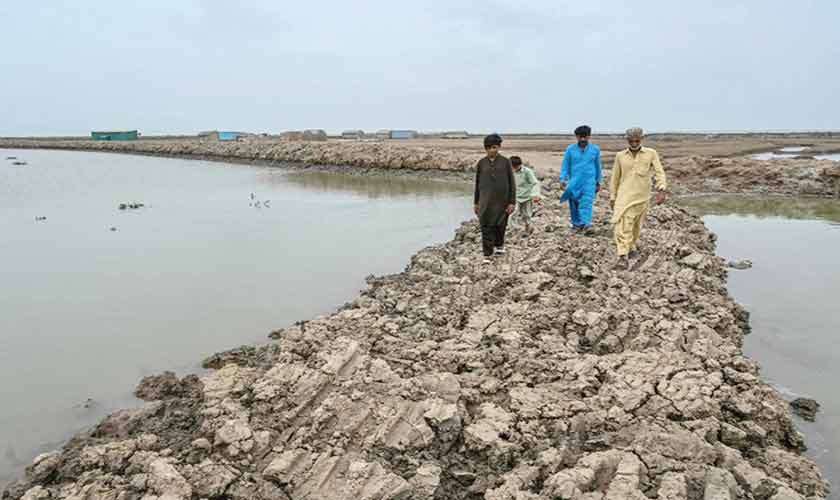
n television, the images are relentless. Flood breaching embankments, punching through; streets turned to channels, with water destroying infrastructure and crops that came in its way. But far downstream in the Indus Delta, a quieter story is unfolding. People are anxiously waiting for the flood to arrive.
I recently spoke with residents of the delta. Ghani Katyar, a resident of the Katyar village on Khobar Creek, said, “The river has grown tired.” When asked what he meant by that, he referred to the dull, tea-coloured water surface. “See how slow the river is. The water is sluggish. It is not carrying much silt.” He said this year’s flows, like those of 2022, had a limited benefit. It can recharge groundwater; boost fisheries; renew mangroves and wetland plants; and support agriculture. I was astonished that he did not use the word ‘flood.’ When I asked him about it, he said that the “river is in floods when it carries silt, creates new land, and pushes away the sea.” He said the local fishers and farmers were anxiously waiting for the flood to reach the Indus Delta.
Similar views were shared by Naseer Memon, a prominent environmental expert. Speaking to The News on Sunday, he said, periodic floods like those this year and 2022 provided temporary relief to the Indus Delta, its people and biodiversity. However, he said there was also need for a sustained flow of water towards the delta. According to him, at least five thousand cusecs of permanent river flow is required besides the flash floods every three to five years. Only then can the river transport and replenish the sediment budget of the delta.
Upstream, a major flood is perceived as a danger. However, in the delta, such floods are a lifeline. When the Indus runs strong, it carries two gifts: fresh water and fine brown silt. Together, they build new ground, refresh exhausted soil, push back the sea and keep mangroves and fisheries alive. “A good flood feeds the delta,” says Umer Jat, another local.
More than a century ago, geologist GK Gilbert noted that a river’s power to carry sediment rises and falls with its speed. Floods provide the river with the speed and strength needed to bring sediment to the delta. Geological literature indicates that in its pre-dam state, the Indus River would transport more than 270 metric tonnes of sediments annually, powered by floods of more than 100 million acre-feet. Today, with less than 0.5 MAF river flow, that too only during the flooding years, the river transports only 13 million tonnes of sediment annually.
Policy documents such as Living Indus: Investing in Ecological Restoration acknowledge that: “The country has lost 2.2 million hectares of land due to sea intrusion, creating a vulnerability for the entire coastal ecosystems and fishing communities in the Indus Delta region are forced to migrate due to sea intrusion.” The solutions proposed in the document include an integrated coastal zone management plan to protect biodiversity, revive mangrove forests, uplift fishing communities and manage urban sprawl.
However, these goals can remain unfulfilled, especially in the context of the Indus Delta, if we continue building riverine infrastructures such as dams and barrages. The harm due to dams and barrages is well documented throughout the world. They alter natural river regimes and starve the delta of sediments, interrupting crucial processes of soil accretion. Yet, a discourse favouring more dams resurfaces in Pakistan during every flooding. Memon is opposed to building mega dams that take decades to complete and require billions of dollars on account of a year or two of high floods.
Dams and barrages also block the fish passage. These especially affect migratory fish species such as Pallo (Indus Shad). The local fishermen of the delta recall how the Pallo would start appearing in the creeks as early as March and would travel upstream through April until August, when the river swelled for spawning. The return migration would start in September and October. The intertwined life history of the Pallo fish and the Indus River has been interrupted by dams and barrages.
“Even this year’s flood can be beneficial,” said Ghani Katyar, “but it is occurring when Pallo starts its return migration rather than upward movement.” These infrastructures have consequences—for lives and livelihoods of the locals.
Mangroves too require freshwater and nutrient-rich sediments. Hajan Jat, a camel herder who has sold all his camels, recalls the tall, green, dense mangrove forests in the delta, where his camels would browse. He says that once mangroves used to be so tall and dense that they would be visible from the sea and would guide fishermen who returned from fishing in the deep sea. He and other residents of his village recall how mangroves protected them from cyclones and coastal flooding. This year’s flood may provide temporary relief to the mangrove ecosystem, but without persistent river flow, these and other crucial ecosystems in the delta will suffer.
Balancing those goals requires more than toggling a gate. To address flooding challenges, some questions need to be asked: Can we release river waters in time to sustain a silt-rich pulse that reaches the coast? Can we clear choke points where the riverbed has risen? Can we reconnect floodplains in a way that stores water safely without trapping the sediment the delta needs? Can we measure success not only in avoiding inundation upstream but also in land gained or not lost to sea downstream? Can we design infrastructure so that it allows Pallo to travel upstream and return freely to the deltaic waters?
Seeing floodwater rush downstream Kotri toward delta is a nostalgic sight. It is time to adopt a more pragmatic approach. A river should not be seen as a source of economic need alone but also as a system that is relationally connected throughout its basin with the people, forests, fish, mangroves and biodiversity.
The writer has a PhD from the University of Georgia, US, in environmental anthropology. He works as a lecturer in the Department of Anthropology and Archaeology, University of Sindh.s