

Print Story
X




The artist re-imagines the ordinary chair to probe solitude, friendship and society
| O |
n my way to Ayaz Jokhio’s exhibition, Three Chairs, at the Barracks Art Museum in Lahore, it was impossible to shake off the ghost of another work: One and Three Chairs, created 60 years ago by Joseph Kosuth. That installation comprises an actual wooden folding chair, a full-scale photograph of the chair and a photocopy of the dictionary definition of the word chair.
Kosuth’s seminal contribution to conceptual art explores the shifting boundaries between reality, its representation and its description. Three chairs are separate, yet each simultaneously substitutes for the others depending on context, prompting the viewer to question the “reality” of one in comparison with the other two.
Ayaz Jokhio’s solo show (August 27-October 12), in both its title and details, alludes to Kosuth’s work. However, it also offers something beyond a purely formal post-modernist exercise.
Jokhio’s illustrious oeuvre, embedded more in ideas than in surface manipulation, includes several artworks linked to earlier artists and practices. The element of appropriation emerged as early as 2001, during his final year at the National College of Arts, when he reproduced a page from Art Through the Ages containing Van Gogh’s self-portrait and its description, scaled to match the actual size of the Dutch painter’s canvas.
This questioning of originality - of the artist’s hand, style and idea - continued in some of his later work. It also extended to exploring the relationship between text and image, as seen in his degree show. There, he cropped one of his third-year studio paintings into a line that read: This Was a Painting. Every letter of the earlier work (crafted in MDF), reconstituted in sequence, affirmed both the history of that piece and, perhaps, the limitations of art history itself.
Numerous other significant pieces reference the art of René Magritte, who persistently challenged the distance between reality and illusion and the logic of language as the signifier of objects. In The Key of Dreams, for instance, four window-like panels depict different objects, yet the descriptions beneath them deliberately defy linguistic convention: the word door appears under the head of a horse; wind under a wall clock; bird beneath a jug; and valise under a suitcase.
In many cases, it is not personal power but the appearance of the chair itself that bestows a sense of strength upon the individual.
By expanding the association between words and images, Ayaz Jokhio also unpicks the settled meaning or function of an object, such as a chair. For convenience, we assume a chair to be a specific item, yet if every mind were searched, innumerable variations would emerge: based on colour, material, size, function, shape, condition, period, position or components. Each variation transmits its own set of messages, shaping a personal idea of chair from what might otherwise appear to be an ordinary article seen, handled or used by millions at once.
Still, certain overarching concepts remain attached to chairs, among them, authority. Chairs appear in late European art, as well as in paintings from the Mughal subcontinent, Persia and the Middle East, most often as parallels to the throne. Even in today’s democracies, a chair conveys social status. At a school function, a political meeting or a family photograph, the central chair, by its placement alone, signifies the importance of the school principal, the party chairman or the head of the household.
The expression of dominance, authority and control is often intertwined with the term chair. In many cases, it is not personal power but the appearance of the chair that bestows a sense of strength upon the individual. Hence, organisers of public gatherings take care to provide the chief guest with a chair that is prominent, elaborate and grand.
In many homes, however, a chair is simply another piece of furniture. It may be used for reading, relaxing, chatting, eating or enjoying music or sport. In some cases, it may serve as a place to contemplate one’s loneliness. Ayaz Jokhio’s Three Chairs (installed separately in three gallery spaces) rekindle all these associations. He introduces the work through the words of American transcendentalist writer Henry David Thoreau: “I had three chairs in my house; one for solitude, two for friendship, three for society.” (Walden; or, Life in the Woods, first published in 1854).
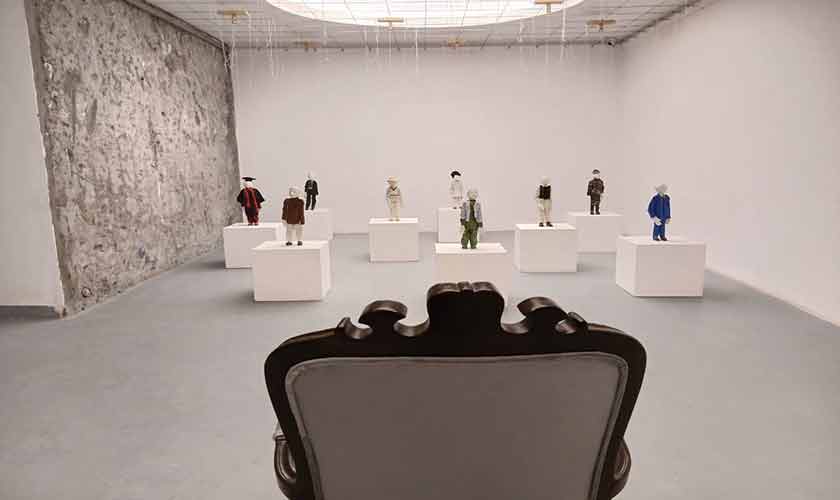
Jokhio’s three chairs, with minor variations in shape and function, yet appearing as though retrieved from an attic, invite a range of interactions. Sitting on one of them, the viewer is saluted by nine puppets (modelled in dry clay). These figures include: a lawyer in a black suit and tie; a cricketer in a Test-match kit; a professor with a dupatta and hood; a mullah in a traditional dress; a soldier in his fatigues; a doctor in her white coat; a well-dressed CEO; a journalist with a cloth bag; and a Pakistani politician. All are caricatured figures who raise their right hands in salute, operated through pulleys and threads.
This work, Society, recalls Jokhio’s participation in the first Karachi Biennale (2017), where student puppets in a classroom at NJV School stood up whenever an outsider entered the room. Yet the artist notes that his fascination with puppetry stretches back to childhood, when performers spun countless tales with makeshift puppets.
The element of narration surfaces again, as this work carries serious and critical content. By incorporating diverse representatives of society, programmed to respond in the same deferential way to the invisible presence of someone seated in the chair, the piece comments on the political situation, critiques the power structure and dissects ingrained behaviours.
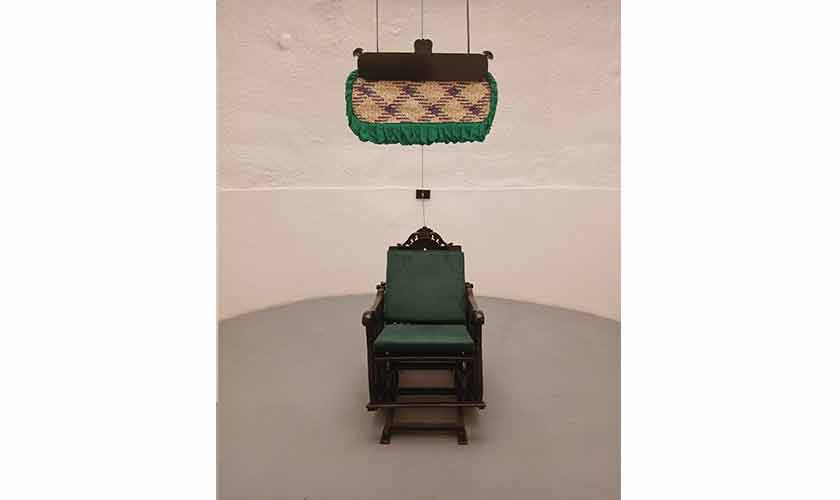
His next work, titled Friendship, is a rocking chair which, the moment someone sits on it, sets an old cloth fan hanging from the ceiling in motion. Friendship usually implies the company of at least two people, talking, walking, sharing a meal, watching a film or shopping together. But Jokhio’s Friendship has only one chair, with no space or provision for another.
This absence recalls the history and mechanisms of fans in the subcontinent. Hand-held straw fans were, and still are, moved by one person to provide relief on a hot day. Electric fans can be adjusted at the push of a button to serve one member of a family. Before the machine age, large cloth fans suspended from ceilings were moved using a rope, often by another person, to cool a room. In Jokhio’s work, the moment you sit on the rocking chair, the traditional fabric fan begins to sway, as if by an invisible friend’s hand (though in reality by a pulley).
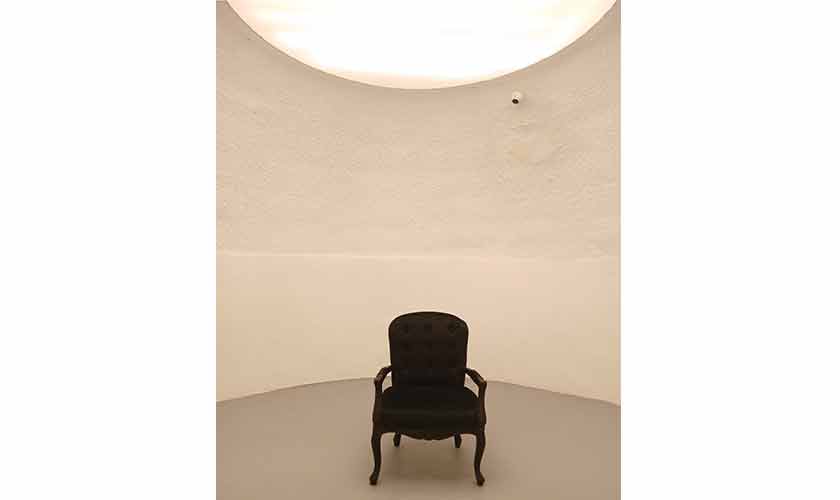
The third work, Solitude, is also a chair. When one sits on it, the entire room is plunged into darkness. The push button attached to the chair triggers this shift, transporting the sitter into another space, detached from companions, the physical environmentand the exhibition itself; perhaps even from the overpowering world of art and the world at large.
It also relieves the visitor of language. Words are the medium of exchange with others; in their absence, the interaction evaporates. What remains instead is solitude, an immeasurable duration of time, and the chair, the last captured in the poetry of Czeslaw Milosz: “Only this chair is real.”
The writer is a visual artist, an art critic, a curator and a professor at the School of Visual Arts and Design, Beaconhouse National University,
Lahore. He can be contacted at quddusmirza@gmail.com.