

Print Story
X

| I |
n the early 17th Century, as monsoon waters swelled the Chenab River, the city of Multan faced a flood that could have wiped it from the map. Mughal engineers, anticipating the seasonal deluge, had constructed a diversion canal that rerouted the river’s fury around the city. Villagers watched anxiously as the waters roared, but the canal held, sparing homes, granaries and lives. It was a testament to foresight and governance—proof that human ingenuity could coexist with nature’s wrath. Today, more than 400 years later, Pakistan’s rivers surge again. But the state’s canals and dykes are crumbling; its planning reactive. Millions of citizens are left wading through an avoidable disaster.
Climate change has turned Pakistan into a frontline climate catastrophe. Yet, rather than build on historical lessons, our leaders remain trapped in corruption, denial, and short-term politics—ensuring millions remain caught in a never-ending disaster cycle. This neglect is not new. From 1950 to 2024, Pakistan has endured devastating floods, each time followed by promises of reform; each time met with recurring destruction. The deeper injustice of climate change is profoundly global. Pakistan contributes less than one percent of global greenhouse gas emissions, yet it ranks among the world’s most climate-vulnerable nations.
Germanwatch’s Climate Risk Index 2025 lists it among the hardest-hit, with the 2022 floods alone causing $30 billion in damage. Just two years later, the 2024 deluge in the Punjab displaced millions and destroyed crops, once again exposing a state unprepared to shield its citizens. The ND-GAIN Index underscores this imbalance: Pakistan is the 41st most vulnerable country, but the 150th least prepared—a stark mismatch between risk and readiness.
The science is clear. Climate change amplified the 2022 monsoon rains, making extreme downpours 50-75 percent heavier than in a non-warming world. The IPCC warns that surpassing the 1.5-degree Celsius threshold will only escalate such extremes, bringing ever more destructive floods, droughts and heatwaves to South Asia. Pakistan’s plight is, therefore, not simply environmental—it is deeply political. It has become a symbol of global climate injustice and domestic mismanagement, where those least responsible pay the highest price, while institutions meant to protect them crumble.
This neglect is not new. Since independence, Pakistan’s history has been punctuated by catastrophic floods—1973, 1992, 2010, 2011, 2014, 2022 and 2024—each leaving behind not only wreckage but also broken promises. The cycle is painfully familiar: disaster strikes, leaders pledge reform, donors arrive with aid, and within months the urgency evaporates. Citizens are left to brace for the next monsoon, knowing that little has changed.
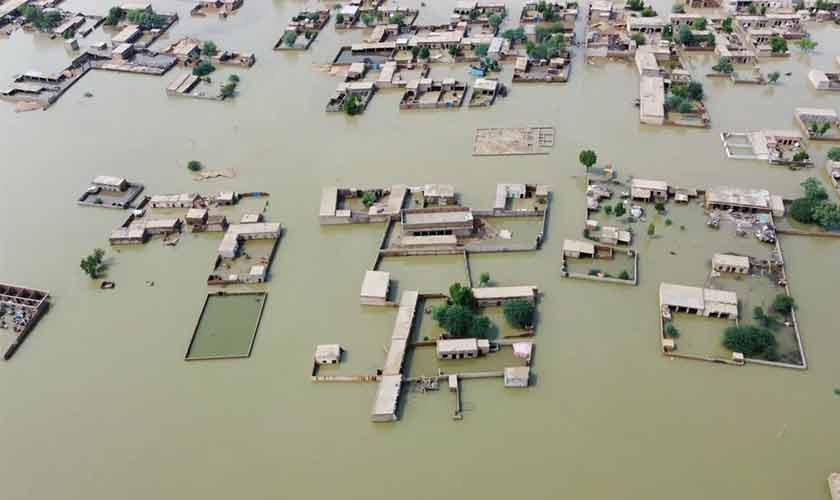
The 2022 floods were the starkest reminder of this pattern. When one-third of the country was submerged, the devastation was biblical in scale: villages erased from maps, millions displaced, crops and livestock annihilated. “We went to sleep in our homes and woke up in a river,” recalls a farmer from Sindh who lost everything, including his ancestral land. Families huddled on roadside embankments for weeks without shelter or sanitation, watching their children grow sick from contaminated water.
For many, the floods were not just a natural calamity—it felt like abandonment. In Islamabad, electioneering and talkshow theatrics eclipsed relief efforts, while in Sindh, Balochistan, and Khyber Pakhtunkhwa, communities waded waist-deep in toxic waters with no state support.
In the aftermath, the government unveiled the Resilient Recovery, Rehabilitation and Reconstruction Framework (4RF), backed by the UN, World Bank, EU and Asian Development Bank. It catalogued staggering losses: $14.9 billion in damages; $15.2 billion in economic costs; and nine million newly impoverished individuals. On paper, it promised to rebuild stronger and smarter. Yet two years later, the reality on the ground tells another story.
The lesson of every flood since 1950 is clear yet unlearned: without systemic reform, Pakistan’s people will continue to survive through courage and improvisation.
Flimsy embankments still line swollen rivers, offering little more than false reassurance. Unsafe homes continue to sprout on floodplains. In Rajanpur, a widow rebuilding her house on the same site washed away in 2022 said, “Where else can I go? This is all I have.” Local governments—meant to be frontline resilience hubs—are hollowed out by underfunding and political interference. In Balochistan, a community leader lamented: “We are the first to be flooded, the last to be heard.”
Yet, amid this vacuum, ordinary people have shown extraordinary resilience. In Dadu, women organised makeshift schools in tents to keep education alive for displaced children. In Southern Punjab, farmers pooled resources to rebuild irrigation channels after official promises stalled. These acts of solidarity show that resilience exists, but it is being carried on the backs of the vulnerable rather than being supported by the state.
What persists, then, is not only environmental exposure but institutional fragility: a governance culture that lurches from crisis to crisis, reacting rather than preparing, and prioritising optics over outcomes. The lesson of every flood since 1950 is clear yet unlearned: without systemic reform, Pakistan’s people will continue to survive through courage and improvisation, while their government remains stuck in cycles of neglect.
The National Disaster Management Authority, created after the 2005 earthquake to anchor disaster response, has collapsed into dysfunction. In 2023–2024, auditors flagged Rs 28.6 billion in financial irregularities, with only a fraction recovered. Public surveys show 84 percent of citizens dissatisfied; in flood-prone areas most residents received no early warnings, no evacuation training and little post-disaster support. Regional monitoring is equally skewed: the Punjab and Islamabad host dozens of weather observatories while Gilgit-Baltistan and Azad Jammu and Kashmir—where melting glaciers feed dangerous rivers—remain dangerously under-monitored. This is not incompetence alone; it is structural neglect.
Into this void step international donors.
UNDP’s $90 million Flood Recovery Programme has rebuilt homes, supported women-led initiatives, and provided cash-for-work to restore livelihoods. In Sindh, a mother recalls how a cash grant bought food and medicine for her children; in Balochistan, a farmer describes the dignity of rebuilding his village through community programmes. These stories inspire but they also indict: Pakistanis are surviving not because of their state but despite it. A nation cannot outsource its own survival.
Breaking the cycle requires more than donor lifelines. The NDMA must be rebuilt with ring-fenced budgets for prevention, subject to independent audits, and given real authority to coordinate with provinces. Early-warning systems must evolve from vague advisories into village-level evacuation orders, disseminated through SMS, radio, mosques, schools and women’s networks. Floodplain laws must finally be enforced to stop reckless development, while investments must prioritise resilient housing, mangrove and wetland restoration, and infrastructure built to withstand climate extremes projected by the IPCC.
Above all, resilience must be rooted in communities. Citizens are not passive victims; they are the first responders, often rescuing neighbours with boats or rebuilding homes with their own hands. They must be trained, resourced and empowered as decision-makers. Donors can help, but Pakistan must reclaim ownership of its survival.
Climate change has made Pakistan a frontline catastrophe but helplessness is not destiny. The Mughal engineers who saved Multan centuries ago proved that governance and foresight can coexist with nature’s wrath. Today, that truth still holds: the waters will recede, but they will rise again. And the greatest tragedy will not be the floods; it will be a state that knows what is coming yet refuses to prepare.
The writer is professor in the faculty of Liberal Arts at the Beaconhouse National University, Lahore.