


Print Story
X




A school’s journey to providing its students clean drinking water
| O |
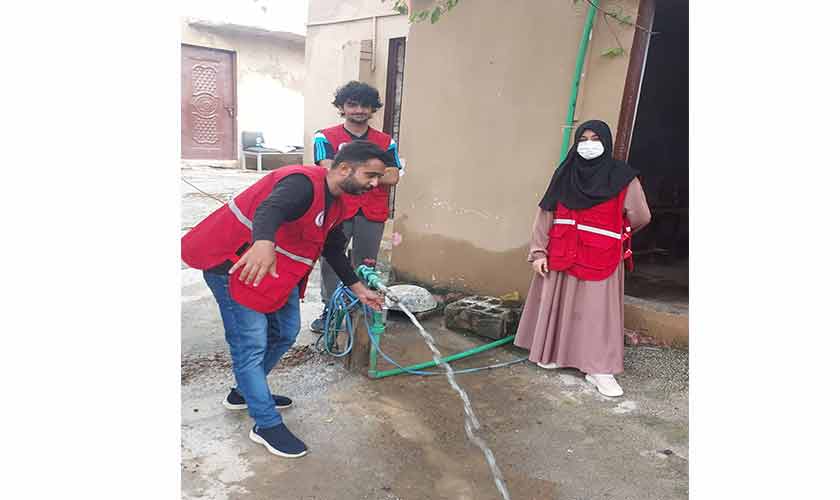
n a warm afternoon in Islamabad’s D-12 Sector, children rush out of their classrooms during the school break. Instead of running toward the school gate or playing in the dusty courtyard, many head straight for a handpump near the old borehole. With smiling faces, they take turns filling glasses of safe drinking water, gulping down relief in the summer heat.
It is a small act, missed effortlessly by outsiders. But for the school, it signifies a silent revolution: clean drinking water, restored through the simple power of rain.
Without water
For years, the school had a borehole dug deep into the ground. But as the groundwater table fell, the borehole dried up.
“Children often had to bring water from their homes,” recalls the principal. “Some went thirsty during the day. Others would leave school early because they couldn’t bear the heat without water.”
Teachers noticed how thirst caused students to lose focus during lessons. “When you are thinking about water, you cannot think about maths or science,” one teacher explained.
In the midst of this challenge, came a group of young volunteers with an unusual idea: why not use rainwater as drinking water?
Enter climate champions
The idea took root under the Climate Advocacy and Coordination for Resilient Action project, implemented by the Pakistan Red Crescent Society in partnership with the German Red Cross, and funded by BMZ.
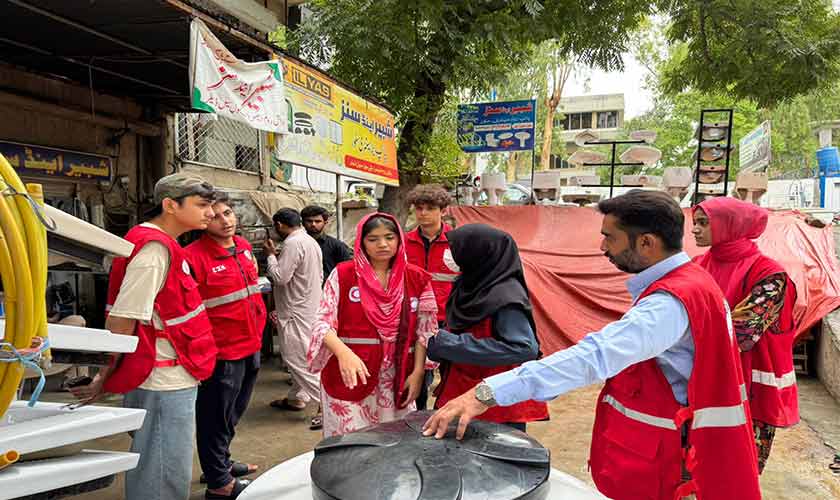
As part of the project, PRCS trained young volunteers as climate champions, preparing them with the skills to advocate, design and implement local climate adaptation initiatives.
After their training, groups of volunteers were invited to submit concept notes for small projects with a budget of Rs 100,000, each. One such group, led by a spirited volunteer named Pireh and Nisar Chang, identified the struggling school in D-12.
“There was a borehole but there was no water,” Pireh said. “We thought that if we can recharge the groundwater through rainwater harvesting, this borehole could serve the children again.”
Science of simplicity
The solution was deceptively simple. The team installed pipes along the roof of the school building. When rain fell, water coursed down the roof and into the pipes, gathering momentum. Instead of wasting away into the drains or flooding the street, this water was channelled directly into the dried borehole.
With each rainfall, underground reserves slowly revived.
“It was like bringing the borehole back to life,” one volunteer explained. “The same handpump that stood useless for years is now running again. The children can drink clean water at school without worrying.”
Happy children
For the students, the difference has been life-changing.
“Before, whenever we used to be thirsty, we had to go home,” said one boy shyly. “Now, we just drink here. We don’t miss our classes anymore.”
Rainwater harvesting offers a low-cost, practical solution. By capturing water where it falls on rooftops, courtyards and roadsides, and channelling it into storage tanks or boreholes, communities can reduce reliance on external supplies and recharge their groundwater reserves.
Another student chimed in: “In summer, it was very hard for us. We had no water and could not study properly. Now, water is available.”
Their joy is echoed by the principal. “We are very thankful to the PRCS team that they initiated such a great project. It is running successfully, and our children are now able to drink water during school hours. This is not just about water, it is about health, dignity and the right to education.”
A chorus of support
The initiative has drawn wide admiration.
Sajjad Ali Kandhir, deputy director on climate change adaptation at the PRCS, sees this as a boost for education. “This project will help students focus on their studies. Clean drinking water is essential for learning, and our volunteers have shown that youth-led actions can bring real change.”
Ghulam Rasool Farooqui, programme manager for the German Red Cross, admired the creativity of the youth. “Such initiatives are the motivation we need. Our young people have the energy and innovation to lead climate adaptation actions. This is a shining example.”
Misbah Mushtaq, deputy director of youth and volunteers at the PRCS, emphasised on the bigger vision. “Volunteers are the backbone of the PRCS. Their initiatives, such as this, can be replicated in other schools and communities across Pakistan. What these young people have achieved is both inspiring and practical.”
And for Nisar Chang, the volunteer leader, the effort was deeply personal.
“We worked hard to make this project successful so that the children could benefit. When we saw them drinking water happily, all our efforts felt worth it.”
Rain as a resource
The story of this school underlines a fact: rain can be used as a resource.
Too often, monsoon rains deluge streets, damage homes and flow away unused. At the same time, groundwater levels across the country are plummeting disturbingly. According to experts, cities like Islamabad, Rawalpindi and Lahore face critical water stress as aquifers are overdrawn.
Rainwater harvesting offers a low-cost, practical solution. By capturing water where it falls on rooftops, courtyards, and roadsides, and channelling it into storage tanks or boreholes, communities can reduce reliance on external supplies and recharge their groundwater reserves.
A model to replicate
This school is now inspiring conversations across the PRCS. The hope is that such youth-led initiatives can be scaled up to bring solutions to schools, mosques and community centres throughout Pakistan.
“This is only the beginning,” said Misbah. “If our young volunteers can do this in one school, imagine what they can achieve in hundreds of schools.”
The CACRA project, by combining climate advocacy with grassroots action, is sowing seeds of resilience. Each small project is a demonstration, a proof-of-concept that adaptation does not always require billions; it requires imagination.
Rain, reimagined
As dark clouds fold again over Islamabad, children at the D-12 school no longer look at the sky with worry. For them, rain now means refreshment, relief and learning without break.
Clutching a glass of water with a grin, a student said: “This water is life. Thank you for bringing it back to us.”
Pakistan’s path to climate resilience may begin with small actions leaving big impacts.
The writer is a freelance contributor.