

Print Story
X




The 2025 floods were an inevitable outcome of certain actions, superheated by a changing climate
| T |
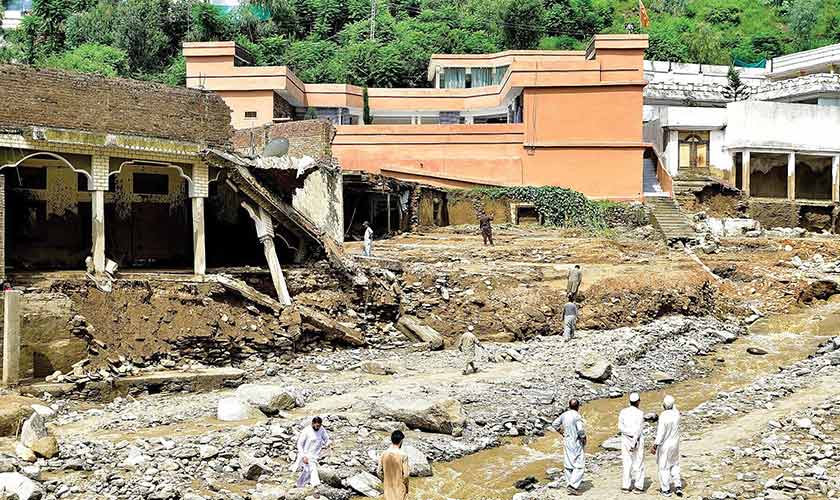
The images out of Khyber Pakhtunkhwa in August 2025 are eerily familiar: villages and roads destroyed by flash floods. In the days that followed, the word “cloudburst” found currency in media accounts and public conversation, a tidy, quasi-biblical explanation for the devastation. The real story is far more complex and sad.
“No cloudburst (defined as an event in which more than 10 cm rain falls in an hour over a small area) was observed in the worst-affected districts of Buner, Saidu Sharif, Mingora, Bajaur or Mansehra according to ground-based observation by Pakistan Meteorological Departments. Rather, the disaster was a result of an “extremely intense and long-duration monsoon system.” This is not a pedantic distinction; it is the secret to why Pakistan’s recurrent flooding.
The 2025 Khyber Pakhtunkhwa floods were an inevitable intersection of several actions, superheated by a changing climate.
The main cause was a major change in atmospheric circulation. A persistent monsoon low-pressure system over the region kept drawing in moisture-laden air from the Bay of Bengal and the Arabian Sea. It was not a burst of violence but a sustained, weekslong deluge. This wasn’t a patchwork of individual events, but rather a huge “atmospheric river” soaking northern Pakistan, and eastern Afghanistan.
Khyber Pakhtunkhwa’s steep mountains and small valleys are a natural aggravator of rainwater runoff. Rain can go on for days and weeks at a time so that the earth is saturated. When the soil can absorb no more water, the rest has nowhere to go but to run down the mountains.
No single weather event can be directly linked to climate change, but its signature is on it. Warmer air can hold more moisture as air’s capacity to hold water vapour increasing by about 7 percent for each 1°C increase in its temperature. The atmospheric warming is transforming the monsoon seasons into a period of increased peril for extreme rainfall events. A 100-year storm may today be a 50-year storm, even a 20-year storm.
While the rain was ‘natural,’ the scale of the disaster was profoundly man-made. Decades of negligence, irresponsible mismanagement and willful blindness have eroded the country’s natural defences.
A number of policy failures stand out as egregious. The most prominent seem to be uncontrolled deforestation in the mountains. Forests are not just so many trees; they are complex living infrastructure. Their roots hold the soil together so that it does not erode. They also serve as a vast sponge, soaking up rainfall and releasing it gradually in springs and rivers. Uncontrolled, often illegal, logging and forest clearance for agriculture have done away with this important buffer. Without it, “water drains swiftly and violently down stripped slopes.” This is not a new problem, either. It is a longstanding crisis that has seen poor enforcement, political corruption and few substantial replanting efforts.
Illegal encroachments on forests had been quite apparent for a long time. The governments simply looked the other way. Towns and cities have pushed right to the rivers’ brink, restricting free movement of water. When the Kabul River and its myriad tributaries are running full, they claim their natural space, with terrible consequences for the people encroaching on those. Lack of responsible urban planning and violations of building codes put millions of people in harm’s way.
Pakistan’s flood policies have always been reactive. Resources are deployed after disaster hits. The focus then is on rescue and relief. These are heroic initiatives — but they go only so far toward preventing the damage in the first place. Funds have finally been found for early warning systems but those often fail in the last mile, for instance when a satellite-based prediction of rain serves cannot reach a farmer living in a remote village, or when that farmer cannot be enabled to evacuate. The infrastructure like dams and barrages is mostly designed for irrigation and power production and not delicate flood mitigations.
We need a qualitative shift from short-term relief toward long-term, holistic resilience. We know the solutions; all we need is political will and sustained investments.
We should initiate a 10-year, rigorous national reforestation programme targeting the most severely endangered watersheds of Khyber Pakhtunkhwa and the Azad Jammu and Kashmir. This cannot be a mere photo-op; local communities must be part of planting and protecting native species.
There should be zero tolerance for illegal logging. Enhanced satellite monitoring and tough law enforcement should break sup the criminal mafias behind the trade. We should use GIS mapping to demark flood plains and enforce a strict ban on construction. This politically difficult but has to be nonnegotiable to save lives.
We should invest in multi-purpose dams and storages. As politically sensitive as the issue is, dams are needed not just for power but also for flood modulation. They can hold back excess water during peak flow and allow it to be released over time. Light-duty community check dams on hill torrents can also delay runoff.
A national programme to de-silt rivers and reservoirs is necessary to ensure that they have space for water to flow through and be stored.
We also need to invest in technology and capacity to deliver block-level or village-level forecasts.
Every policy, from agriculture to infrastructure, must be tested against a climate change proof of concept. Building a new bridge? Its pillars should be able to withstand a 2050 flood, not a 1950 one.
We need also to chase grants and soft loans from international climate funds (such as the Green Climate Fund) to pay for large-scale adaptation projects, pitching the investments as critical for promoting national stability.
The Khyber Pakhtunkhwa floods of 2025 were a tragedy, but not an anomaly. They are a symptom of a system that has valued short-term gain over long-term survival. The fable of exceptional downpour deflects culpability onto an act of nature. The more difficult to accept truth is that we have effectively co-created this disaster with our actions and inaction.
The take-home from the meteorologists is twofold: this was a widespread, long-lived monsoon event, the sort that we are also becoming more likely to see in a warming world. We can’t feign surprise every time. The only answer that will do is to stop focusing exclusively on counting the bodies and tallying the damage after the storm and to begin the hard work of building a nation that can withstand the storms that are to come. The recipe for resilience is there; what is needed is the courage to put it to work.
The writer is the central information secretary of the Awami National Party. He can be reached at anpspox@gmail.com