

Print Story
X




In her solo show, Attiya Javed incises the membrane of memory
| R |
odrigo García, in his short book A Farewell to Gabo and Mercedes: A Son’s Memoirs, recalls the last days of Gabriel García Márquez:
“My father was fully aware of his mind slipping away. He would say, ‘I work with memory. Memory is my tool and my raw material. I cannot work without it. Help me.’ And then… he regained some tranquillity and would sometimes say, ‘I am losing my memory, but fortunately I forget that I’m losing it.’”
Attiya Javed, the textile artist, is also dealing with the amnesia of her father, who migrated from undivided India and settled in Lahore. When leaving one’s ancestral home, one can only take a handful of possessions, as was the case in 1947, but one also carries the heavier baggage of intangible things: the memories that accompany a traveller.
In fact, this process continues throughout one’s life, despite changes of place or circumstance. Once memory falters, the worst displacement takes place; not a physical one, but the disorientation of reality: skipping words, names, dates, facts. This is often associated with old age.
Even relatively young individuals find it hard to recall unpleasant episodes in their lives. Advancing years, like termites, silently eat what lies in the cabinet of the mind unless it is preserved by measures such as writing down every detail.
All of us who go for weekly groceries, holding tight to our shopping lists, recognise the importance of that small piece of paper, or notes on a smart device. As Yuval Noah Harari points out in Sapiens: A Brief History of Humankind: “The first texts of history contain no philosophical insights, no poetry, legends, laws or even royal triumphs. They are humdrum economic documents” — such as: “A total of 29,086 measures of barley were received over the course of 37 months. Signed, Kushim.”
As this clay tablet reveals, every form of writing, literature, history, mathematics, commerce, astronomy was invented to fight forgetfulness. Umberto Eco, in one of his essays (The Future of Literacy), highlights another side of this relationship:
“According to Plato (in the Phaedrus), Thoth, or Hermes, the alleged inventor of writing, presents his invention to the Pharaoh Thamus, praising this new technique that will allow human beings to remember what they would otherwise forget. But the Pharaoh is not satisfied. My skilful Thoth, he says, memory is such a great gift that it ought to be kept alive by training it continuously. With your invention people will no longer be obliged to train memory. They will remember things not because of an internal effort, but by virtue merely of an external device.”
In presenting the failing mindscape of her parents, Attiya Javed also depicts herself, since all of us, neurologically, culturally and emotionally, are replicas of our parents.
Diaries, journals, notebooks, letters, whether on paper or computer, are records of our ideas, emotions, observations and relationships. Yet there is a difference between the two formats: physical and digital. The former carries more than the message, the imprint of a hand, the passage of time, the feel of the material, the sense of scale, even folds, stains, marks and cuts that change with every piece of paper. The latter, whether an intimate email, a newspaper article, a book chapter or an office order, is typed on one machine and accessed on a single system.
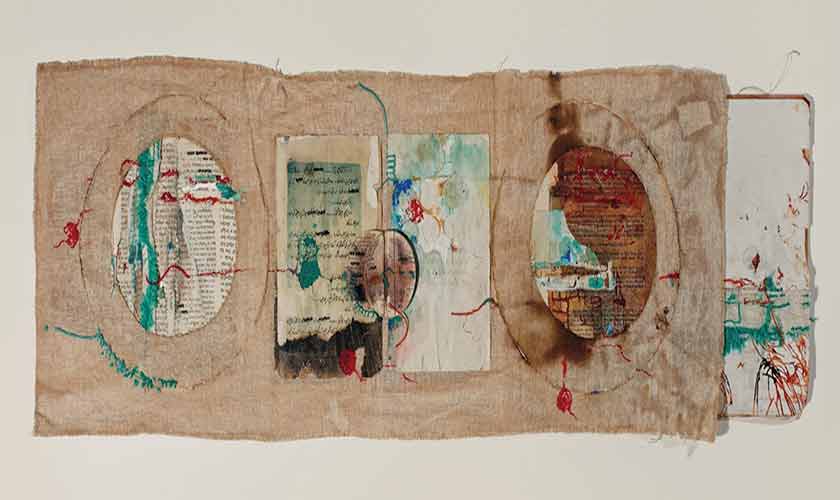
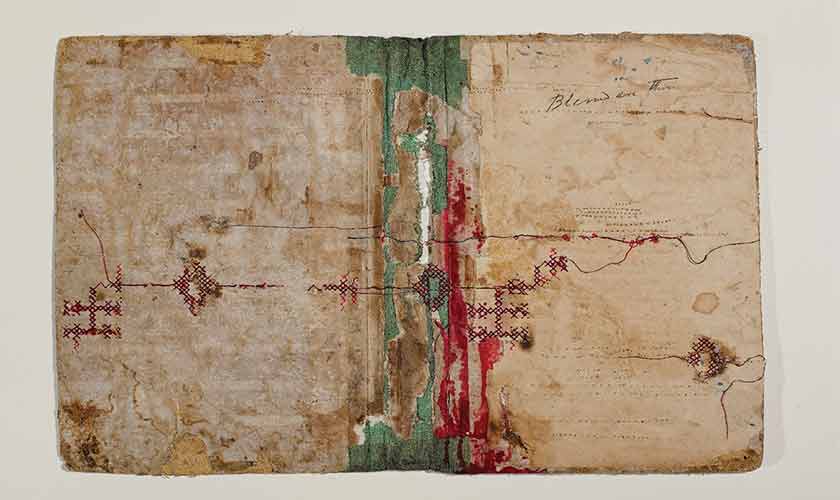
In her recent solo exhibition A Thread that Remembers (August 13 – September 4) at White Wall Gallery, Lahore, Attiya Javed resurrects the memory of her elderly parents by displaying fragments of books, torn pages, lines of thread and layers of felt. Each piece on the blank wall becomes a reservoir of singular, familial and simultaneously shared memories: incidents from the past that cannot be separated from personal trauma, political crisis and societal upheaval.
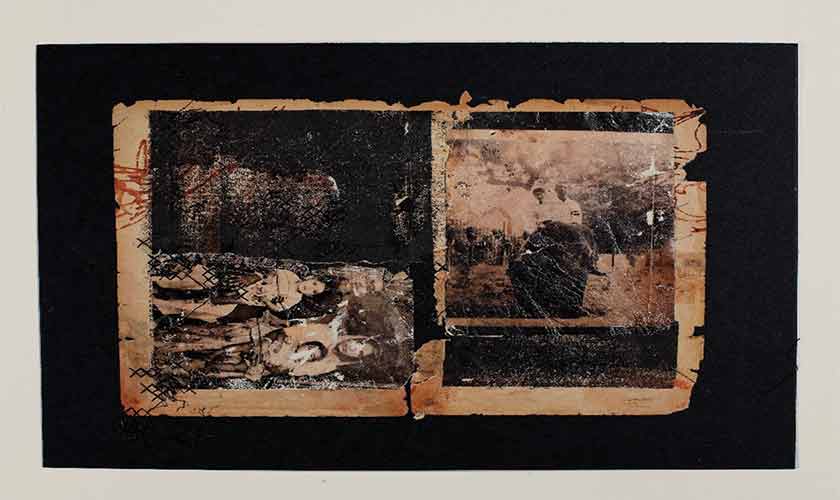
She combines multiple elements to narrate a story of suffering and loss. Photographs, which may represent another era, carry this sense not only because of their black-and-white tone, but also through the size of the prints, the style of buildings and the attire of the characters, figures who may have disappeared, if not in body then within their minds. What remains after that sudden or slow departure is a huge heap of leftovers, a sort of CV of no use. In Javed’s mixed-media work, it is the past that binds every component together more than any material substance.
There is variety in her choice of objects, many of which appear decayed and disintegrating. There are pages from vintage editions of books including The Adventures of Huckleberry Finn by Mark Twain; Quick Service by PG Wodehouse; Alcina the Enchantress; a French language primer; and a few pages of Urdu books, which, with their repetition of names, seem salvaged from a single volume. From the selection of titles and their publication dates, it appears that for the artist the content of the texts holds little significance, beyond their presence as signs of spoken and inscribed word. For the textile artist, words become lines and language a pattern, without further connotation.
This position is not dissimilar to that of a child or an elderly person, since both may fail to read the text before them and are unable to identify the figures in a photograph. For them, the contours of reality turn into webs of hazy texture.
Drawing on her experience, exposure and excellence in fabric art, Javed weaves layers over printed or handwritten components, so much so that the surfaces beneath are often concealed, inviting the viewer to look more closely and for longer. What emerges from this encounter is a blend of words and marks, of lines scrawled with a pen and the flow of thread. Entangled, intertwined, jumbled, overlapped and at places even raised from the surface, these threads, in black or red, evolve into regular patterns or dense pulps of texture. Smudges, stitches and spots further add painterly qualities, with a sensitivity in handling both imagery and material that becomes the prime subject of the artist.
Beyond her intention of portraying her father’s weakened grasp on reality, a prominent motif in some of her work is the pattern of circles. These are not merely painted shapes, but carved out of actual surfaces, suggesting a sieve through which the substantial and the valuable disappear, while also allowing the inquisitive spectator to glimpse what lies behind. This reinforces the fragile foundations of memory.
Through this and other pictorial means, Attiya Javed has created a series of sensitive images, almost like substitutes for real people.
Artists are often assumed to create self-portraits in every work they produce. This holds true in Javed’s case. In presenting the failing mindscape of her parents, she also depicts herself, since all of us, neurologically, culturally and emotionally, are replicas of our parents, glimpsed in a mirror of the future.
By blending times, marks and objects from particular periods, Attiya Javed incises the membrane of memory. The act can be as painful as it is pleasant.
The writer is a visual artist, an art critic, a curator and a professor at the School of Visual Arts and Design, Beaconhouse National University, Lahore. He may be contacted at quddusmirza@gmail.com.