

Print Story
X




Iran’s missile and drone forces accomplished what decades of Western sanctions had aimed to prevent
| D |
espite certain setbacks, Iran has largely stood its ground against the might of the Israeli war machine.
This is the consequence of Iran’s strategic vision, its spirit of self-sufficiency and the power of an alliance rooted in ideals. Iran’s Emad-3 missiles and Fattah-2 hypersonic missiles are said to have overwhelmed the state-of-art Israeli air defences, disabling airbases and immobilising its economy, prompting an appeal to the United States for intercession. The resulting Israeli willingness to reach a ceasefire, which still holds, signals the end of an era of uncontested regional hegemony. The point is, this victory is not an end. It is a beginning for strategic change. To secure its independence, Iran has to make rejuvenation of its Air Force its top priority. It should seek a strategic partnership with the Islamic Republic of Pakistan.
Iran’s missile and drone forces accomplished what decades of Western sanctions were aimed to prevent: strategic deterrence. By saturating defences, disrupting critical infrastructure and showcasing hypersonic capability, the attacks became a reminder that asymmetric warfare has teeth. Warfare today requires a more balanced, multi-domain force. Missiles are unmatched in range and firepower, but a modern air force brings key advantages to the task.
Securing and controlling the skies above Iran and its near periphery is essential for an extended defensive campaign to protect vital infrastructure and to facilitate ground and naval tactics. Missiles deliver killing blows, but fighters control the battlespace. Fighter jets have more flexible roles than a ballistic missile. They are better suited to intercept threats and for precision strikes on time-sensitive targets, particularly when it comes to providing close air support. A ballistic missile cannot do that. State-of-the-art warplanes are loaded with sensors, radars and electronic warfare suites. They give pilots vital battlefield insights and allow them to interfere set defences. They are vital in conjunction with missile operations. Visible air patrols and response speed demonstrate striking power and will power and enhance deterrence beyond missile launch threats. A reliance on a single weapons system such as Iran’s ballistic missile force can prompt counter-strategies; a rejuvenated air force makes the country’s defensive and offensive capabilities that bit more diversified, affording more options, more resilience and more unpredictability.
Pakistan can be the ideal counterpart for the renaissance of Iran’s air force. The May Indo-Pakistani war was a reminder of regional instability and ever-present danger from Indian belligerence. In this encounter, the PAF used Chinese-produced J-10C fighter aircraft to bring down a series of Indian planes, including advanced Rafales. This indicated superior operational capability. The episode provided a wealth of real, tested combat experience for which there is no real alternative.
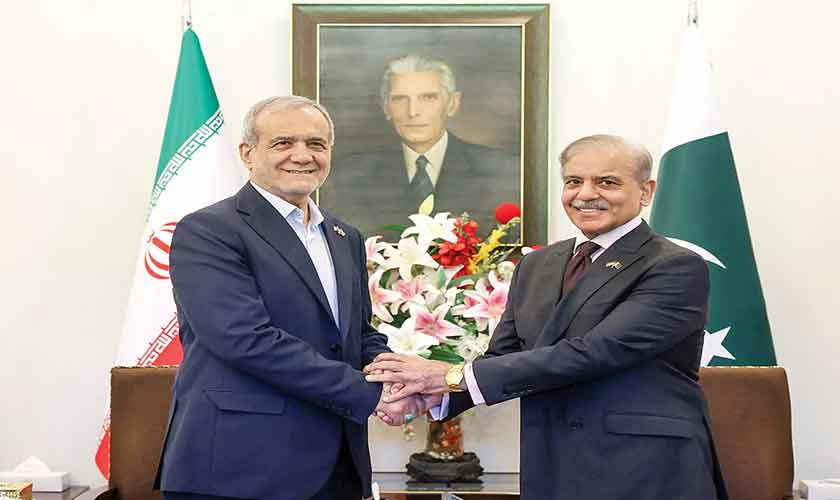
Both Iran and Pakistan face existential threats from hostile neighbours that many global powers support. Both these states advocate multipolarity, oppose Western hegemony and favour solidarity and regional stability. This overlap of strategic interests is a basis for trust that is more solid than situational alliances. Recent measures including the 2024 security cooperation agreement and coordinated military exercises, underscore both countries’ shared goal of a strong defence and regional cooperation. This alignment not only makes a case for collaboration; it also makes it a strategic imperative.
Both Iran and Pakistan face existential threats from hostile neighbours that many global powers support. Both these states advocate multipolarity, oppose Western hegemony and favour solidarity and regional stability.
There is potential for great technological synergy between the two. It is further enhanced by the emphasis on indigenous development. Available for deliveries from March 2023, the JF-17 Thunder Block 3, the PAF’s most advanced type featuring features including active-electronically scanned array (AESA) radar plus PL-15E BVRAAM compatibility, among others, has been designed for optimal performance in contemporary aerial warfare. Iran could purchase production licence or set up joint facilities for production of this (Pakistan-China) joint-developed multi-role fighter. If future blocks are co-developed, Iran could also incorporate its own avionics and weapons technologies. Another ability to partner around, is that of Pakistan’s J-10C, which proved itself effectiveness during the May 2025 conflict. It is crucial that indigenous technologies beyond airframes, such as radar systems, electronic warfare pods, air-to-air missiles and precision-guided munitions are pooled. Pakistan’s expertise in the assimilation of a variety of Chinese and local systems is a treasure trove of experience.
A strong Iran-Pakistan air force alliance can lead to a contiguous northern expanse of air power from the Persian Gulf to the Himalayas. Deterrence may be strengthened by this single air threat with a strategic depth. The fact that Pakistan was strictly neutral during the June 12 conflict was important. A formal air power partnership can makes solidarity more tangible. Joint ventures are often cost-effective; lower costs are achieved by pooling research and development expenditure as well as economies of scale. The collaboration can also help Iran’s domestic aerospace industry that might import technology from and tap into Pakistani and Chinese supply chains.
Such an alliance may be operationalised gradually. Joint exercises, air defence integration, counter-air operations, electronic warfare and so on can be added one at a time. Exchange of personnel for training and orientation flights can improve interoperability. Licensed JF-17 Block 3/4 production in Iran or joint venture can be negotiated next. The possibility of collaboration for next generation technologies and advanced materials can further reinforce the alliance. Formation of joint air combat doctrines and integrated command-and-control organisations can guarantee smooth cooperation in future possible contingencies.
Russia will remain an important partner, especially for advanced air defence systems such as the S-500, and possibly strategic bombers. However, its aerospace industry is limited by protracted conflicts and sanctions. China is a critical economic and diplomatic bulwark as well as the primary source of platforms like the J-10C. Yet Pakistan also brings something special to the table; in addition to close cultural and strategic alignment, it also provides the immediate, battle-proven operational capability.
Its June 12 triumph revealed that Iran has become a dominant force in the missile arena. The May Indo-Pakistan war similarly proved that the threat of conventional warfare persists. It also underscored the worth of a powerful air force. By focusing on air power as the avenue for military cooperation with Pakistan, Iran can achieve the final piece in its military modernisation puzzle, transitioning from the domain of asymmetric deterrence to a balanced and predominate conventional force. The Fattah-2 exploded the myths of Israel’s invincibility, the JF-17 Thunder could represent a future where the skies above West Asia are protected by legitimate power of sovereign nations, united in resistance and mutual respect. Air force renaissance is a military necessity as well as the logical next step for Iran to preserve a multipolar future.
The writer is the central information secretary of the Awami National Party. He can be reached at anpspox@gmail.com