Print Story
X




Recent rains exposed authorities’ claims regarding Karachi’s preparedness. Can one still hope for a metropolitan that can manage heavy rains?
| S |
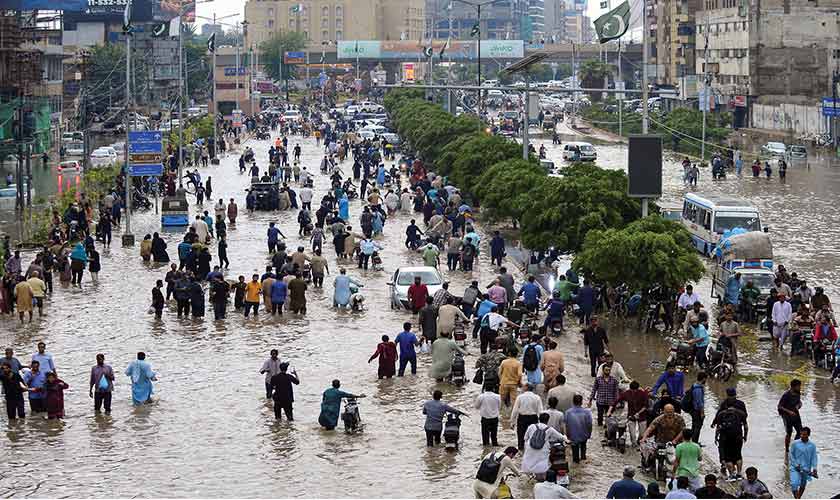
ince August 19, Karachi is slowly returning to normalcy after a severe bout of torrential rains. The Met Department, and the federal and provincial disaster management authorities had issued rain warnings some time ago. However, the rain directly affected hundreds of thousands of people. Many school vans were stuck for hours in the inundated roads. Hundreds of university students could not return home as vehicles broke down. Most of the ordinary vehicles—cars, motor bikes, rickshaws, vans and small pick-ups—taking to the streets broke down. Office and factory workers, riders and other outdoor service providers were severely impacted due to challenges in mobility. Only some SUVs were able to operate in the flooded streets.
According to weather advisories, Karachi might receive still more rain. While the city management is making tall claims about preparedness, past experiences do not make for confidence. Elected municipal councillors, chairmen of union committees and towns The News on Sundy spoke to were very concerned about the status of preparedness. Most of them complained about the debris and solid waste heaps the rain runoff had deposited in major nullahs, especially in Karachi Central, East and West. Where repairs and small-scale developments have been undertaken, the quality of work has been dubious. Nightmares from the past rain episodes continue to haunt the citizens. Spilling of drains and absence of directed flow of rain water make downtown streets, transit ways and road lanes dysfunctional. After road repairs, contractors tend to leave behind much debris. In many cases, they simply add layers of asphalt on the existing base without removing the damaged layer. This raises the road level beyond that of houses in the nearby lanes so that they get flooded even during light to medium showers.
The city and provincial leaders have been seen supervising dewatering of inundated streets. However, this is only possible several hours after the most intense rain. The affected people wonder if the inundation levels can be reduced.
There are many reasons for the sad state of affairs. Absence of a mechanism for integrated bulk drainage along the major streets is an obvious factor. It is disheartening to see the prime traffic corridors, including the II Chundrigar Road, Shara-i-Faisal, Shaheed-i-Millat Road, major arteries in Clifton and Defence Housing Authority, Maulvi Tamizuddin Khan Road and Shahrah-i-Pakistan, turn into ponds whenever it rains in Karachi. During the course of haphazard urban development in the form of spot densification, unauthorised change of land use from residential to commercial/ mixed use, encroachments on roads, uncoordinated work by infrastructure agencies managing electric power and natural gas, and a general state of disrepair of public spaces including local drains and footpaths, the situation has become absolutely dismal.
Karachi is blessed with two major rivers—Lyari and Malir. These used to get their annual share of water through monsoon rains and other showers. These rivers were connected to more than three dozen larger drains (nullahs) and indirectly linked to over five hundred smaller drains that contributed rain water. Poor land use control, inappropriate infrastructure design, obstructions to the rain water flow into larger drains and rivers and the shrinking of the right of ways of drains and rivers has played havoc with the efficacy of city’s drainage pattern. The inadequate coverage and development of sewerage system is also a continuous bane for the city. City agencies conveniently allow rain water drains to be informally converted into sewage conduits. Despite project-based interventions for decades, the distinct and efficient working of sewerage and drainage system of the city has remained a distant dream.
Among other challenges, this situation distorts the rain water drainage options for the neighbourhoods. Multiple jurisdictions also impede in facilitating rain water drainage. Corridors of movement passing through multiple jurisdictions are affected. One finds most of these corridors completely inundated during rains as access to existing drains is severely obstructed during commercial development.
A major challenge the city continues to experience in the wake of torrential rains is the ongoing development works. Bus Rapid Transit Red Line construction is taking place along the University Road and allied corridors. It is one of the major arteries of movement, where major neighbourhoods, educational institutions and healthcare facilities are located. Currently, it portrays a picture of complete chaos. The construction work aimed at securing independent right of way for the BRT buses has hampered the routine flow of other vehicles. The side drains, service lanes (where they exist), and other infrastructure are in a state of disrepair. Excavation have caused movement along this corridor to be an extremely difficult task for the ordinary. How this corridor will fare during torrential rains is anybody’s guess.
Development of storm drains and allied works is being carried out in parts of the Defence Housing Authority. Some of this work is currently in progress. Since the work is being done along ordinary corridors of movement, unprecedented hardship is already faced by residents and visitors. The authorities shall do well to announce plans for speedy drainage of rain water in such locations and facilitate pedestrian and vehicular movement during the monsoons.
The city leaders presented a sorry picture during the heavy rains. Followed by a bunch of photographers and media men of choice, they had presented a narrative of efficiency and performance that hardly holds in the wake of misery faced by the people. The city leadership has been presented with a Karachi Climate Action Plan prepared under the auspices of an international agency by assorted group of experts, allied stakeholders and civil society members for adoption and enforcement. Many of its components had a direct and indirect link with Karachi’s drainage situation. The city leadership must work to build consensus among stakeholders for the greater good of this city. One hopes that this and other similar plans will become the guiding framework of sustained action throughout the year, not the mundane high visibility visits by the city’s leadership to affected sites for photo-ops.
The writer is an academic and researcher based in Karachi.