Print Story
X




Basir Mahmood’s work turns everyday gestures and food into meditations on life
| I |
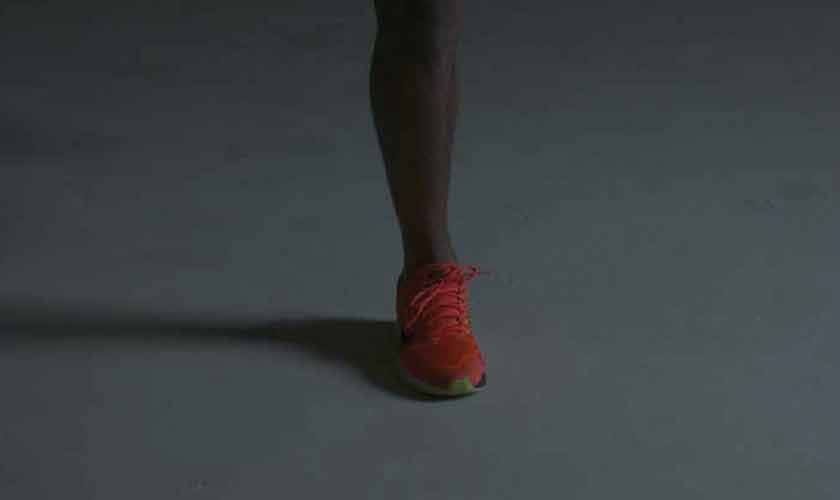
n Authors Space of No Physical Action is the title of Basir Mahmood’s 00:09:00 video, part of his recently concluded solo exhibition In-Between Spaces of Energy and Consumption. Mahmood, an alumnus of the School of Visual Art and Design, BNU, and recipient of various awards, lives in Amsterdam but continues to produce some of his work in Lahore. For this recent video piece he invited athletes to exercise in his studio. Once they were physically exhausted, he asked them to remain static for a specific length of time. In the short clip, one glimpses a single leg wearing red sneakers, balanced like a stone sculpture, like a human model posing in a drawing studio.
The work can also be read as a response to historic artworks that depict humans and animals in action, yet are rendered in stone, bronze plaster or wood. Traditional mediums such as painting, drawing and sculpture were limited to capturing a single instant from a sequence of movement. A classic example of this is the Greek sculptor Myron’s Discus Thrower (c. 450 BCE), which depicts the moment just before the athlete releases the disc.
Basir Mahmood operates the other way round. Employing video – a medium that is by nature time-based – he emphasises that movements are mere illusions. This recalls Zeno’s Arrow Paradox, quoted by Aristotle in Physics:
“If everything, when it occupies an equal space, is at rest at that instant of time, and if that which is in locomotion is always occupying such a space at any moment, the flying arrow is motionless at that instant of time and at the next instant of time.”
Mahmood’s video connects to his other work (displayed from August 19-28) at Canvas Gallery, Karachi. These actions are frozen in photographs – acts that may look impulsive or arbitrary but are, in fact, carefully orchestrated by the artist. In that sense, one can speculate that there is not much distance between an author’s craft and an artist’s practice. Both fabricate a world full of activity – wars, voyages, relationships, sports – involving a single life or generations, a limited group or an entire society. This world exists first in an imagination, later to be transferred into text, or onto paper, canvas, video or other media.
The mind of a creative person is the realm of dreams, where reality exists in a different version. It can be shifted, moulded, merged – yet it remains a parallel truth. It is fully credible, like the art of Basir Mahmood.
What links everyday existence to the sphere of sophisticated ideas is the artist’s strategy of telling his script: a story that is not purely a construction but also food for thought. Especially around food itself, for it not only contains energy but is also a symbol of fertility and of decay. It further denotes the uneven distribution of resources across classes around the globe.
The mind of a creative person is the realm of dreams, where reality exists in a different version.
The diet of a business tycoon may equal in quantity to that of his domestic staff; It can even be less. As Aravind Adiga observes in his novel The White Tiger, the rich, by choice, often adopt aspects of a poor person’s lifestyle: they walk and prefer small, light meals. Beyond biological need, however, lies the lust to acquire more than what the average person eats in a day.
Basir Mahmood’s A Complete Meal reflects that situation. A bare arm holds a single bite of boiled rice – repeated across 19 identical prints. These grains allow a human being to endure daily tasks, yet also become a point of conflict between individuals, societies and states.
On the other hand, food also plays a role in binding people together – bringing them closer at a fruit stall, around a family dinner table or during a wedding ceremony. At times it triggers happiness, at others tension; often the two interlocked.
This duality is signified in a pair of artworks, Anatomy of the Two I and Anatomy of the Two II. In these photographs, two local wrestlers grapple with one another. Their gripping, grappling and struggling anatomies, set against darkening backdrops, echo multiple images from art history, particularly European, in which outward human interaction conveys deeper, inherent meanings.
The presence of oranges placed within the folds and bulges of bodies appears quixotic – almost as if added afterwards. Yet, in a video of the photographic process (and as the artist explains), these oranges were carefully positioned between the contours to symbolise both a source of energy and a means of introducing abstraction into an otherwise coherent and classical composition.
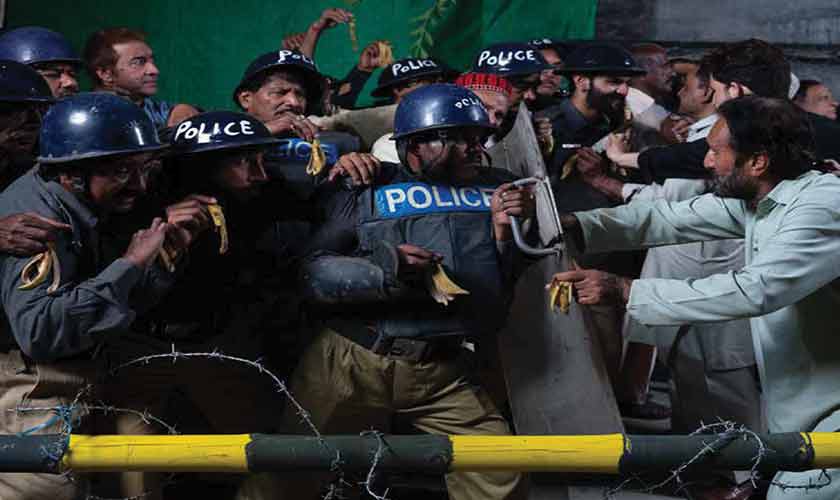
A similar subject, though with different characters and postures, appears in another work, Of the Same Taste. Inspired by footage of riots in Lahore, Basir Mahmood reconstructed the scene in minute detail: policemen in uniforms and helmets stopping protesters with metal shields, wooden poles and barbed wire, while political agitators push back.
The only odd element in this otherwise familiar scene is the banana peel – present in the hands of both citizens and constables. The banana peel may not entirely fit the story, yet Mahmood’s pictorial ingenuity made it indispensable to the picture. Through colour alone – the police uniforms, the barrier and the skin of the banana – yellow merges with blackish grey.
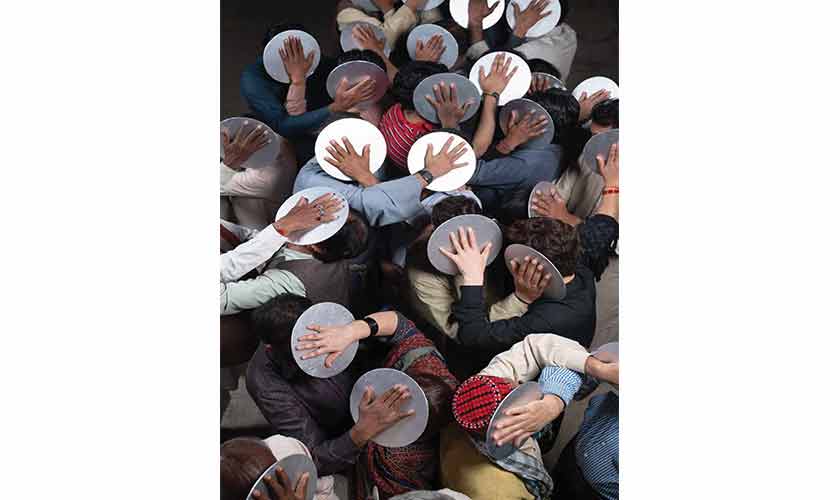
The story of food continues in another work, Total Eclipse, in which men and women conceal each other’s faces with cleaned cake bases. These bakery discs, held against the heads of individuals, seem at once joyous, celebratory and comic. At the same time, they recall the medieval painters’ convention of placing flat halos beside the heads of holy figures – a device repeatedly seen in the icons and paintings of Cimabue, Giotto and others.
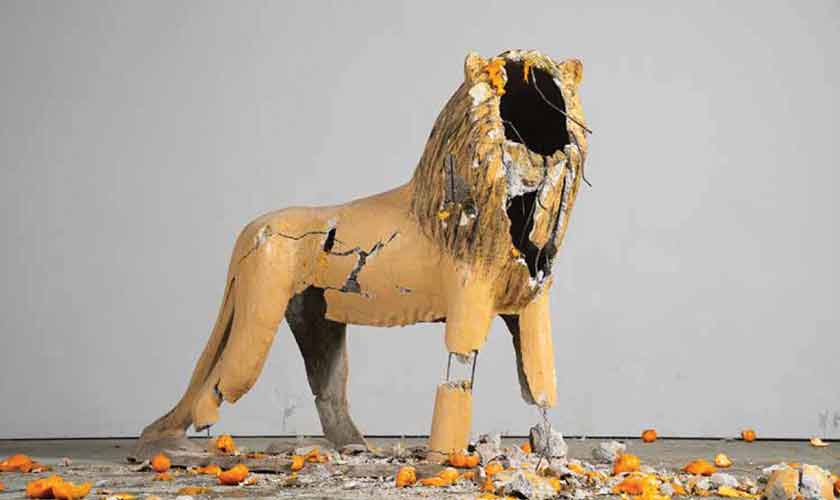
The crossing between delight and despair, physical relaxation and exertion, power and pity reappears in another image. A towering garden lion, in a dishevelled state, stands amid scattered orange peel. Both the essence, power or character of the beast, and the vitality of the fruit, have disappeared in this arrangement (Power Lion), which could easily be mistaken for a snapshot of a common park on a busy Sunday, and yet also stands as a landmark of life’s futility.
It is hard to believe that any of this work, characters or elements are simply photographed. As Ismail Kadare observes, “every story” has three phases: “the first purely imagined, the second clothed in words and the third finally told to others.” Most of these images, in their structure and detail, embody duality – of intimate touch, of human roles, of the dual manifestation of the same substance.
This is evident in A Moon and A Half (diptych), in which an old man notes down the measurements of a young boy’s dress; the roles are reversed in the second image. In his past work, Basir Mahmood has often returned to the motif of vendors selling coats on their shoulders, or a tailor stitching a dress. In this work from 2025, he revisits the same subject – but in a different frame of mind.
In conversation, Mahmood shared his observation of a tailor taking everyone’s measurements for a new garment, and wondered who, in turn, measures the tailor for his own dress. It is a saga of client and service – or of powerful and weak – that revolves on a never-ending scale.
This brings us to another of Zeno’s paradoxes: Achilles and the Tortoise. In the words of Jorge Luis Borges:
“Achilles runs ten times faster than the tortoise and gives the animal a head start of ten metres. Achilles runs those ten metres, the tortoise one; Achilles runs that metre, the tortoise runs a decimetre; Achilles runs that decimetre, the tortoise runs a centimetre; Achilles runs that centimetre, the tortoise a millimetre; fleet-footed Achilles, the millimetre, the tortoise, a tenth of a millimetre, and so on to infinity, without the tortoise ever being overtaken.”
The writer is a visual artist, an art critic, a curator and a professor at the School of Visual Arts and Design, Beaconhouse National University, Lahore. He can be contacted at quddusmirza@gmail.com