Print Story
X




Sholay at 50, is the fire that refuses to go out because of its nuance and relevance to contemporary times
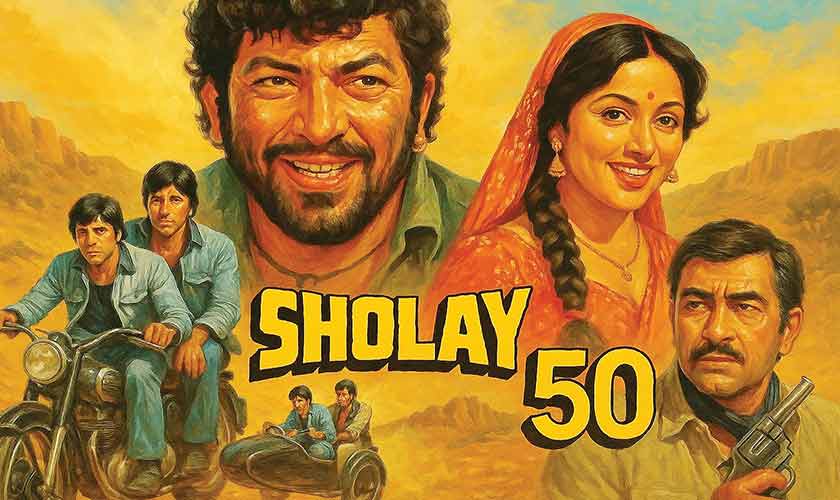
“Few films in Indian cinema have transcended generations the way Sholay has—its dialogues and characters, even silences, are etched into popular culture.”
—Subash K Jha in Economic Times,
August 14
| H |
Half a century after its 1975 release, Sholay stands not just as a blockbuster but as a cultural touchstone that has significantly shaped the grammar of Hindi cinema. It endures by transforming genre into a powerful narrative tool and, beneath that, by serving as an allegory of 1970s India’s societal upheaval.
A Western, rewired
The Western frontier, isolated, vulnerable and unruled, becomes Ramgarh, a community menaced by a bandit who answers to no one. The village is not just a backdrop, but a character in itself, representing the common people’s struggle against the forces of lawlessness.
The lone sheriff is replaced by Thakur Baldev Singh, a former policeman stripped of his arms and, symbolically, of the state’s power. He hires two petty crooks, Veeru and Jai, not because they are virtuous, but because they can do what the state cannot. That is the film’s core proposition: institutions talk; people act.
The images make the point without speeches. Cinematographer Dwarka Divecha’s wide frames carve the rocky Deccan into an arena where power has a transparent geography, where those who stand higher control the vantage point and are trapped in open ground. The 70mm release was not a gimmick; it made the landscape part of the story. RD Burman’s score and MS Shinde’s editing regulate the film’s pulse, letting scenes breathe and then snap shut. Songs carry plot and emotion; they aren’t detours but decisions set to melody.
Characters as motive, not decoration
The premise is simple: Thakur recruits Veeru and Jai to capture Gabbar Singh, but the film runs on character. Veeru (Dharmendra) is exuberant and has an appetite, convinced luck will keep paying out. Jai (Amitabh Bachchan) is quiet, tender behind a dry gaze. The famous coin, two heads, always heads, reveals his ethics: he prefers to attribute hard choices to chance so others don’t see his sacrifice. Their friendship is affectionate, physical and unperformed. It is not bromance as swagger; it is caretaking.
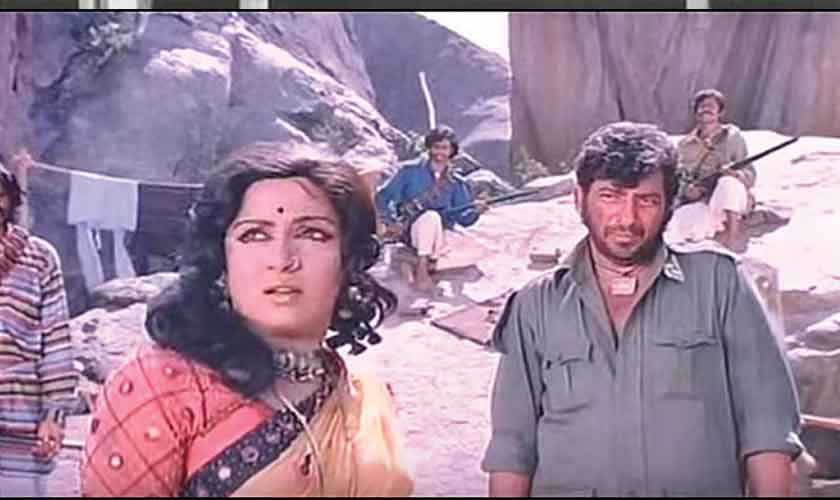
Thakur (Sanjeev Kumar) is vengeance constrained by a belief in law. His missing arms are more than trauma; they are the broken grammar of the state. He needs Gabbar alive to prove that due process still exists, even as he aches for retribution. That contradiction drives the film’s climax and gives it a stable charge: the law must be seen to prevail, the law that failed when it mattered most.
Gabbar Singh (Amjad Khan) is not an ideology; he’s the weather. He kills as a demonstration, jokes as domination and rules by unpredictability. His one-liners are ritual, not quips; they rehearse power. The performance is unforgettable because it gives chaos a voice and a rhythm. He’s not a backstory; he’s a condition.
Basanti (Hema Malini) and Radha (Jaya Bhaduri) anchor the film’s emotional register. Basanti’s motor-mouth and hustle are survival strategies; she works, negotiates and loves with cheerful nerve. Radha moves through rooms like a low flame: grief without display, longing that refuses speech. Her scenes with Jai are brave for their restraint, glances and pauses instead of declarations. The film remains a man’s negotiation of justice, but it grants its women memory and agency rather than leaving them as plot furniture.
The humour isn’t a garnish. Asrani’s preening jailer, “angrezon kay zamanay ka jailer,” skewers petty authoritarianism that has outlived the empire. Sidekicks bungle menace into farce. Veeru and Jai’s banter oxygenates a story that regularly stares down despair. Because the film laughs, its darkness hits cleaner; because it plays, its threats feel sharper. The tonal range is not chaos; it’s orchestration.
Form that serves
meaning
Sholay’s craft keeps the spectacle honest. Set pieces read clearly because the action is diagrammed for understanding, not just impact: who knows what, who sees whom, who chooses. Songs advance character: Yeh Dosti writes the film’s central covenant in melody; Mehbooba turns entertainment into menace as performance becomes coercion. Ambient sound, bangles, boots, the metallic jangle of weapons, do quiet narrative work.
Editing trusts patience. The film withholds the extent of Gabbar’s violence until the dread can carry it; it cuts away from sentiment before it curdles. The pace is confident: scenes end when meaning lands, not when a gag is exhausted.
What does one owe the law when the law cannot protect one? Sholay keeps that question alive without a sermon. Thakur’s demand that Gabbar be captured alive is both faith and theatre; it is how the state tries to stitch itself back together in public. The climactic choice—kill or restrain—becomes a performance of legality. The film refuses easy vindication of vigilantism, but it doesn’t romanticise the badge either. It understands that democracies live in ambiguity and asks the audience to hold it.
Sholay’s portrayal of male friendship is not just radical, but deeply inspiring. Jai’s acceptance of risk, symbolised by a coin toss, is a shield; Veeru’s reception of luck is akin to love. Their banter, mockery and physical affection are devoid of any societal anxiety. When Jai tragically departs, the narrative doesn’t just lose a hero; it loses its equilibrium. Veeru, without his caretaker, cannot embody the same kind of courage. Heroism here is not about dominance, but about the ability to carry someone else’s fate. This profound understanding has left an indelible mark on Indian screenwriting for decades, even when imitators replicate the quips but miss the underlying tenderness.
The village as nation
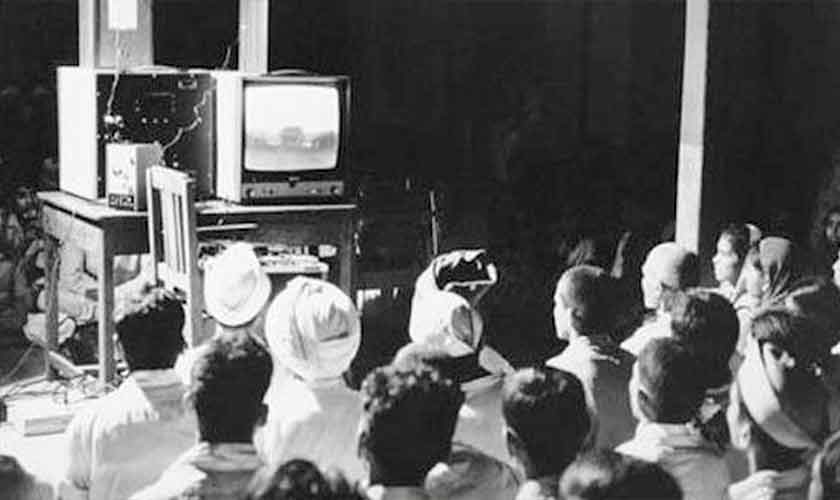
Ramgarh is a miniature polity: elders, workers, a priest, gossip and the child with questions. It is frightened yet stubborn, a community that survives through everyday courage more than institutional rescue. In the mid-1970s, as the Emergency strained faith in governance, the film offered a parable without banners. The state insists on legitimacy; the people persist through solidarity; violence thrives where authority is theatrical and protection sporadic. Sholay shows this without lecturing. The village is not a backdrop: it is the story itself.
Few films naturalise themselves in public speech as completely. Lines migrated to tea stalls and living rooms; images became shorthand for moods. That staying power isn’t simple nostalgia. The film structures itself like folklore: discrete episodes—Veeru atop the water tower, Thakur’s shawl slipping, Basanti’s forced dance—that can be retold out of order and still evoke the whole. Archetypes are thickened with quirks, making them easy to remember and hard to exhaust.
Culture mythologises what it can re-perform; Sholay built itself to be performed again and again.
Endurance comes from re-readability. Every generation finds another conversation inside Sholay: about the reach of law, the ethics of retaliation, the limits of romance in a world that barters women’s safety, the uses and abuses of performance. Filmmakers study its pacing and blocking; actors learn silence from Jai and coiled grief from Radha; writers borrow its boldness with stakes and its cool about ambiguity. Audiences return for the clean pleasure of a story that respects their intelligence, one that lets laughter and fear share a frame.
The film’s moral weather remains current. In any era anxious about institutions, the appeal of two flawed men taking on a necessary task endures. That they do it under the gaze of a broken guardian and against an absolute villain keeps the question hard: can you rehabilitate the idea of justice by enacting it, however compromised the circumstances? Sholay says we have to try and also that trying has a cost no song can fully soften.
Subtext, now
Seen today, the film’s undercurrents feel newly legible. The satire of petty tyrants hasn’t dulled. The bandit camp’s spectacle warns how charisma and cruelty court each other. The village self-organises: women keep economies moving; men negotiate safety; elders broker order that barely holds. Basanti’s dance, coerced performance turned into ransom, exposes how entertainment masks violence. Radha’s silence refuses grief as spectacle; she insists on interiority in a film famed for noise. None of this is policy talk, yet the politics are present: a society is only as safe as its most vulnerable performance.
Ask for the defining frame and answers diverge: the bridge ambush; Gabbar on a rock like an evil god; Thakur’s exposed stumps; Basanti’s dust-streaked plea; the water-tower dare. I choose something smaller: Jai at Radha’s threshold, refusing to disturb the air. In a movie crowded with roar, that look is the manifesto. Sholay knows how to ignite, but it survives because it knows how to breathe.
Fifty years on, the film carries its bureaucracy of praise: retrospectives, syllabi, memes and affectionate parody. It can bear the weight because it was built for it. What it will not do is fade into reverence. It keeps moving between laughter and dread, allegory and action, past and now, asking the only question that matters on both sides of the law: when everything is at stake, what kind of person will you be? That question is why the fire still burns.
Narendra Pachkhédé is a critic and writer who splits his time between Toronto, London and Geneva